IICRC Water Damage Restoration in Newport Beach: A Homeowner’s Guide
Most Newport Beach homeowners sign a work authorization before anyone explains what the IICRC S500 standard actually requires. That standard spells out drying targets, equipment ratios, and documentation duties that a certified firm must meet. It’s a technical document, but it’s also the only leverage you have to make sure your home gets dried correctly. If you’d rather not spend your evening reading about psychrometrics, call (855) 855-9631 and we’ll walk you through it.
What the IICRC S500 Standard Actually Mandates
The S500 is the IICRC’s codified standard for professional water damage restoration. It’s a 500-page reference document that governs how restoration should be performed, from initial inspection through final documentation. It’s not a marketing badge. It’s a technical specification.
The standard requires:
– Psychrometric monitoring at regular intervals – temperature, relative humidity, and specific humidity readings taken daily at minimum, recorded in writing.
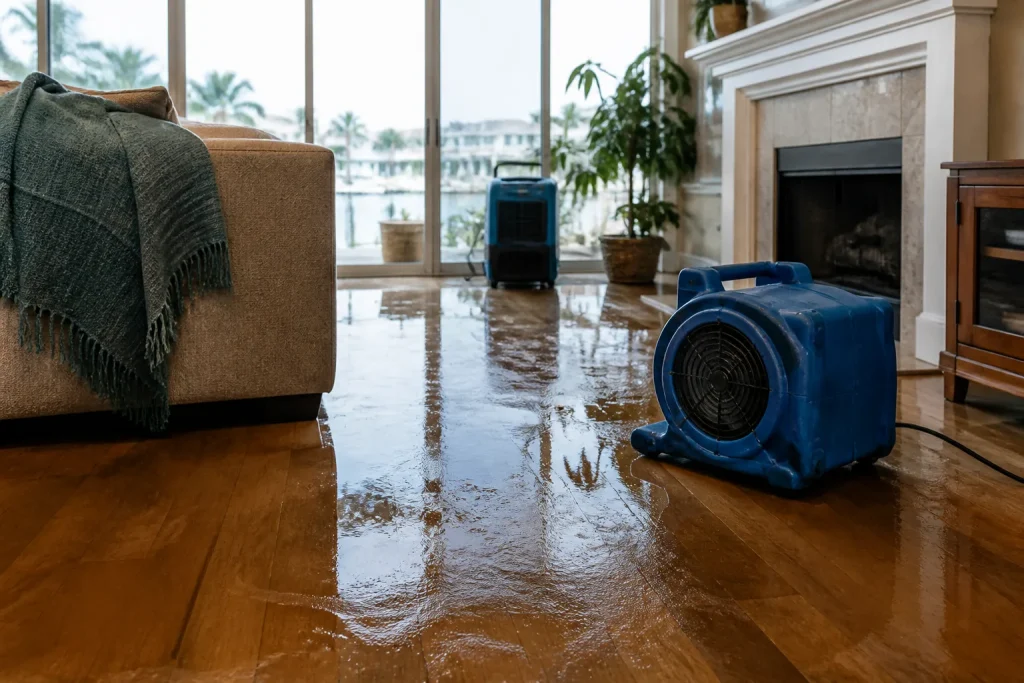
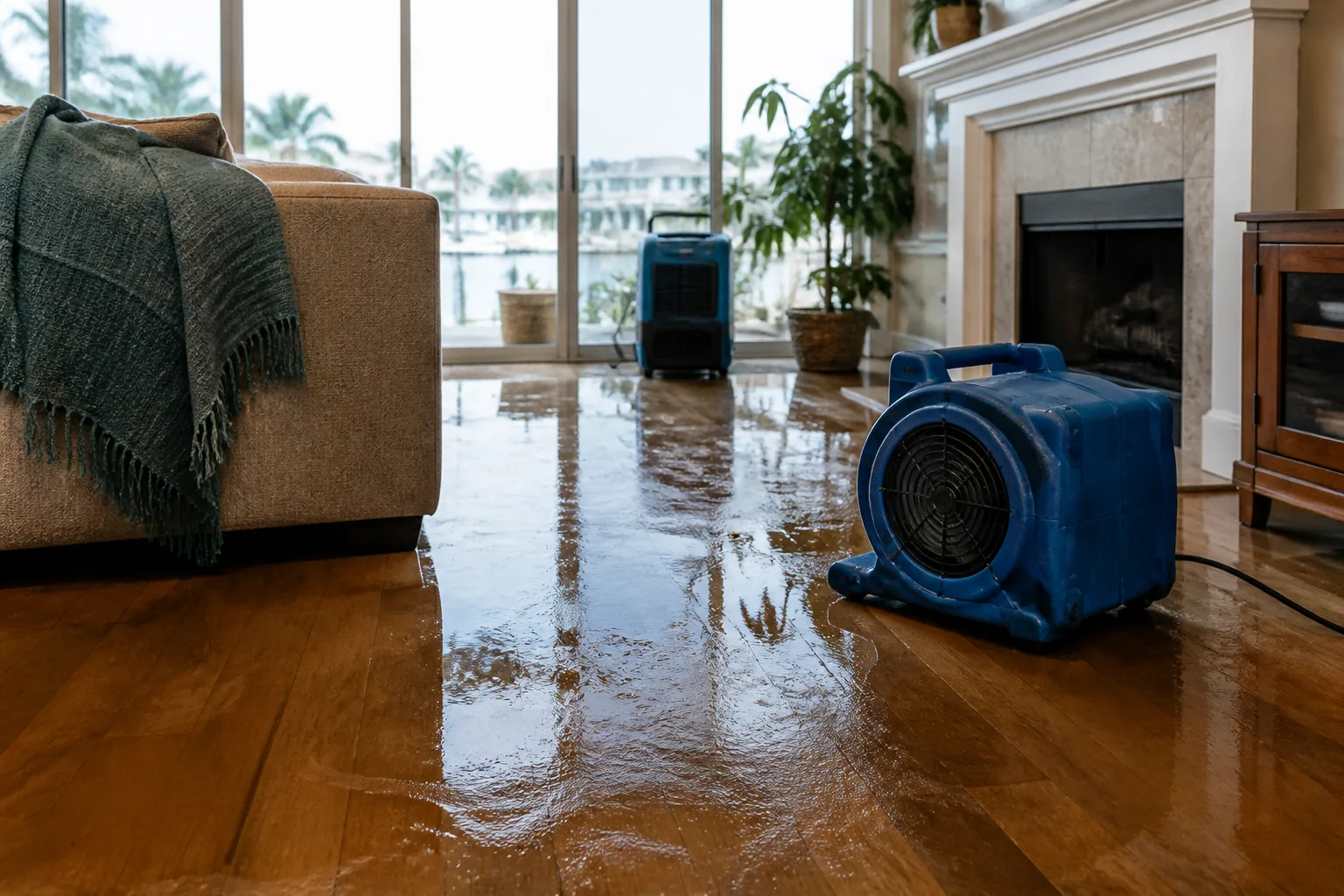
– Equipment placement ratios – as a baseline, one dehumidifier per 100 – 150 square feet of affected area, with air movers spaced every 10 – 16 linear feet along wet walls.
– Moisture content readings – taken with penetrating and non-penetrating meters, logged per material type, not just a single “it’s dry now” walkthrough.
– A written drying log – daily records that show moisture levels trending toward a specific target: the material’s pre-loss equilibrium moisture content.
That last point matters more than most homeowners realize. Every material – oak flooring, drywall, plywood subfloor – has a natural moisture level it maintains in normal conditions. The S500 says restoration is complete when affected materials return to that pre-loss number, verified by meter readings, not when the carpet “feels dry to the touch.” Drying below that number causes its own problems. Drying above it leaves hidden moisture that feeds mold.
Here in Newport Beach, our coastal humidity complicates this. A home on Balboa Peninsula may see indoor relative humidity of 55 – 65% on a normal August afternoon. That means “dry” for a Newport Beach home requires more aggressive dehumidification than it would for a house in Palm Springs. The standard doesn’t change, but the equipment needed to hit it does.
Ask any restoration company you’re considering: what’s the pre-loss equilibrium moisture content for my flooring material? If they hesitate, you have your answer.
Certified Firm vs. Certified Technician: Why the Distinction Matters
This is the question that separates the informed from the fleeced.
An IICRC-certified technician is an individual who passed training in a specific category – water damage restoration, structural drying, etc. That’s a legitimate credential, and it means that person has some working knowledge of the S500.
But a certified firm is a different thing. IICRC firm certification means the company itself has met organizational standards: it carries proper insurance, maintains a written customer complaint policy, keeps current certified technicians on staff, and submits to ongoing compliance requirements. Accountability sits at the company level, not the individual.
Why does this matter on a residential job in Newport Beach? Because if a technician makes a mistake – misclassifies a Category 2 loss as Category 1, or pulls equipment a day early to free up a machine – a certified firm has a structured process for correcting that mistake and a professional body holding it to account. A general contractor with one guy who took a weekend IICRC class? You’re on your own.
Guild Water Damage holds the firm certification, and the distinction is baked into how we run projects. A technician’s name goes on the drying log. The company’s name goes on the work authorization. That means someone who wasn’t in the room that day is still reviewing the numbers.
When you’re vetting a restoration company, ask the direct question: “Is your firm IICRC-certified, or just some of your technicians?” If the answer is only the latter, ask what happens when a drying log shows flat or rising moisture for three consecutive days and nobody makes a change. If there isn’t a documented protocol for that, they’re improvising your home’s recovery.
How S500 Classification Determines What Gets Replaced
The S500 classifies water damage in two ways, and both decisions affect how much of your home gets torn out and rebuilt.
Categories describe the water source:
– Category 1 – clean water from a supply line, tub overflow, or similar sanitary source.
– Category 2 – “gray water” containing significant contamination: washing machine discharge, sump pump failures, aquarium leaks.
– Category 3 – “black water” carrying pathogens: sewage backups, storm surge, rising seawater that enters the home.
Classes describe the extent of absorption:
– Class 1 – minimal absorption, small area, mostly impermeable materials.
– Class 2 – large area, significant absorption into carpet, cushion, and materials up to 24 inches.
– Class 3 – greatest absorption, potentially water coming from overhead, widespread saturation.
– Class 4 – deep absorption into hardwood, concrete, stone, and other low-permeability materials requiring specialized drying.
These classifications aren’t academic. A Category 1 Class 2 loss can often be dried in place with professional air movers and dehumidifiers. A Category 3 Class 3 loss requires removal of contaminated materials, antimicrobial application, and a much larger drying footprint. Misclassify either one and you get a scope of work that’s either dangerously under-managed or wastefully destructive.
We regularly see one particular misclassification pattern in Newport Beach, especially in older homes on Lido Isle and around the harbor: a slow plumbing leak behind a wall gets treated as a Class 1 event, when weeks of moisture accumulation against drywall and framing has effectively created Category 2 conditions through stagnation and microbial growth. The crew sets air movers and leaves. Six weeks later, the homeowner smells it.
The class and category decisions determine everything downstream on your insurance claim. When the adjuster reviews the file, the first thing they check is whether the classification matches the documented conditions. If it doesn’t, the supplement gets rejected and you’re paying out of pocket.
Why Newport Beach Adjusters Expect IICRC-Compliant Documentation
Here’s what we’ve watched change over the last five years.
Newport Beach insurance adjusters – and the independent adjusters insurers bring in after major loss events – are increasingly reviewing restoration files against IICRC standards before approving supplements. They want daily moisture logs. They want equipment counts that map to the S500 baseline ratios. They want before and after meter readings, in writing, tied to specific rooms and materials.
When that documentation is missing or thin, claims stall. The adjuster asks the restoration company to justify its scope, and if the restoration company can’t produce logs showing why it needed that dehumidifier for nine days instead of five, the line item gets questioned. In the worst cases, the homeowner gets stuck with the difference.
This isn’t a secret. Insurance carriers have loss consultants and auditors who know the S500 cold. They’re not grading on effort – they’re grading on documentation.
The practical takeaway: before you sign anything, confirm the restoration company produces daily drying logs and provides them on request to your adjuster. Most legitimately IICRC-certified firms do this as standard practice. If a company tells you they “don’t usually document that closely” or offers to “keep it simple for the insurance company,” you’re talking to a shop that hasn’t been through the claims process with a modern Newport Beach policy.
We work with Dri-Eaz and Phoenix dehumidifiers in part because their data logging capabilities produce the kind of record adjusters accept without argument. That matters more than most people think until the desk adjuster asks for the file.
Three Questions to Ask Before Signing Authorization
You don’t need a certification to hold a restoration company accountable. You need three questions.
1. “What’s the pre-loss equilibrium moisture content for my flooring material, and how will you verify we’ve reached it?”
This is the single most revealing question. An IICRC-certified firm will answer with a number range and a method – non-penetrating meter readings on the surface, penetrating readings for the subfloor, logged daily. A company that’s winging it will say something vague about “until it’s dry.” That’s not a standard. That’s a feeling.
2. “Can I see your equipment placement plan before work starts?”
The S500 specifies air mover and dehumidifier ratios. A legitimate restoration company will sketch where each machine goes and explain why – this wall is saturated, this area needs negative air pressure, this closet needs a focused air mover. If the answer is “we’ll just set up what’s needed,” they’re planning to under-deploy equipment and extend your drying timeline. Every extra day of moisture is more microbial growth. You’re paying for that, one way or another.
3. “Will you provide daily drying logs to my insurance adjuster without me having to ask?”
The answer should be yes, without hesitation, as a standard part of the job file. If a company hedges on this one, walk. The drying log is the only verifiable proof that the restoration met professional standards. Companies that don’t keep logs don’t keep them because they can’t defend what the logs would show. An XPOWER air mover can’t document itself. The log is the accountability.
These questions aren’t confrontational. A professional won’t blink at them. The ones who have something to hide will get defensive, and defensiveness is data.
Coastal Climate and the Drying Equation in Newport Beach
Newport Beach adds a specific variable to every drying job that inland restoration work doesn’t face: salt-laden marine air and consistent relative humidity above the comfort threshold for most of the year.
That ambient moisture means the drying equation tilts. Dehumidifiers work against the outside environment here in a way they don’t in the Inland Empire. Equipment that would dry a comparable structure in Riverside in four days may take six in Corona del Mar. That’s not a failure of the machinery. It’s physics – the water has somewhere to go when the outside air is dry, and nowhere to go when it isn’t.
The other variable is salt content in the air and in groundwater, particularly for homes near the water on the peninsula or around the Back Bay. Salt is hydroscopic – it attracts and holds moisture. Materials that have absorbed saltwater or been exposed to salt-laden humidity over time dry differently, and they require different meter calibration to read accurately. A technician who doesn’t account for this will get readings that say “dry” when the material is still several moisture points above target.
That’s a Newport Beach-specific restoration detail, and it’s exactly the kind of thing that distinguishes someone who’s been drying homes here for years from someone who applies a generic inland protocol to a coastal property.
When to call a pro: if you’re looking at water that’s been standing for more than 24 hours, water from a sewage source or a rising harbor swell, or water that’s traveled behind drywall or under flooring, don’t attempt a cleanup with a shop vac and a fan. Those are S500 Category 2 or 3 conditions, and they require extraction equipment, containment, and drying systems that aren’t available at Home Depot. The window to mitigate damage successfully is measured in hours, not days. If you’re in Newport Beach and not sure what you’re looking at, call us before you spend money on rental equipment – we’ll tell you honestly whether it’s a DIY dry-out or a professional restoration.
Related services in Newport Beach: if water intrusion has already led to microbial growth, see our guide to Mold Remediation in Newport Beach. If the water event originated from or occurred alongside a fire suppression response, see Fire Damage Restoration in Newport Beach. And for a full picture of what the drying process looks like from start to finish, start with Water Damage Restoration in Newport Beach.
The Bottom Line
IICRC certification is a technical standard, not a logo. The S500 specifies how drying must be measured, documented, and verified. A homeowner who knows a few key points from the standard – monitoring intervals, equipment ratios, moisture targets – can tell within ten minutes whether a restoration company is actually following it. Ask for the pre-loss equilibrium moisture content. Ask to see the equipment plan. Ask whether daily logs go to the adjuster. A legitimate firm welcomes all three questions, because the answers demonstrate exactly why they’re worth hiring.
If you’re in Newport Beach and need help, Guild Water Damage home offers free estimates – call (855) 855-9631.
Frequently Asked Questions
Does IICRC certification guarantee a quality restoration job?
No. It guarantees the firm has met baseline technical, insurance, and accountability standards – and that it’s subject to a professional code that protects you if things go wrong. Quality still depends on execution. What certification does is make it far harder for a company to hide sloppy work behind vague language. The S500 gives you objective benchmarks to check against.
Can my insurance company recommend an IICRC-certified restoration firm in Newport Beach?
Yes, and most will when you ask, though they’ll usually give you several options rather than one recommendation. That’s fine – the important thing is that whichever firm you choose meets IICRC firm standards and produces documentation your adjuster will accept. Ask specific questions about drying logs, and get answers in writing before signing work authorization.
How long does a typical IICRC-compliant drying job take in Newport Beach?
Most residential water losses fully dry in three to seven days with proper equipment placement. Coastal humidity can extend that timeline by a day or two compared to inland properties. Your daily drying logs will show the trend. If moisture readings plateau or rise for multiple consecutive days, that’s a sign the drying plan is failing and equipment or placement needs to change.
What happens if I choose a cheaper, non-certified restoration company?
You may get lucky, or you may get a partial dry-out that leaves hidden moisture in your walls or subfloor. That moisture feeds mold growth you won’t see for weeks, and by the time you smell it, the scope of remediation has grown. Your insurance claim may also suffer – adjusters increasingly expect IICRC-compliant documentation, and when they don’t get it, supplement requests die on the desk. The cost difference shrinks quickly when the remediation has to be redone.
Written by the team at Guild Water Damage, serving Newport Beach since 2017.
Need Damage Restoration Help?
Call Guild Water Damage — licensed & insured, here with fast after-hours help in Newport Beach.
(855) 855-9631