Last updated October 30, 2026
 Water damage drying
 Fire & smoke cleanup
 Mold remediation
 Storm response
 Sewage cleanup
 Reconstruction
Free visual inspection and a written scope of work before any mitigation begins - photos, moisture readings, and drying logs go in your claim file
The scope we write is the scope we bill. Anything new gets shown to you, in writing, before we touch it.
Get your free estimateDamage Restoration Emergency Preparedness Guide for Newport Beach Homes
In a pipe-burst event, water migrates to a second room in an average of 8 minutes. The median time from damage discovery to contractor call in Newport Beach runs over 40 minutes, and most of that delay isn’t hesitation. It’s homeowners standing in a spreading puddle, trying to figure out who to call and whether to touch anything first. This guide compresses those first 30 minutes into a decision sequence, and you can find more guides & resources on our blog. You’ll learn which three shutoffs matter most, which rooms to protect in what order, what to photograph before cleanup starts, and how to tell a credentialed restoration technician from a salesperson who got dispatched first. Newport Beach homes have specific vulnerabilities, from open-plan layouts on the peninsula to slab foundations in older tracts, and this guide addresses them directly.
Quick Answer
Emergency preparedness for a Newport Beach home means knowing your water, zone, and HVAC shutoffs cold, documenting the damage before moving anything, and having a credentialed restoration contact on file before water ever appears. The goal is not to prevent every possible loss. The goal is to compress response time so a $15,000 claim doesn’t become a $60,000 one. Preparation is a decision process, not a shopping list.
Restoration work we handle
Table of Contents
- The Three Shutoffs Every Newport Beach Homeowner Must Execute in Under 60 Seconds
- Room-by-Room Damage Priority Matrix for Newport Beach Layouts
- The 10-Minute Documentation Protocol Before You Touch Anything
- How to Evaluate a 24-Hour Emergency Response Claim
- Pre-Event Preparation: What to Keep Ready and Why Digital Copies Fail
- Newport Beach Specific Risks: Climate, Construction, and Geography
- Why Equipment and Credentials Change the Outcome
- Common Mistakes to Avoid
The Three Shutoffs Every Newport Beach Homeowner Must Execute in Under 60 Seconds
Most water damage in Newport Beach homes is not from storms or flooding. It’s from supply line failures, water heater ruptures, and fixture overflows. A supply line under pressure will keep feeding water until someone stops it. The difference between a contained spill and a cross-floor saturation is often the time it takes to find the shutoff valve.
There are three shutoffs that matter, and each serves a different role in the first minutes of an emergency.
1. The main water shutoff
This is the master valve that stops all water entering the house. In post-2000 Newport Beach construction, the main shutoff is typically located at the street-side meter box or on an exterior wall near the front hose bib. In pre-1990 homes, particularly in neighborhoods like Corona del Mar and Newport Heights, the main valve is often inside the garage, behind a panel, or in a crawlspace access point. Sellers rarely point it out during a walkthrough, and most homeowners discover its location for the first time during an emergency.
Find it now. Stand by it once. Then physically turn it. Valves that haven’t moved in five years seize, and the moment of a pipe burst is the wrong time to discover yours needs a wrench and penetrating oil. A quarter-turn ball valve is the standard in newer homes and closes in under two seconds. An older gate valve needs multiple full rotations and can snap at the stem if forced. If yours is a gate valve, have a plumber swap it for a ball valve before the next emergency.
2. Secondary zone valves
Most Newport Beach homes have at least one zone valve controlling a branch line: exterior irrigation, a water feature, a pool autofill, or a guest bathroom on a separate run. If the main shutoff is inaccessible or you need to preserve water service to another part of the house while isolating a leak, zone valves are the answer. They are typically located near the main shutoff in newer construction, or at the point where a branch line splits from the trunk line in older homes.
Map every zone valve in your house this week. Label them with a marker or a tag. A piece of masking tape with “GUEST BATH” written in sharpie is the difference between a ten-second isolation and a twenty-minute search.
3. HVAC shutoff
This one gets missed in nearly every generic preparedness guide, and it matters specifically for water damage. A leaking ceiling register or a condensate overflow means the HVAC system is either causing the water or distributing it. More importantly, in any flood or overflow event, the blower motor will pull humid air through ductwork and push it into every room the system serves. Turning off the HVAC at the thermostat is not enough. The air handler needs to be shut down at the disconnect switch, usually located on the unit itself or on a nearby wall.
If water has reached any return air duct, the system should remain off until a professional can inspect it. Running a system with saturated ductwork spreads moisture into wall cavities and subfloors, expanding the scope of damage dramatically.
Practice all three shutoffs once per year. Time yourself. The target is under 60 seconds total from the moment you decide to shut things down to the moment all three are off. Most Newport Beach homeowners we’ve worked with fail this test the first time, and nearly every one of them says the same thing afterward: “I had no idea it would take that long.”
Room-by-Room Damage Priority Matrix for Newport Beach Layouts
Not all water damage is equal. The same volume of water in a hallway is a nuisance. In a kitchen above a crawlspace, it’s a structural event. When water is actively spreading or has just stopped, the order in which you protect rooms determines the final repair scope and cost.
Here’s the priority matrix we use when assessing a Newport Beach home, ranked by consequence.
Priority 1: Rooms above or adjacent to structural elements
The highest priority is any space where water can reach subflooring, load-bearing framing, or foundation components. In Newport Beach’s older neighborhoods, many homes are built on raised foundations with a crawlspace below. Water in a hallway or bathroom on the ground floor of these homes drops directly into the crawlspace, where it sits against joists and sill plates. Saturated framing wicks moisture upward into wall cavities, and within 48 hours you have a mold condition feeding on the paper face of drywall and the wood framing itself. For a deeper look at local requirements, see our guide on Damage Restoration Permits, Codes & Inspections in CA: What You Need to Know.
In open-plan layouts common in Newport Beach’s 1970s to 1990s tracts, a kitchen overflow doesn’t stop at the kitchen. The continuous floor plane means water runs under base cabinets, across the living room, and into adjacent hallways. Treat the entire open-plan zone as Priority 1 when water appears in any part of it.
Priority 2: Rooms with high content value
After structural areas are stopped or isolated, move to spaces where contents carry real financial or sentimental value. Home offices with electronics, closets with stored clothing, and any room with rugs or furniture that can be saved if moved quickly. In coastal Newport Beach homes, this often includes garages converted to storage, where cardboard boxes on concrete floors wick water upward through capillary action and destroy contents from the bottom up.
Priority 3: Rooms with water-resistant finishes
Bathrooms with tile floors, laundry rooms with vinyl, and garages with epoxy coatings have the most time before permanent damage sets in. Standing water on these surfaces still needs extraction, but the finish layer buys you hours, not minutes. Address these spaces after structural and high-content areas are protected.
Newport Beach open-plan note: If your home has a continuous floor surface across multiple rooms, treat the entire contiguous area as one priority zone. You cannot effectively isolate one room in an open plan without physical barriers, and by the time water reaches the threshold of the next room, it has already traveled underneath the flooring material at the seams. Pull-back or extraction decisions should consider the whole zone, not the visible puddle.
The 10-Minute Documentation Protocol Before You Touch Anything
Insurance adjusters evaluate claims based on evidence. The quality of your documentation in the first ten minutes after discovering damage has a direct impact on the settlement amount, and most homeowners document wrong. They photograph the visible puddle and move on. Here’s what actually matters.
Complete this protocol before moving any furniture, before mopping, before pulling up a rug, and before a restoration contractor begins any work. The goal is to establish pre-mitigation conditions that prove the full scope of the loss.
- Establish the room with wide shots first. Stand in each doorway and photograph the entire room before any close-ups. This proves where water traveled, not just where it pooled.
- Photograph every affected surface at floor level. Get down low. Baseboards, door casings, and the bottom 12 inches of walls are where water wicks upward, and adjusters look specifically for visible moisture lines in these areas.
- Document contents before moving them. Photograph furniture, rugs, electronics, and stored items exactly where they sit. If you move something, photograph the floor underneath immediately. The water line on a rug or the staining under a piece of furniture is claim evidence.
- Record a continuous video walkthrough. Start at the front door and walk slowly through the entire affected area, narrating what you see and the time you discovered it. A continuous video cannot be accused of selective documentation.
- Photograph the source. If a supply line ruptured, photograph the failed fitting. If a water heater leaked, photograph the unit and the area around the base. If an appliance overflowed, photograph the appliance and its connection points.
- Photograph the shutoffs. Document that you turned off the water, zone, and HVAC shutoffs. This is evidence of mitigation, and insurance policies typically require the homeowner to take reasonable steps to prevent further damage.
The entire protocol takes under ten minutes on a phone. The value is measured in the difference between a settled claim and a disputed one. If a restoration contractor arrives and wants to start extraction immediately, insist on completing this documentation first. A credentialed technician will not object to a ten-minute delay that protects both parties.
How to Evaluate a 24-Hour Emergency Response Claim
Nearly every restoration company in Orange County advertises 24-hour emergency response. The claim is meaningless without specificity. What matters is not that someone answers the phone. What matters is who gets dispatched and what equipment arrives with them.
When you call an emergency restoration line, ask these four questions before ending the call:
- “Will the person arriving be a certified technician or a salesperson?” Many companies dispatch a salesperson or estimator first, who evaluates the scene and then schedules a crew for later. The first-responder’s job title changes the timeline.
- “Are you IICRC-certified, and is the technician who will arrive certified?” The Institute of Inspection, Cleaning and Restoration Certification is the restoration industry’s primary technical credential. A company can hold a certification while dispatching uncertified field staff. Ask specifically about the person coming to your door.
- “What equipment will the first truck carry?” A real emergency response truck carries extraction pumps, air movers, dehumidifiers, and moisture meters. A truck carrying only a clipboard and a camera is an evaluation visit, not a response.
- “Will you provide a written scope before any work begins?” The answer should be an immediate yes. A written scope, agreed before extraction starts, is the single most effective protection against scope creep and surprise billing. Companies that can’t produce one on site are a liability risk.
Guild Water Damage runs an IICRC-certified process on every job, and our field teams arrive with professional-grade Dri-Eaz and Phoenix equipment in the first truck. When you call for an emergency in Newport Beach, the dispatcher can tell you the technician’s certification status and what equipment is on the way before the call ends. If the dispatcher at any company can’t answer those questions, call someone else.
Pre-Event Preparation: What to Keep Ready and Why Digital Copies Fail
Preparation before a loss event takes one afternoon and pays compounding returns. The core principle is that emergency information must survive in the moment when you need it, and the moment you need it is chaotic.
Digital copies fail for predictable reasons. A phone dies. A cloud drive requires a password you can’t remember under stress. A home computer is in a different room, or the modem is underwater. The insurance declarations page saved only as a PDF in your email is exactly as useful as a paper document in a safe deposit box: accessible in theory, inaccessible in the emergency.
Here’s what to assemble in a single physical location, ideally a waterproof sleeve in the garage or a kitchen drawer:
- Insurance declarations page, printed. Not the full policy. The declarations page has your policy number, coverage limits, deductible, and claim contact number. That’s what you need in the first hour.
- Plumbing shutoff map. A hand-drawn diagram showing the main valve, each zone valve, the HVAC disconnect, and the location of the water heater. If you’re not home when the emergency happens, this map lets a neighbor or family member execute the shutoffs for you.
- Restoration contractor contact, written down. Not just saved in a phone. A card or a piece of paper with the Guild Water Damage number, (855) 855-9631, and the Guild Water Damage home address. If the person on the phone has to search for a number while water spreads, the whole protocol slows down.
- Plumber and electrician contacts. A restoration company can extract water and dry the structure. A licensed plumber stops the source if a shutoff fails. An electrician handles power disconnects if water reaches outlets or the panel.
- Photos of your home’s water shutoffs, printed. A picture eliminates ambiguity. “It’s the red valve behind the water heater” fails when the person standing there is your 19-year-old neighbor who has never been in your garage.
Assemble this packet once. Update it when you change insurance carriers, replace a water heater, or rework plumbing. The packet should take under five minutes to read in full, because in the moment, you have under five minutes to act.
Newport Beach Specific Risks: Climate, Construction, and Geography
Newport Beach homes face a combination of risks that generic preparedness guides miss. The coastal marine layer means morning humidity levels stay elevated through much of the year, which accelerates mold growth after any water event. The same moisture that keeps marine layer fog hanging over the peninsula every June morning is the moisture that feeds mold inside a wall cavity after a slow leak. If you’re unsure what to watch for, our Damage Restoration Warning Signs: A Newport Beach Homeowner’s Reference Guide covers the key indicators. If a supply line drips behind a vanity in Newport Heights for two weeks, the resulting mold condition is typically farther along than an identical leak would be in Riverside or Temecula simply because the ambient humidity kept the wood and drywall from ever fully drying on their own.
Construction style multiplies these risks. Older neighborhoods like Balboa Island and parts of Corona del Mar feature raised foundations with wood substructures. Water in a crawlspace sits against wood framing in coastal air and begins supporting fungal growth within 48 hours consistently. Newer construction in Newport Coast tends to be slab-on-grade with more robust waterproofing at the foundation level, but slab leaks are a chronic issue in these homes, and a slab leak runs unnoticed longer than a visible rupture because the water has nowhere to pool visibly. By the time a homeowner notices warm spots on the floor, a musty smell, or spiking water bills, the leak has often been active for weeks.
The geography matters too. Homes in the lower elevations near the Back Bay sit closer to the water table. Crawlspaces in these areas can have standing groundwater even without a plumbing failure, which means the margin between normal crawlspace humidity and a moisture problem is already thin. Add a supply line leak to that environment and structural drying becomes a longer, more technical process than it would be at higher elevation.
These are the conditions that make a credentialed, properly equipped restoration contractor worth finding before the emergency. A generalist with a wet-dry vac and a fan cannot dry a coastal crawlspace. A professional with the right equipment and a documented protocol can, and the difference shows up in the final repair scope.
Why Equipment and Credentials Change the Outcome
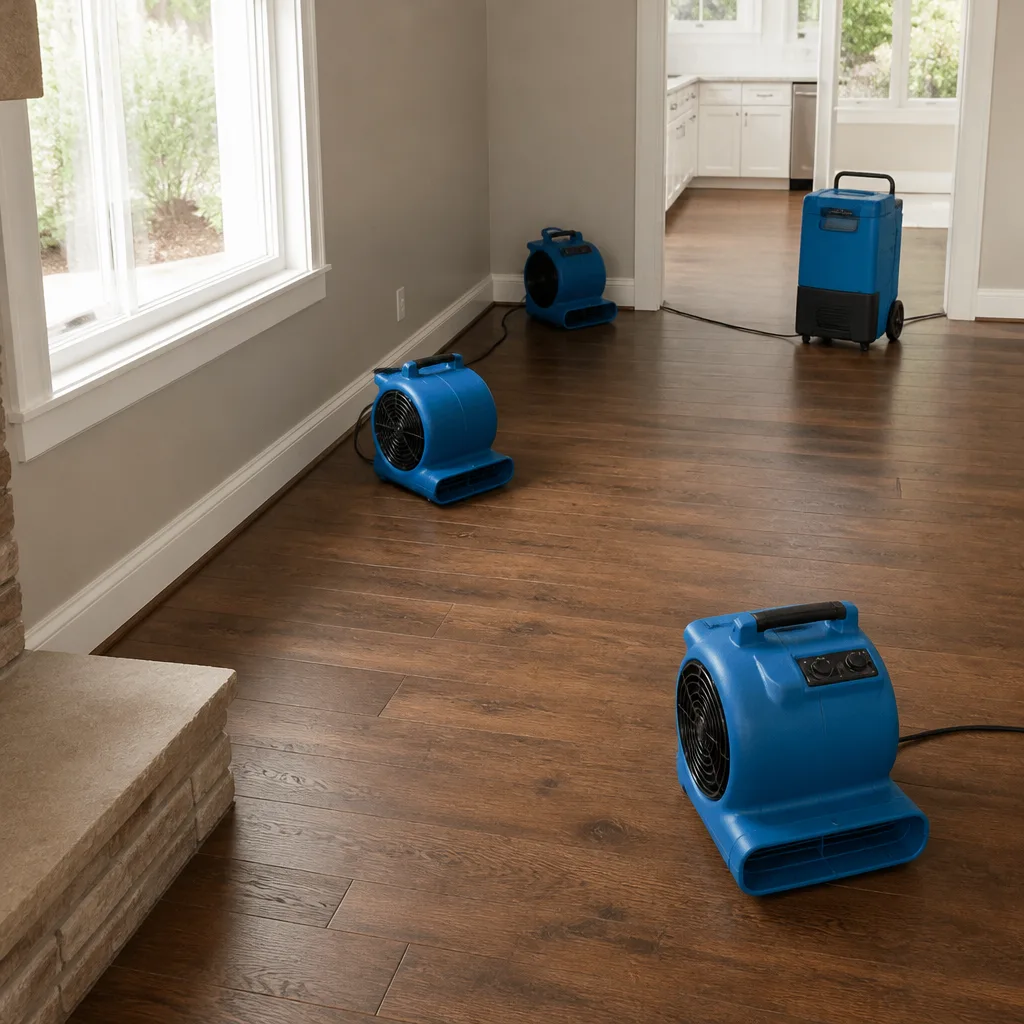
Restoration equipment is not interchangeable, and anyone who says otherwise is selling something other than expertise. The difference between a big-box rental dehumidifier and a professional-grade Dri-Eaz unit is the difference between drying a wall cavity in three days and drying it in seven. Those four days are exactly when mold decides whether to establish itself.
Guild Water Damage runs professional-grade equipment from brands specified by commercial restoration engineers: Dri-Eaz and Phoenix dehumidifiers and air movers, XPOWER fans for targeted airflow, and Injectidry systems for cavity drying. The Injectidry capability matters specifically for Newport Beach homes because it enables drying inside wall cavities and subfloors without tearing out drywall or flooring first. A conventional approach involves cutting holes in walls to access the wet cavity, which expands the repair scope. Injectidry pushes controlled airflow through the cavity itself, which means the structure dries while the wall stays intact. Fewer holes, less demolition, lower final cost.
The credential stack matters equally. Our process is IICRC-certified and we hold membership in the Restoration Industry Association and the IFA. The combination matters because it means the field work follows documented, auditable protocols rather than individual technician judgment. The Guild standard means every water loss, mold remediation, and fire restoration project runs the same certified process, regardless of which technician arrives. That repeatability is the point of certification, and it’s what protects the homeowner when the adjuster asks why a particular step was taken.
For water damage specifically, our Water Damage Restoration in Newport Beach service covers the full scope from emergency extraction through structural drying and reconstruction coordination. For mold conditions that develop after a water event or from chronic humidity, our Mold Remediation in Newport Beach process addresses the source, not just the visible growth. And for fire losses, our Fire Damage Restoration in Newport Beach service manages the smoke, soot, and structural damage under one credentialed contractor from start to finish.
Common Mistakes to Avoid
- Calling the insurance company before stopping the water. Yes, you need to report the claim. No, the adjuster on the phone cannot turn off your main valve. Shut off the water first, document the scene second, call the insurance company third. The order matters because every minute the water runs expands the claim, and some policies reduce payouts for damages that occurred after the homeowner failed to mitigate.
- Using a household fan to dry a saturated wall cavity. A box fan moves air across surfaces. It does not extract moisture from inside wall cavities, subfloors, or ceiling plenums. The visible surface dries while the hidden cavity stays wet, and the homeowner believes the problem is solved right up until the mold appears.
- Hiring a generalist contractor for the emergency response. A general contractor is the right call for reconstruction after drying completes. The emergency response needs a restoration company with certified technicians and professional extraction equipment. Using the generalist as the first responder puts the drying process in the hands of someone who doesn’t run it as a daily practice.
- Not documenting the pre-existing condition of the home. If the adjuster can’t tell what existed before the loss and what was caused by the loss, the claim gets negotiated down. The documentation protocol above exists to prevent exactly this scenario.
- Waiting to call because it’s late or the damage “doesn’t look that bad.” Water damage is a compounding problem. Wet drywall at hour eight looks dramatically different from the same drywall at hour forty-eight. The same applies to mold. A small visible patch is often the tip of a larger hidden condition. Call at the first sign, regardless of the hour. The emergency line exists for exactly this reason.
- Trusting a digital-only copy of your insurance information. As covered above, digital copies fail in predictable ways during emergencies. Print the declarations page and keep it in the preparedness packet. The one time you need it is the one time your phone will be dead, wet, or in the other room.
See the difference
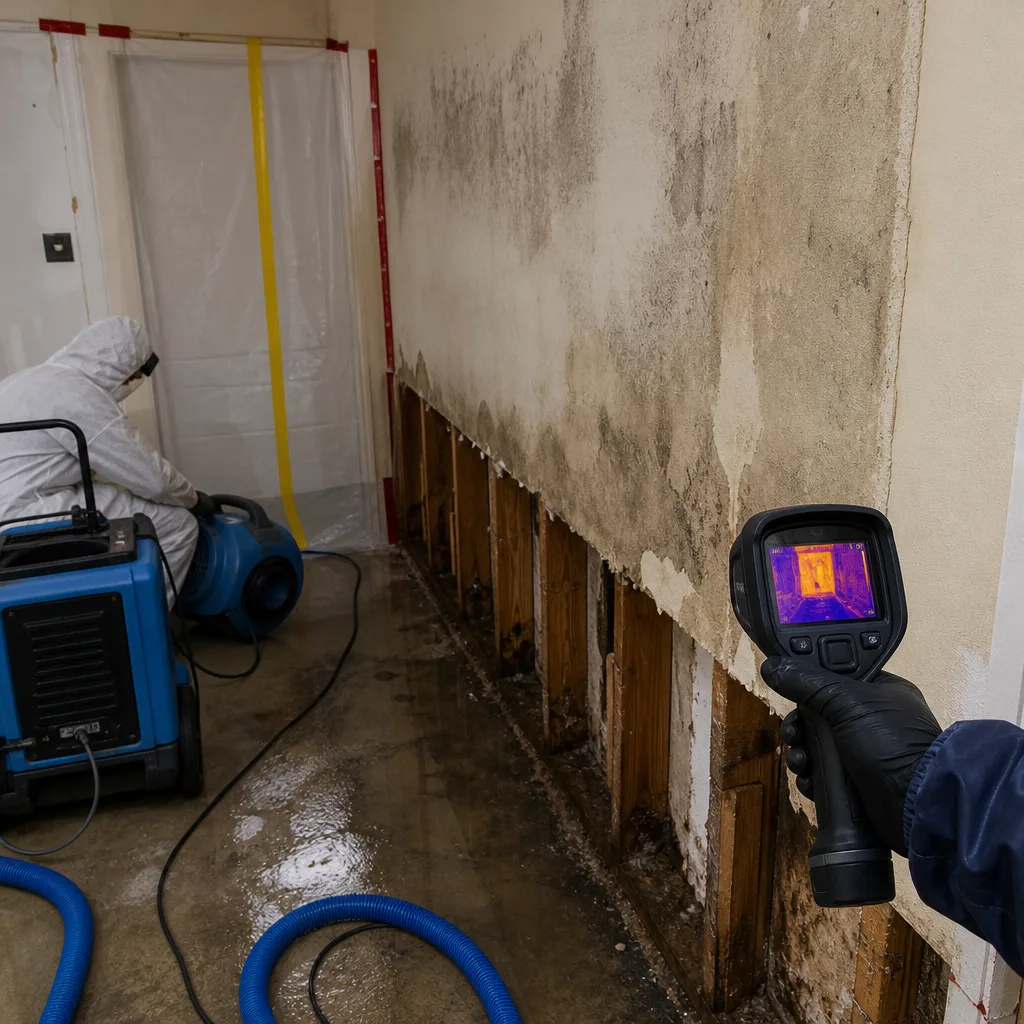 Before
 After
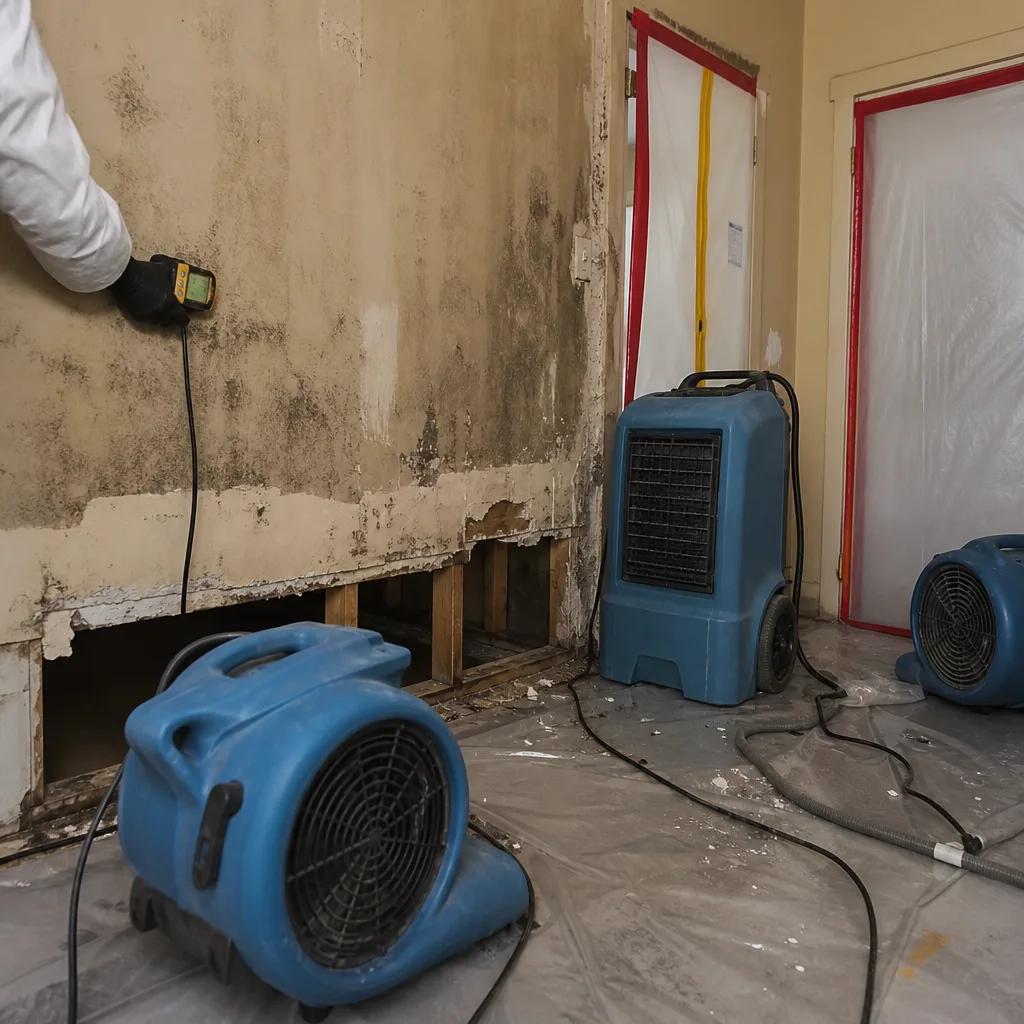 Before
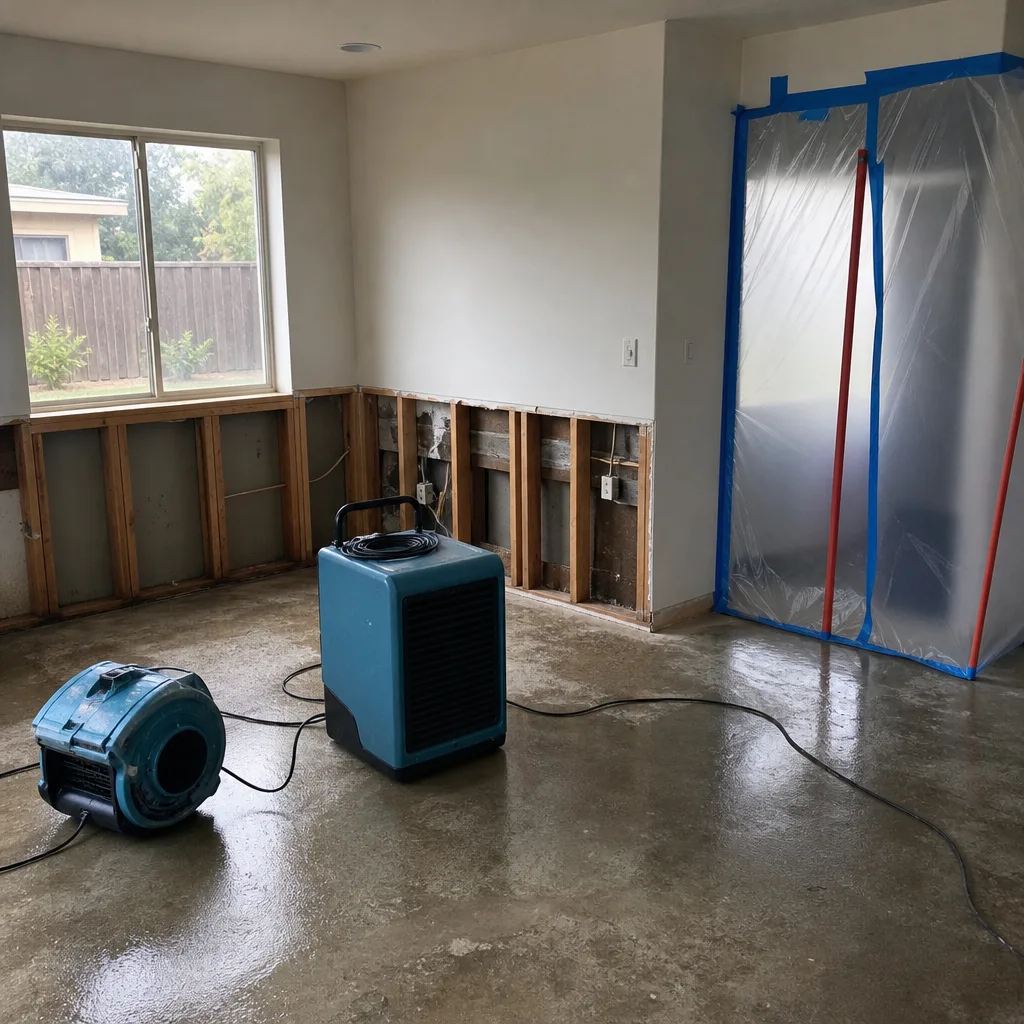 After
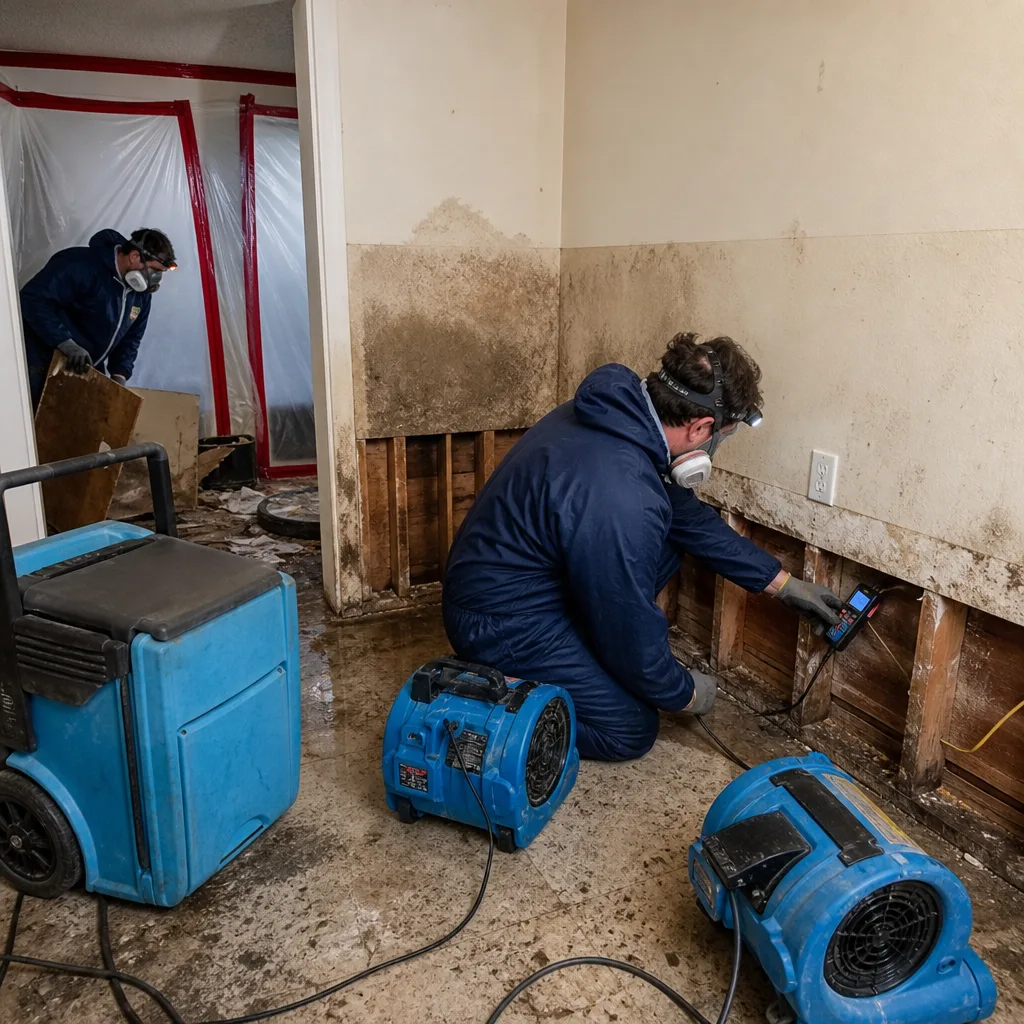 Before
 After
When to Call a Professional
Any water event that reaches flooring, walls, or structural cavities warrants a professional assessment. The visible puddle is never the full picture. Water travels along floor joists, wicks up drywall, and settles into subfloors where it cannot be seen. The same applies to any visible mold growth, regardless of size, and any fire event that leaves smoke residue on surfaces or odor in the air. A professional assessment provides moisture readings, a written scope, and a documented baseline for your insurance claim. If you’re uncertain whether the situation warrants a call, it warrants a call. Guild Water Damage offers free estimates in Newport Beach. Call (855) 855-9631 and a credentialed technician will evaluate the condition, document the findings, and provide a written scope before any work begins.
Frequently Asked Questions
Water damage restoration in Newport Beach typically ranges from $3,500 to $25,000 depending on the scope, with the final number driven by the square footage affected, the water category, and how quickly mitigation began. The single biggest cost variable is response time: a same-day extraction with professional drying equipment often saves thousands in the repairs that follow. Call (855) 855-9631 for an exact quote on your specific loss. Estimates are free.
Most standard homeowners policies in California cover sudden and accidental water damage from burst pipes, appliance failures, and water heater ruptures, but typically exclude damage from gradual leaks, lack of maintenance, and flood events. Your declarations page is the definitive answer, and your restoration contractor should provide photo documentation that directly supports your claim. For specific coverage questions, call your adjuster, then call (855) 855-9631 to move the mitigation forward.
Call within the first hour when possible. Water migration to secondary rooms begins within minutes, and the difference between a contained loss and a multi-room loss is often determined by when professional extraction started. Most restoration companies in Orange County advertise 24-hour response, but as outlined above, the quality of the response matters more than the hour of the call. Ask the dispatcher whether a certified technician will arrive, and what equipment the first truck carries.
No. A wall cavity holds moisture in the insulation, the backside of the drywall, and the framing itself. Household fans and rental dehumidifiers dry the visible surface and leave the hidden cavity wet, which creates the conditions for mold growth inside the wall. Professional drying uses targeted airflow and calibrated dehumidification, and in some cases cavity-drying systems like Injectidry that dry the wall from the inside without demolition. A moisture meter reading from a credentialed technician provides an objective answer on whether the wall is actually dry.
Not always. The scope of demolition depends on the extent of mold growth, the materials affected, and how far the moisture penetrated. In many Newport Beach homes, non-invasive drying methods can address wall and subfloor cavities before mold establishes, which means less demolition. When mold has already established on drywall, that material typically needs removal. The only way to know is through a professional assessment with moisture readings and a visual inspection. Our Mold Remediation in Newport Beach process begins with exactly that assessment.
Prepare this weekend. The preparedness packet described above takes one afternoon to assemble, and the shutoff practice takes ten minutes. Waiting for a warning sign means waiting for an emergency, and by the time the emergency arrives, the window for preparation has closed. The homeowners who fare best after a water loss in Newport Beach are the ones who assembled their packet, practiced their shutoffs, and pre-selected their restoration contact before the first drop hit the floor.
The Bottom Line
Emergency preparedness for a Newport Beach home is a decision sequence, not a collection of supplies. Know your three shutoffs and practice them. Map your rooms by consequence and protect structural areas first. Document the loss before touching anything. Vet your restoration contact with the four questions that separate credentialed technicians from dispatch-only services. And assemble a preparedness packet that survives the chaos of the moment. The variables that turn a manageable claim into a catastrophic one are determined in the first 30 minutes. A credentialed contractor with professional equipment and a documented process changes what happens in those 30 minutes, and in the days that follow. When the call has to be made, Guild Water Damage answers at (855) 855-9631.
Written by the team at Guild Water Damage, serving Newport Beach since 2017.