Emergency Water Damage Restoration Near Me: What Newport Beach Homeowners Should Do First
If you’ve just discovered water damage in your Newport Beach home, the first call is not your insurance company. It’s your water shutoff, followed by a certified restoration contractor who can start mitigation before mold gets a foothold. Here’s the sequence that matters in the first 90 minutes, and the mistakes that turn a $3,000 repair into a $40,000 structural remediation. If you’d rather not handle this yourself, call Guild Water Damage at (855) 855-9631 and we’ll walk you through it.
The First 90 Minutes: A Priority Sequence, Not a Panic Sequence
Water damage in Newport Beach unfolds on a clock, not a calendar. The Institute of Inspection, Cleaning and Restoration Certification (IICRC) S500 Standard, which governs professional water damage restoration, is explicit: mold amplification begins within 24 to 48 hours of water intrusion. But that’s the outer boundary. The first 90 minutes determine whether you’re dealing with a contained dry-out or a full gut.
Here’s the sequence, in order of technical priority:
- Stop the source. If it’s a burst supply line, shut the fixture valve. If it’s a slab leak or you can’t find the source, shut the main water valve. In Newport Beach, most homes on the Peninsula and Balboa Island have their main shutoff at the street near the sidewalk, often under a round concrete or plastic lid. Hillside properties in neighborhoods like Dover Shores or Harbor View may have the main at the lowest point of the property where the line enters from the street. Know where yours is before you need it.
- Kill power to affected areas. Water and electricity don’t negotiate. If water has reached outlets, switches, or appliances, trip the breaker for those circuits at the panel. Do not walk through standing water in a room with live power. If you can’t reach the panel safely, call a licensed electrician. This is not a step to skip.
- Document everything on your phone. Before you move a single wet item, take wide-angle photos of every affected room, close-ups of the water source, and video of any standing water. Walk room to room and narrate what you see. This is the evidence your claim rides on, and once you start moving things, the damage picture changes.
- Call a certified restoration contractor. This is the call that actually stops the bleeding. A contractor who runs IICRC-certified processes can have professional-grade drying equipment on site the same day.
- Call your insurance company. Now. After mitigation is underway or at least scheduled. Because here’s the part most homeowners get wrong: waiting for the adjuster before you start mitigation is the most expensive advice you’ll ever follow.
Why “Wait for the Adjuster” Costs You a Wall System
We hear this from Newport Beach homeowners all the time: “My insurance company said to wait until they send someone out.” Here’s what that actually means. The adjuster might arrive in 48 hours. If your claim is assigned to a third-party field adjuster during a storm surge in Newport Beach, it could be 72. By then, Category 1 water has become Category 2 or 3, and mold has started colonizing drywall paper and baseboard cavities.
Your policy requires you to mitigate further damage. It’s in the contract. Insurers cannot reasonably deny covered mitigation costs when the work is properly documented, follows IICRC S500 protocols, and was necessary to prevent secondary damage. What they can deny is the extra layer of reconstruction that becomes necessary when nobody started drying for three days.
The distinction matters. If you call us, we photograph the initial condition, run moisture mapping, log equipment placement, and document drying progress daily with psychrometric readings. That’s an audit trail. If you wait and the baseboards swell and the drywall wicks water up four feet, you’re now paying for something that didn’t have to happen. The RIA code of ethics we hold ourselves to includes documenting everything, and that documentation is what carries your claim.
Newport Beach-Specific Risk Factors That Change the Math
Water damage in Newport Beach is not the same as water damage in Irvine or Costa Mesa. The geography and building stock create specific failure patterns we see repeatedly.
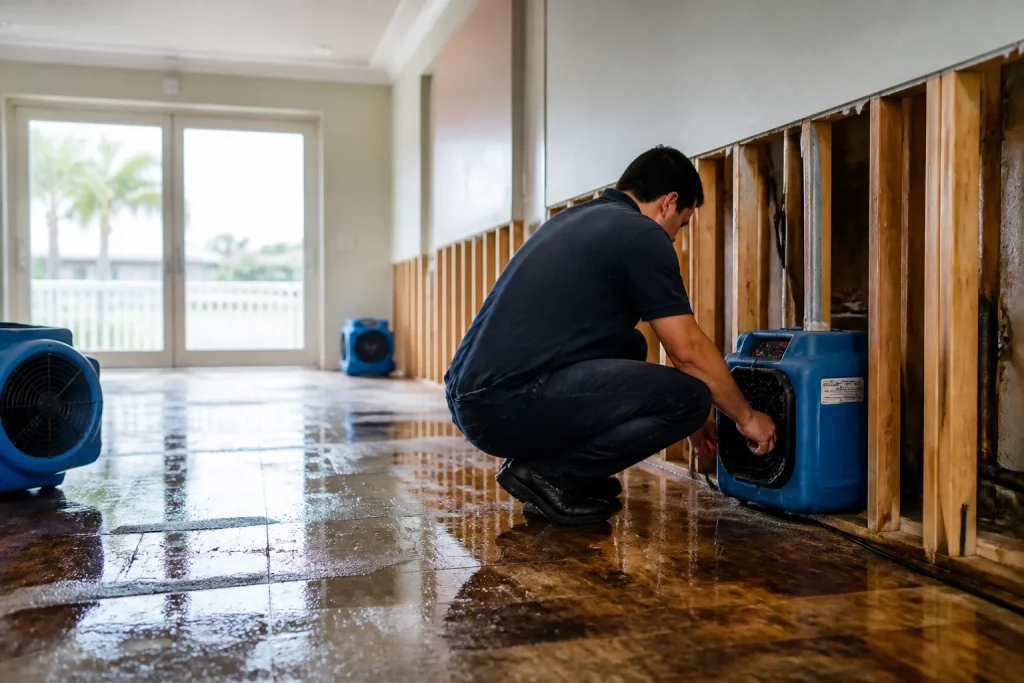
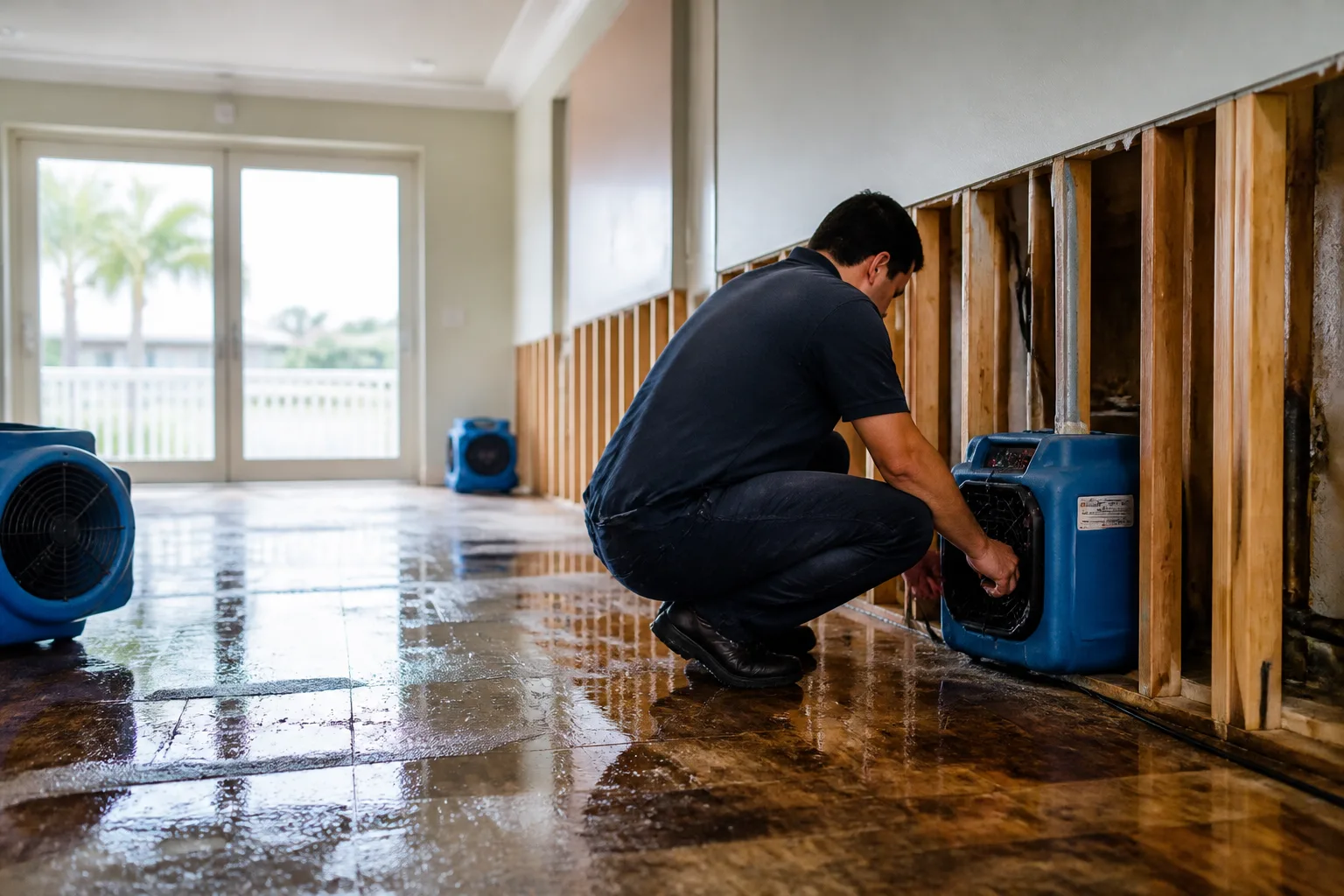
Peninsula and Balboa Island homes often sit at or near sea level. Many were built before modern moisture barrier standards, which means vapor barriers under slabs are either compromised or nonexistent. When a pipe leaks inside a wall cavity, the surrounding air is already moisture-loaded from the marine layer, so drying times extend and mold pressure increases. We run Dri-Eaz and Phoenix LGR dehumidifiers at commercial capacity for exactly this reason. A consumer-grade unit from a big-box store won’t move enough air to dry a wall cavity in Newport Beach humidity.
Bayfront properties face a different problem: Category 2 groundwater intrusion during king tides or storm surge. Water that comes in from the bay, or from groundwater pushing up through a slab, is contaminated. It carries silt, bacteria, and whatever else is in the water column. That’s not a mop-and-fan situation. That’s a remove-and-sanitize situation, full PPE, and disposal per IICRC protocols.
Hillside homes in neighborhoods like Newport Coast, Harbor Ridge, or Spyglass have lateral migration issues. Water from a leak at the top of a slope inside the home doesn’t pool. It runs downhill through slab cracks, under flooring, and into wall cavities you can’t see. So the visible puddle isn’t the whole story. That’s where moisture mapping matters more than a visual inspection, and why we run Injectidry systems to dry inside walls and subfloors without tearing everything out. Preserve more, tear out less isn’t a slogan. It’s a hard dollar difference on the reconstruction side.
What to Verify Before You Let Any Contractor in Your Home
Emergency restoration is a moment where homeowners make bad decisions because they’re scared and someone is standing in their doorway. Here’s what you check before you sign anything or let anyone start pulling baseboards.
- Current IICRC firm certification. Ask for their certificate number. Look it up on the IICRC website. If they can’t produce it, send them home. The IICRC certification is the restoration industry’s most recognized technical credential, and it’s not a one-and-done deal. Firms have to maintain continuing education credits.
- Proof of liability insurance naming you as certificate holder. Any credentialed contractor can send this to your phone in minutes. If they hesitate, that’s your answer.
- What equipment they’re actually loading into the truck. Ask: “What dehumidifiers are you bringing?” If the answer is anything other than named professional brands like Dri-Eaz, Phoenix, XPOWER, or B-Air, you’re talking to someone with rental equipment and rental competence. Commercial-grade LGR dehumidifiers remove 100-plus pints per day. Consumer units remove 20 to 30. You cannot make up that deficit with more time, because mold doesn’t wait.
- Whether they carry Injectidry or equivalent cavity-drying capability. This is the single biggest differentiator between a restoration specialist and a generalist contractor. Injectidry panels and hoses dry inside wall and subfloor cavities without demo. If a company’s only plan is “cut it out and throw it away,” you’re paying for their limited toolset.
At Guild Water Damage, the answer to every one of those questions is documented, current, and available before you sign anything. That’s the guild standard: a documented, repeatable process, not a technician’s gut feeling.
Work Authorization vs. Assignment of Benefits: The Form You Should Read Twice
That paper they slide across the counter during an emergency? It’s not just permission to start work. It’s one of two documents, and the difference determines who controls your claim.
A work authorization says the contractor is authorized to perform specific work and bill for it. You still control the claim. You still negotiate scope. You still direct payment. This is the appropriate document for emergency mitigation.
An assignment of benefits (AOB) is a different animal. You’re signing over your right to the insurance claim benefit to the contractor. They bill the insurer directly, they negotiate the settlement, and if there’s a dispute, they’re the ones fighting it, not you. In some scenarios that’s fine. In an emergency, it’s often signed without reading.
Read the header. Ask: “Is this a work authorization or an assignment?” If it’s the latter and you didn’t ask for it, don’t sign it. We use plain work authorizations on every Newport Beach job. Our relationship is with you, not your insurance company’s claims department. We document everything, we coordinate with your adjuster, and we hand you the evidence. But the claim stays yours.
When to Call a Pro
You should call a pro any time water has touched drywall, flooring, cabinetry, or anything you can’t move and dry completely within a few hours. If water came from a contaminated source like a toilet, dishwasher, or groundwater, that’s a Category 2 or 3 loss and requires sanitization protocols, not just drying. If you smell must or see discoloration on drywall within days of a leak, you’re already dealing with microbial growth and it’s no longer a beginner project. In Newport Beach, with our humidity and older housing stock, the threshold for professional intervention is lower than you think.
Related services in Newport Beach: Water Damage Restoration in Newport Beach and Mold Remediation in Newport Beach. If you’re dealing with a post-fire situation after water was used to extinguish a blaze, Fire Damage Restoration in Newport Beach covers that intersection too.
One quick story. We pulled a dehumidifier out of a garage over in Cameo Shores last month where the homeowner had spent three days running a consumer unit he bought online. The drywall had wicked water up 18 inches. His IICRC-certified neighbor told him to call us. The drying log from that consumer unit showed the relative humidity inside the wall cavity never dropped below 70 percent. Mold doesn’t care that you tried. By the time we arrived, the remediation scope was triple what it would have been on day one. The equipment matters. The certification matters. The first 90 minutes matter.
The Bottom Line
Water damage in Newport Beach is a race against humidity, building design, and the 24-to-48-hour mold clock. The winners shut the water off, kill the power, document everything, and get a credentialed contractor on site before they ever dial the insurance company. The losers wait for the adjuster, buy a rental dehumidifier, and sign a form they didn’t read. If you’re in Newport Beach and need help, Guild Water Damage offers free estimates and same-day response. Call (855) 855-9631 and we’ll get certified technicians and professional-grade equipment to your home today. Learn more about our approach at Guild Water Damage home.
Frequently Asked Questions
Most certified restoration contractors in Newport Beach offer same-day emergency response. We dispatch crews to homes across Newport Beach, including the Peninsula, Balboa Island, Corona del Mar, Newport Coast, and the harbor areas. The key is calling early in the sequence, right after you’ve shut the water and cut power. Call (855) 855-9631 and we’ll route a crew immediately if the job requires it.
Most homeowners policies cover sudden and accidental water damage, including burst pipes, appliance failures, and water heater ruptures, provided the damage wasn’t caused by neglect or a maintenance failure. Your policy also requires you to mitigate further damage promptly, which means reasonable mitigation costs are typically covered. The documentation matters: photos, moisture logs, and an IICRC-certified process give your adjuster what they need to approve the claim.
Fans move air. They don’t remove moisture from building materials. A professional restoration company runs commercial-grade LGR dehumidifiers like Dri-Eaz or Phoenix units, which pull 100-plus pints of water per day from the air, along with air movers positioned strategically to create evaporation across wall and floor surfaces. Without that combination, water stays trapped inside drywall, under flooring, and in wall cavities, and that’s where mold starts.
Category 1 is clean water from a supply line or pipe. Category 2 is contaminated water from appliances like dishwashers or washing machines, or sump pit discharge. Category 3 is grossly contaminated water from sewage backups, flooding, or baywater intrusion. The distinction drives sanitization and demolition decisions. In Newport Beach, bayfront properties dealing with groundwater or storm surge should treat all intrusion as Category 2 or worse until a certified assessment says otherwise.
Written by the team at Guild Water Damage, serving Newport Beach since 2017.
Need Damage Restoration Help?
Call Guild Water Damage — licensed & insured, here with fast after-hours help in Newport Beach.
(855) 855-9631