How to Choose the Right Damage Restoration Company in Newport Beach
Choosing a restoration company in Newport Beach comes down to verifying credentials, equipment grade, and documentation rigor before you sign anything. The right firm runs IICRC-certified processes with commercial-grade drying equipment and writes a scope you can audit line by line. If you’d rather skip the vetting and talk to a credentialed team directly, call (855) 855-9631 for a free estimate.
Yelp reviews cannot tell you whether a restoration company owns LGR dehumidifiers or rents residential units from Home Depot the morning of your job. That single equipment distinction affects drying time, mold risk, and final cost more than any five-star rating. Most Newport Beach homeowners discover this only after the damage is done twice.
Start With Credentials, Not Reviews
The restoration industry has a credentialing problem: homeowners assume any company that shows up with fans and dehumidifiers is qualified. They’re not. The gap between a certified firm and a general contractor who added “water damage” to their truck lettering is wide, and it’s measured in improper dryouts, recurring mold, and claims denials.
In Newport Beach, where coastal humidity extends drying timelines and premium building materials leave little tolerance for error, you need to verify three specific credentials before calling anyone back:
- IICRC firm certification – not just a technician who took a weekend course, but a firm that has passed the certification process and follows the S500 water damage standard as a matter of operating procedure. Ask for the firm’s IICRC number and verify it independently at the IICRC website. A logo on a website proves nothing.
- RIA membership – the Restoration Industry Association holds members to a professional code of ethics and continuing education requirements. Membership signals the company operates within an accountability structure, not just a marketing budget.
- IFA affiliation – an additional layer of professional oversight that most local restoration companies simply do not have. When you find all three together, you’re looking at a specialist, not a generalist.
We hold the full stack: IICRC certification, RIA membership, and IFA affiliation. We list these openly because they’re verifiable, and we encourage every Newport Beach homeowner to check them before deciding who gets access to their walls and subfloors.
Ask Equipment Questions That Generalists Fail
Here’s the fastest way to separate a credentialed restoration firm from a contractor dabbling in drying: call and ask three specific equipment questions. You don’t need technical expertise. You just need to hear the right answers.
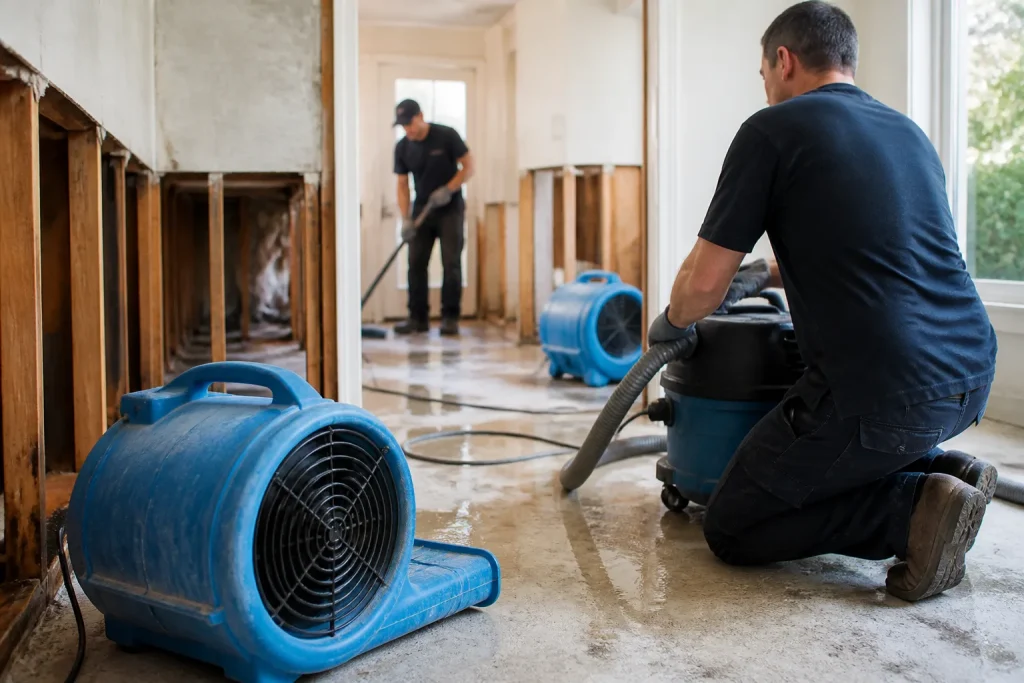
What’s the make and model of your primary dehumidifier? A restoration specialist will answer immediately – Dri-Eaz, Phoenix, or similar commercial LGR (low-grain refrigerant) units. A generalist will pause, say “dehumidifiers” vaguely, and hope you move on. LGR units pull moisture down to levels residential units can’t reach, which matters for materials like the hardwood floors and drywall common throughout Newport Beach homes.
What CFM rating are your air movers? CFM (cubic feet per minute) measures how much air each unit moves. Professional drying requires air movers rated at 2,500 CFM or higher placed at precise intervals. A contractor showing up with big-box fans is running a comfort setup, not a drying system.
Do you use thermal imaging cameras for moisture mapping? Moisture hides behind drywall, under flooring, and inside ceiling cavities. Without thermal imaging and moisture meters, a technician is guessing where the water went. Guessing means missed pockets, which means mold months later. Our crews run thermal imaging as standard protocol on every water loss in Newport Beach, and the documentation becomes part of your claims file.
The equipment brands we run – Dri-Eaz and Phoenix among them – are the same ones specified by commercial restoration engineers on high-value coastal projects. That’s not a marketing point. It’s a drying-speed point.
Why Big Franchise Brands Often Underperform Here
Newport Beach is not an average market, and that matters more in restoration than homeowners realize. National franchises standardize their equipment inventories and technician training across hundreds of locations. That standardization works fine in tract housing with basic builder-grade materials. It underperforms in coastal markets where homes feature custom millwork, imported tiles, marine-grade finishes, and complex moisture paths through old growth framing.
The franchise model also tends to cycle technicians through locations. The crew that shows up to your Newport Beach water loss may have spent last month drying basements in Phoenix, where the climate and drying physics are completely different. Our region’s extended humidity means open drying times run longer, materials absorb more, and mold germination triggers faster. A technician unfamiliar with marine-layer moisture behavior will set drying goals that leave your walls damp enough for problems.
Independent certified firms, by contrast, live in this market. We know which Newport Beach neighborhoods see salt-driven corrosion in crawl spaces, which construction eras used materials that wick water laterally, and how the daily fog pattern on the peninsula affects exterior wall cavity drying. That local knowledge compounds with proper equipment and documented protocols. The result is a dry structure on the first pass, not a callback.
If you’re comparing options, water damage restoration in Newport Beach with a firm that names its equipment, its credentials, and its local experience is the route worth taking.
How to Read an Estimate for Scope Completeness
Before you sign any restoration contract in Newport Beach, read the estimate line by line. Not for the price. For the scope. The line items tell you whether the company is running a legitimate restoration or a surface-level cleanup dressed as one.
Three items on a legitimate proposal are non-negotiable:
- IICRC damage class designation. The S500 standard classifies water damage by severity (Class 1 through Class 4) based on absorption rate, affected square footage, and evaporation load. If a company cannot tell you the damage class, they have not assessed the loss properly. Class 4 losses, common when water sat in a Newport Beach slab foundation home over a weekend, require specialized drying strategies and extended equipment runs.
- Psychrometric monitoring line items. Psychrometry is the measurement of temperature, humidity, and vapor pressure throughout the drying process. A real restoration company logs readings daily, adjusts equipment accordingly, and includes this monitoring in the scope. An estimate without monitoring line items means they plan to set fans and walk away.
- A written drying goal statement. Before work begins, the estimate should state the target moisture content for affected materials and the expected drying timeline. Without a written goal, you cannot hold anyone accountable for completion. We apply this on every project we run in Newport Beach; it’s called the Guild standard, and it turns restoration from a judgment call into an auditable process.
We pulled a drying job last month in a Newport Beach home where the previous contractor’s estimate was two lines: “dry affected areas” and “monitor as needed.” No class, no monitoring, no goal. The homeowner had been living with hidden moisture behind baseboards for three weeks. The estimate you receive should read more like a technical scope than a handshake.
Insurance Preferred Vendors and the Conflict of Interest
Your insurance company may recommend a restoration contractor. Here’s what they won’t tell you: preferred vendor programs are built around cost control for the insurer, not completeness of remediation for the policyholder.
When an insurer steers you to a preferred vendor, that contractor has agreed to the insurer’s unit pricing, the insurer’s documentation requirements, and the insurer’s definition of “dry.” That creates an incentive structure where the contractor’s client relationship is with the adjuster, not with you. If a drying goal falls short or a scope gets trimmed to lower severity, the contractor’s referral stream remains intact. You, meanwhile, inherit the mold problem eighteen months later.
Newport Beach homeowners have the right to choose their own certified restoration firm. California law protects your contractor selection. When you choose an independent firm, the final say on scope, drying completion, and mold clearance belongs to the professional with the moisture readings and the certification – not a claims department spreadsheet.
We work with insurance claims every week. We photograph everything, document every moisture reading, and coordinate directly with adjusters. But our contractual and professional obligation runs to the homeowner. That distinction matters when a corner-cutting directive arrives from a claims agent trying to close a file.
For larger losses involving hidden moisture and microbial concerns, mold remediation in Newport Beach deserves the same credential scrutiny as the initial water mitigation. One contractor running both phases reduces the handoff risk that creates coverage gaps.
When to Stop Researching and Make the Call
There’s a moment in every water loss where further comparison shopping costs more than it saves. Water is migrating behind baseboards tonight. Moisture in wall cavities becomes mold in 48 to 72 hours under Newport Beach’s coastal humidity. Every day spent requesting quotes from uncredentialed contractors extends the drying timeline and expands the damage.
If you’re seeing standing water, warping floors, or rising damp lines on drywall, the time for research ended when you noticed it. Call a credentialed firm, ask the three equipment questions above, verify the certifications, and get someone professional on site. The estimate itself tells you whether you chose well: it should include a damage class, monitoring line items, and a written drying goal.
The same applies to fire losses, where smoke residues become more difficult to remove with each passing day. Fire damage restoration in Newport Beach runs on the same principle: documented scope, named equipment, credentialed technicians.
For ongoing general questions about what we cover, start at the Guild Water Damage home page. But if your house is actively wet, skip the reading list and call.
The Bottom Line
Choosing a damage restoration company in Newport Beach is not a comparison-shopping exercise. It’s a verification exercise. Check the three-credential stack: IICRC firm certification, RIA membership, IFA affiliation. Ask the equipment questions: make and model of the dehumidifier, CFM rating of air movers, thermal imaging for moisture mapping. Read the estimate for a damage class designation, psychrometric monitoring, and a written drying goal. And remember that your insurance company’s preferred vendor list serves the insurer’s cost model, not your long-term structural health.
If you’re in Newport Beach and need help, Guild Water Damage offers free estimates with documented scopes – call (855) 855-9631.
Frequently Asked Questions
The baseline credential is IICRC firm certification – not just a certified technician, but a firm certified under the restoration industry’s most recognized standard. RIA membership adds a code of ethics and ongoing education requirement. IFA affiliation provides an additional layer of professional accountability. Verify all three independently rather than trusting website logos.
Ask for the make and model of their primary dehumidifier. Commercial LGR units from brands like Dri-Eaz or Phoenix pull moisture to levels residential units cannot match. Also ask the CFM rating of their air movers; professional units run 2,500 CFM or higher. If they hesitate on brand names or give you a vague answer, you’re talking to a generalist. Call (855) 855-9631 if you want to ask these questions to a team that passes them immediately.
You have the legal right to choose your own certified firm in California. Preferred vendor programs prioritize insurer cost control, which can mean trimmed scopes, rushed dryouts, and incomplete remediation. Choose an independent certified firm that documents everything and coordinates directly with your adjuster while keeping its professional obligation to you.
A legitimate estimate names the IICRC damage class, includes psychrometric monitoring line items for daily temperature and humidity readings, and states a written drying goal with target moisture content. An estimate without these three elements is a scope gap waiting to become a moisture problem. Estimates from Guild Water Damage include all three, and they’re free – call (855) 855-9631.
Written by the team at Guild Water Damage, serving Newport Beach since 2017.
Need Damage Restoration Help?
Call Guild Water Damage — licensed & insured, here with fast after-hours help in Newport Beach.
(855) 855-9631