Water Damage Restoration What It Really Costs: What Newport Beach Homeowners Pay in 2026
Most Newport Beach water damage restoration jobs land between $2,800 and $7,500 for a typical Class 2 event in 2026, with Class 3 and 4 structural drying running $9,000 to $25,000 once walls, slab, and custom finishes are involved. That range is wide because restoration isn’t one service – it’s a sequence of decisions about drying method, demolition scope, and material matching. If you’d rather skip the spreadsheet and get a straight answer, call (855) 855-9631 and we’ll walk you through it.
We pulled a drying job out of a garage over in Lido Isle last month where the homeowner had already received two bids $6,000 apart. Same square footage, same visible water line. The difference? One contractor quoted a Class 1 clean-water extraction with a week of air movers. The other had mapped moisture in the sill plates, found the water had wicked up the drywall from a slab leak, and scoped a Class 3 with Injectidry cavity drying behind baseboards. The first bid wasn’t cheaper. It was just scoping less.
Why Newport Beach Restoration Costs Run 35-60% Above National Averages
Flat-rate estimating tools built in other markets break down fast in Newport Beach. Three local variables push restoration invoices higher, and none of them are contractor padding.
First, coastal humidity. The ocean air in Newport Beach keeps ambient moisture levels high year-round, especially from May through October. A wall cavity that dries in 72 hours in Phoenix might take five to seven days here because the air you’re blowing through it is already carrying moisture. That extended drying window means more equipment days, more monitoring visits, and more electricity on the invoice. Every additional day of dehumidifier runtime is a line item, not a judgment call.
Second, construction materials in Newport Beach homes skew high-end. Travertine flooring, custom millwork, engineered hardwood, and hand-troweled plaster are common finishes from Balboa Peninsula to Newport Coast. When those get wet, they don’t get replaced with off-the-shelf material from a big-box supplier. They require matching, sampling, and specialty subcontractors who price accordingly. A restoration crew that tears out $40-per-square-foot travertine needs to account for $40-per-square-foot travertine going back in, not $3 ceramic tile.
Third, access and parking on the peninsula simply cost more. Crews have to stage equipment carefully on narrow streets, sometimes coordinate with HOA rules, and haul commercial drying rigs into second-floor units with no elevator. These are real labor hours that don’t appear on a national cost estimator.
What a Restoration Invoice Actually Contains: A Line-by-Line Breakdown for 2026
Here’s what a properly scoped water damage restoration invoice in Newport Beach includes in 2026, with the local pricing benchmarks we see on active jobs. This is the document structure an adjuster will expect to see, organized by trade and phase.
- Emergency extraction and containment: $450 to $1,200. Truck-mounted extraction of standing water, setup of plastic containment barriers, and initial antimicrobial application. This should happen day one.
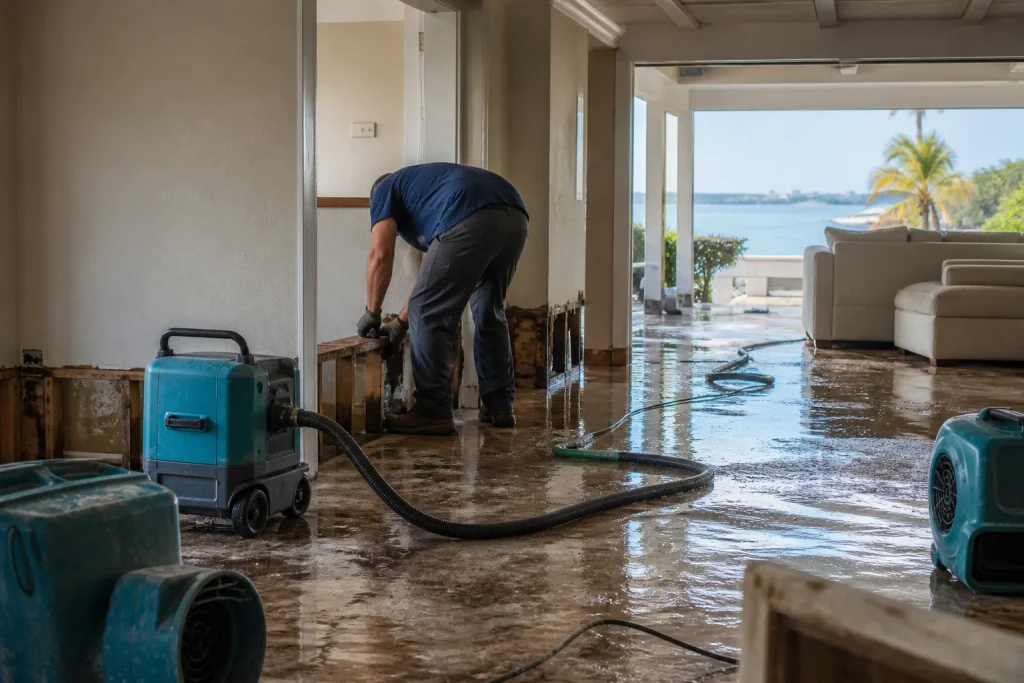
- Drying equipment daily rate: $65 to $110 per day per air mover, $95 to $160 per day per commercial dehumidifier. A typical 1,500-square-foot Class 2 loss runs 14 to 22 air movers and 3 to 5 dehumidifiers.
- Moisture monitoring and documentation: $250 to $600 total across a standard job. Includes daily moisture readings, thermal imaging where applicable, and the drying log that documents equipment performance day by day.
- Structural cavity drying (when applicable): $800 to $2,500 per affected room. Systems such as Injectidry inject dry air into wall cavities and subfloors without removing drywall. This is where a specialized process preserves millwork and finished surfaces.
- Microbial treatment and odor control: $400 to $1,800. Application of EPA-registered antimicrobials after drying is complete, including fogging in enclosed cavities.
- Controlled demolition and debris removal: $500 to $3,000. Cutting and removing unsalvageable drywall, baseboards, and insulation, with haul-away from Newport Beach job sites.
- Rebuild and finish work: $4,000 and up. Drywall repair, texture matching, paint, and reinstallation of trim. This phase varies more than any other line item based on material grade.
Any estimate you receive should break out these categories. One that says “water damage cleanup: $4,750” with no line items isn’t an estimate – it’s a placeholder waiting to become a change order.
Why the Damage Class Changes Everything (And Why Some Estimates Omit It)
Before you can trust any water damage restoration cost number in Newport Beach, you need to know what class of water damage you’re looking at. The IICRC defines four classes, and the price difference between them is not incremental.
Class 1 is the least severe: a small area, minimal water absorption, mostly impermeable materials. A slow leak under a kitchen sink caught the same day is Class 1. Expect $1,200 to $2,400 total in Newport Beach.
Class 2 involves water that has wicked into walls, flooring, or cabinetry across a whole room. A supply line failure behind a washing machine that goes unnoticed for a few hours falls here. Budget $2,800 to $7,500. Most jobs we see are Class 2.
Class 3 means water has saturated walls from floor to ceiling, often from an overhead source like a burst pipe in an attic or a second-floor bathroom failure. Ceilings, insulation, and studs are wet. Expect $8,000 to $15,000 before any rebuild considerations.
Class 4 means water has penetrated low-permeability materials: concrete slab, plaster, brick, or hardwood subflooring. This requires deep drying with specialty equipment and often takes 7 to 14 days. Class 4 jobs in Newport Beach regularly exceed $15,000, and slab saturation under engineered hardwood can push $25,000 once flooring replacement is included.
Here’s the part most homeowners miss: the class designation should be determined by a certified technician with a moisture meter and a thermal camera, not by whoever answers the phone. When a restoration company can’t tell you the class of loss on the initial call, you’re not dealing with a measurement-based process. You’re dealing with a guess that will be corrected later at your expense.
How Newport Beach Home Values Change the Rebuild Math
A restoration invoice isn’t just about drying. It’s about what goes back in after the drying is done. In Newport Beach, the replacement cost math is different than it is in Irvine or Costa Mesa, and it’s worth understanding why.
Take an engineered hardwood floor in a Newport Coast home. A general contractor who doesn’t specialize in restoration might quote a material allowance of $8 to $12 per square foot and plan to install a mid-grade replacement. The existing floor might be a $22-per-square-foot product, installed with a specific wear layer and a matching stain. When the replacement doesn’t match, the insurance claim may cover a full-room replacement, not just a patch – but only if the documentation supports it.
Travertine is another one. Natural stone varies from lot to lot. You can’t pull a section of wet travertine out of a Balboa Island entryway and expect a new batch to match without sampling. Custom millwork in older Harbor Island homes often predates modern trim profiles. Recreating it requires a millwork shop that charges restoration rates, not production rates.
This is why a restoration firm’s trade network matters more than its drying equipment. The most expensive line item on most Newport Beach restoration jobs is the rebuild, not the drying. A company that handles Water Damage Restoration in Newport Beach with in-house rebuild capability or an established specialty subcontractor network is pricing a complete restoration. A company that hands you a dry-out bill and waves goodbye is pricing half a job.
What the Insurance Billing Structure Actually Looks Like
Most Newport Beach water damage claims are priced through Xactimate, the software platform that restoration contractors and insurance adjusters both use. Xactimate assigns line-item pricing based on zip code, which means it already accounts for some Newport Beach cost pressure. The negotiation happens around which line items are included and what quantity is justified.
Where adjusters tend to push back: extended drying days beyond the software’s baseline, the use of specialized cavity-drying systems such as Injectidry when the adjuster wants to see demolition instead, and rebuild finish matching when standard material allowances are lower than the actual existing material.
This is where documentation separates a legitimate claim from a denied one. A restoration company should be able to provide:
- A moisture map showing affected areas with before and after readings
- A daily drying log with equipment counts and psychrometric data
- Photo documentation of the affected materials and their condition
- A written scope that maps each line item to a specific room and damage class
- Clear communication with your adjuster when scope questions arise
An IICRC-certified restoration firm follows a documented process for exactly this reason. The certification isn’t a decoration. It’s a requirement that the drying was performed to an industry standard that the insurance company recognizes. When we prepare scopes for Newport Beach adjusters, we’re working from the same certification-backed protocols we’d follow regardless of who’s paying – homeowner or carrier.
Dry-Only vs. Full-Service: Where the Low Bid Hides Its Margins
A dry-only scope means the restoration company extracts water, sets drying equipment, monitors until dry, and then leaves. You’ll get a dry house with wet-damaged drywall still on the walls, flooring still buckled, and no plan for putting it back. The dry-only contractor hands you a list and says “call a general contractor.”
A full-service scope means the same company handles extraction, drying, controlled demolition, and rebuild – either with in-house crews or a managed subcontractor network. One written scope, one point of accountability, one insurance claim coordinator.
The “cheaper” dry-only bid looks appealing until the math catches up. Here’s what happens in practice: the general contractor you hire for rebuild isn’t a restoration firm. They may not understand what surfaces need to be brought to what moisture content before reinstallation. They may not carry the microbial treatment documentation that your insurance adjuster wants to see. And when the seam between “dried” and “rebuilt” fails – mold grows behind a reinstalled baseboard, a floor buckles after it’s put back – you’re now coordinating between two contractors who both point at the other one.
For the rebuild phase, we handle the full scope in-house: water damage restoration, Mold Remediation in Newport Beach, and Fire Damage Restoration in Newport Beach under one credentialed roof. The value isn’t speed. It’s that the same team that measured the moisture is the team that decides when reconstruction begins. There’s no gap between drying and rebuilding for miscommunication to live in.
Factory-Grade Equipment, a Guild Standard, and What Dri-Eaz and Injectidry Actually Get You
Walk into a restoration supply store and you’ll see shelves of dehumidifiers and air movers for rent. Homeowners sometimes ask whether they can dry a small water event themselves with rental gear. Here’s what professional-grade actually means.
The dehumidifiers we run in Newport Beach homes are Dri-Eaz and Phoenix units – commercial refrigerant and desiccant dehumidifiers rated for continuous operation in enclosed spaces. They’re not the same machines you rent at a home center. A homeowner-grade dehumidifier pulls 20 to 30 pints per day at laboratory conditions. A commercial unit pulls 70 to 140 pints per day under the warm, humid conditions you actually find inside a flooded wall cavity.
The other distinction is injective drying capability. Injectidry systems move dry air into wall cavities, behind built-in cabinetry, and under subfloors through small inlet ports – without cutting open the wall. A conventional contractor has to remove drywall to dry the cavity behind it. Injectidry means we preserve more structure and put less back. In a Newport Beach home with custom finishes, that’s the difference between a $4,000 patch and a $18,000 demolition-and-rebuild. The equipment cost to us is higher, but the total cost to you is often lower.
We operate as a restoration guild, which means our technicians work from documented, certification-based protocols rather than ad-libbing a drying plan on site. RIA and IFA membership means we’re accountable to external standards, not just our own word. The process is repeatable and auditable, which is exactly what an insurance adjuster wants to see.
When to Call a Pro (and When to Wait)
One practical note from years of showing up at Newport Beach homes: the single most expensive decision in water damage restoration is waiting too long to get a professional on site. Water that hits drywall wicks upward within hours. Wood floors absorb water through the seams. And the microbial growth window starts around 24 to 48 hours after saturation. Call a pro the same day you see water. Don’t wait for the weekend.
That said, if it’s a small, contained spill on tile or concrete with no wall contact and you’re certain the source is stopped, you can mop up and run fans. The moment water has touched drywall, baseboards, cabinets, or flooring seams, you’re in restoration territory, and the clock is running.
If you need help right now, Guild Water Damage home is the starting point for our full service area and contact details. For mold-related concerns following a water event, see our Mold Remediation in Newport Beach page. For damage involving electrical systems or gas lines following a fire event, see our Fire Damage Restoration in Newport Beach page.
The Bottom Line
Water damage restoration in Newport Beach costs more than national averages because the homes are built with harder-to-match materials, the coastal air slows drying, and the standard of documentation your insurance carrier expects is higher. A realistic 2026 budget for a typical Class 2 event is $2,800 to $7,500. Class 3 and 4 events start at $8,000 and can exceed $25,000. The most important line item is the one you won’t see on a low bid: the scope that got left out.
If you’re in Newport Beach and need a straight answer, Guild Water Damage offers free estimates. Call (855) 855-9631 and we’ll tell you what you’re looking at – the class of loss, the drying method, the rebuild scope – before you commit to anything.
Frequently Asked Questions
Most Newport Beach water damage restoration jobs cost between $2,800 and $7,500 for a Class 2 event in 2026, while Class 3 and 4 structural drying runs $9,000 to $25,000 or more. The range depends on damage class, square footage affected, drying duration, and whether custom finishes like travertine or millwork need replacement. Call (855) 855-9631 for a free estimate specific to your home.
If the water damage is sudden and accidental – a burst pipe, a failed supply line, a water heater rupture – most homeowner policies cover restoration, including drying, demolition, and rebuild. Gradual leaks, ground seepage, and flooding from rising water are typically excluded unless you carry a separate flood policy. Your restoration company should document the loss with moisture readings, photos, and a line-item Xactimate scope. We coordinate directly with adjusters.
For an active water event in Newport Beach, a restoration crew should be on site the same day you call. Emergency extraction and equipment placement within the first 24 hours is the difference between a drying job and a mold remediation job. Delaying gives water time to wick into walls and subfloors, which raises both the damage class and the invoice. Call (855) 855-9631 as soon as you see water.
If water has touched drywall, baseboards, cabinets, or flooring seams, you need professional drying with moisture monitoring. Rental equipment can’t reach wall cavities or subfloors, and without moisture mapping you won’t know when it’s actually dry – or where mold is already starting. A professional assessment costs nothing in Newport Beach and tells you whether you’re looking at a simple dry-out or a full restoration scope.
Related Services in Newport Beach
Water damage often leads to secondary issues. If you’re dealing with musty odors or visible mold growth after a leak, see our Mold Remediation in Newport Beach page. If the house has been affected by a fire or smoke event and you need restoration help, see our Fire Damage Restoration in Newport Beach page. For the complete scope of water damage services, start with Water Damage Restoration in Newport Beach.
Written by the team at Guild Water Damage, serving Newport Beach since 2017.
What happens when you call
- 1
A real person answersNo phone trees — you reach a local pro.
- 2
You get an upfront price rangeHonest numbers before anyone is dispatched.
- 3
A background-checked tech heads outLicensed & insured, dispatched right away.
- 4
You approve before work beginsNothing starts until you say go.
Need Damage Restoration Help?
Call Guild Water Damage — licensed & insured, here with fast after-hours help in Newport Beach.
(855) 855-9631