Last updated October 30, 2026
 Water damage drying
 Fire & smoke cleanup
 Mold remediation
 Storm response
 Sewage cleanup
 Reconstruction
Free visual inspection and a written scope of work before any mitigation begins - photos, moisture readings, and drying logs go in your claim file
The scope we write is the scope we bill. Anything new gets shown to you, in writing, before we touch it.
Get your free estimateThe Complete Water Damage Restoration Guide for Newport Beach Homeowners
Most water damage in Newport Beach doesn’t start with a storm. It starts with a pinhole leak in a copper supply line that’s spent 40 years breathing salt air. The marine layer that keeps our summers mild also keeps ambient humidity at levels that slow evaporation to a crawl, which means a leak that would dry out in 48 hours in Riverside can still be feeding mold growth on day four here. This guide maps the full restoration sequence against the specific conditions we deal with in Newport Beach, so you know what actually needs to happen, in what order, and why shortcuts fail along the coast. For professional help, see our Water Damage Restoration services.
Quick Answer
Water damage restoration in Newport Beach follows a five-phase sequence: emergency water extraction, structural drying with professional-grade equipment, moisture mapping to confirm dry-out, antimicrobial treatment to prevent mold, and rebuild of damaged materials. Because Newport Beach’s marine-layer humidity (averaging 75% relative humidity during summer months) extends drying timelines by 20 – 40% compared to inland conditions, the process typically takes four to seven days for structural drying before rebuild can begin. The single most important decision you’ll make is whether the restorer has IICRC certification and the equipment to verify dry-out with documented moisture readings, not just visual inspection.
Restoration work we handle
Table of Contents
- Coastal Variables: How Newport Beach’s Climate Changes Every Restoration
- The Four Water Damage Categories and Why Misclassification Is a Liability
- The Five-Phase Restoration Sequence, Step by Step
- Slab-on-Grade vs. Raised Foundations: Why Equipment Placement Matters
- What IICRC, RIA, and IFA Credentials Actually Mean for Your Claim
- Insurance Documentation: What Adjusters Need From a Restorer
- Drying Technology: How Non-Invasive Methods Preserve More, Tear Out Less
- What Water Damage Restoration Costs in Newport Beach
Coastal Variables: How Newport Beach’s Climate Changes Every Restoration
Newport Beach sits inside a microclimate that inland restoration timelines simply ignore. The marine layer that rolls in most evenings between May and September holds relative humidity at 70 – 80%, and that number matters more than most homeowners realize. The IICRC S500 standard, which governs professional water damage restoration, includes a drying equation based on the moisture differential between wet materials and ambient air. When ambient humidity stays high for twelve to sixteen hours a day, that differential shrinks, and evaporation slows proportionally.
Our experience in neighborhoods from Balboa Peninsula to Spyglass Hill consistently shows structural drying timelines running 20 – 40% longer than what equipment manufacturers publish. Dri-Eaz, Phoenix, and XPOWER manufacturer drying charts assume inland baseline conditions: 50% relative humidity, good airflow, typical insulation values. None of those assumptions hold within a mile of the coast. A wall cavity that dries in 48 hours in Santa Ana takes 72 to 96 hours here. A concrete slab in Corona del Mar with trapped moisture under vinyl plank flooring can take a week.
The second coastal variable is salt-air corrosion. It’s not a drying-time issue; it’s a failure-mode issue. Copper supply lines throughout Newport Beach’s older housing stock, particularly the post-WWII tract homes built in the 1950s and 1960s, sit inside wall cavities and under slabs that have absorbed decades of airborne salt. The result is corrosion that weakens copper from the outside in, producing pinhole leaks that release water slowly for weeks or months before anyone notices. By the time a homeowner sees water staining on a ceiling or buckling at a baseboard, the leak has usually been active long enough to saturate framing, insulation, and drywall well beyond the visible damage area.
What this means for restoration: the wet zone is almost always larger than the stain suggests. Moisture mapping, done with the same equipment an IICRC-certified restorer uses on every project, doesn’t just confirm what you can see; it identifies what you can’t. The alternative, treating only visible damage, leaves trapped moisture in place. In Newport Beach’s humidity, that trapped moisture doesn’t dissipate on its own. It feeds mold growth inside walls for months, and you’ll be redoing the work at double the cost.
The Four Water Damage Categories and Why Misclassification Is a Liability
The IICRC S500 standard divides water damage into four categories, and the difference between them determines what materials can be saved, what must be removed, and how the entire job is documented. A restorer who skips this classification step, or classifies without documenting reasoning, is doing the homeowner a disservice that can affect both health and insurance coverage.
Category 1: Clean Water. This is water from a sanitary source: a broken supply line, a failed water heater inlet, a sink overflow that hasn’t contacted other materials. Restorers can dry Category 1 materials in place, which is the least invasive outcome. Even Category 1 water, though, degrades to Category 2 within 48 hours if it sits in a warm, humid environment. Newport Beach’s coastal humidity accelerates this timeline.
Category 2: Gray Water. Water with some contamination: washing machine discharge, dishwasher overflow, aquarium leaks, toilet overflows with no human waste. Gray water contains microorganisms and nutrients that support bacterial growth. Drying in place is still possible if the restorer moves fast and applies antimicrobial treatment, but any porous material that’s been saturated for more than 48 hours typically should be removed.
Category 3: Black Water. Grossly contaminated water containing sewage, seawater, or floodwater from the bay or ocean. This is the category that catches coastal homeowners off guard. If a Newport Beach property takes on water from a storm surge, a high tide that overtopped a seawall on the Balboa Peninsula, or a sewage backup, that water is Category 3 by definition. The salt content alone makes drying in place impossible for any porous material: drywall, insulation, carpet pad, and flooring all must be removed. Structural framing, once contaminated, requires thorough cleaning and antimicrobial treatment before it can be covered.
Specialty Category: Saltwater Intrusion. The S500 standard treats seawater as a distinct case, not just Category 3 with extra steps. Saltwater is corrosive, conductive, and hygroscopic. It draws moisture from the air even after the source is gone, which means materials that look dry at the surface can still be wet underneath. Salt also attacks metal surfaces: fasteners, electrical connections, plumbing lines, and structural steel. Proper saltwater restoration requires salt-specific cleaning protocols that a general contractor without IICRC training typically doesn’t know to apply.
Misclassification is a liability in both directions. Treating gray water as clean water can leave contaminated materials in a wall cavity. Treating clean water as Category 3 can mean unnecessary demolition of salvageable material. The right classification, documented with moisture readings and source identification, protects both the homeowner’s health and the insurance claim.
The Five-Phase Restoration Sequence, Step by Step
Restoration is a sequence, not a menu. Skipping a phase or moving out of order produces the same result every time: an incomplete dry-out that fails within months. Here is the sequence we follow on every Guild Water Damage project, aligned with IICRC S500 standards.
- Water Extraction. This is the emergency phase. The source is stopped first, then standing water is removed using truck-mounted or portable extraction systems. Extraction removes most of the free water, which reduces drying time dramatically. If this phase is done properly, the next phase is measured in days. If it’s skipped or rushed, everything else takes longer and costs more.
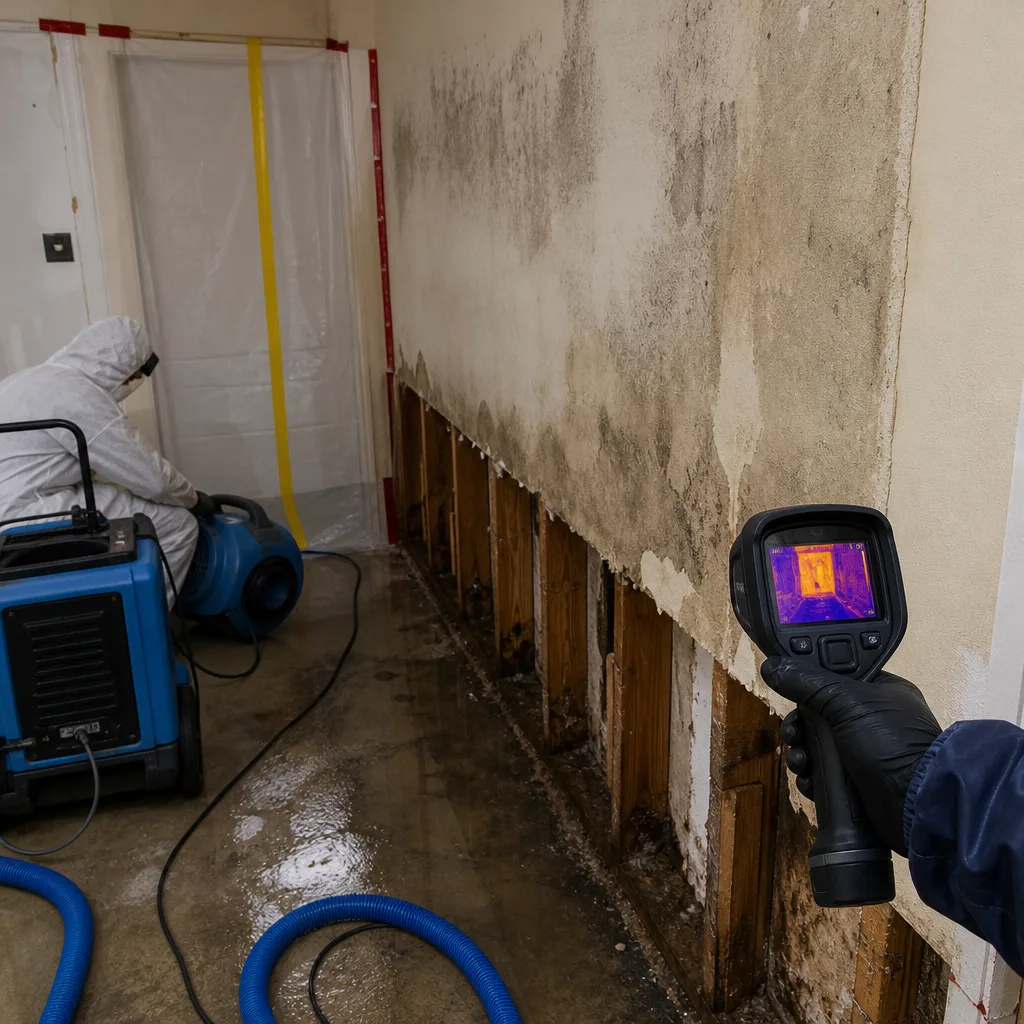
- Moisture Mapping and Documentation. After extraction, the restorer takes moisture readings across floors, walls, and ceilings, using non-invasive meters and thermal imaging where needed. The readings are recorded as a baseline map. This map drives equipment placement and tells the restorer when the job is actually done, not when it looks dry.
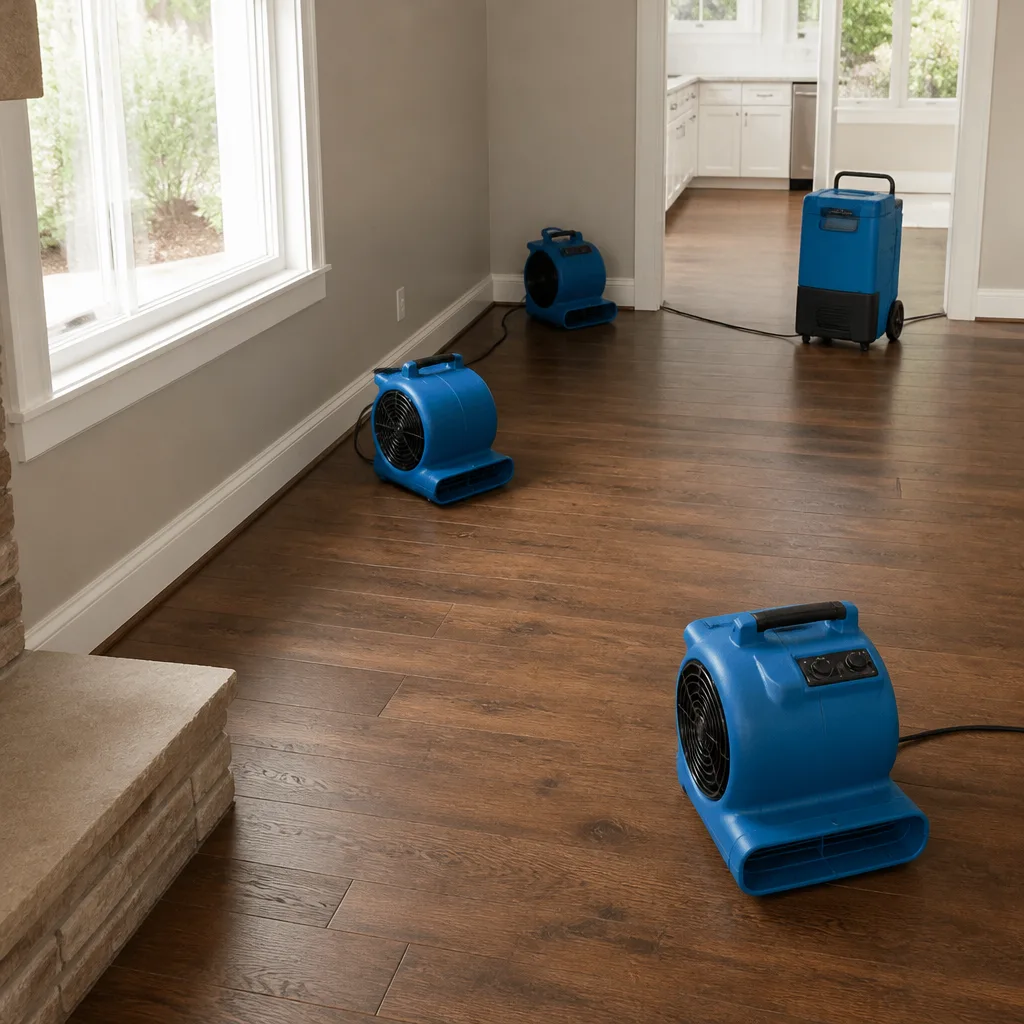
- Structural Drying. This is where the professional-grade equipment comes in: air movers from Dri-Eaz or Phoenix, commercial dehumidifiers from XPOWER or B-Air, and in-wall drying systems from Injectidry when needed. Equipment runs continuously until moisture readings return to the dry standard for the material type, not until the surface feels dry.
- Antimicrobial Treatment. Once materials are dry, the cavity is treated with an EPA-registered antimicrobial to prevent any spores that survived the drying process from colonizing. This phase matters most in Newport Beach, where the ambient humidity that slowed drying will also feed any residual microbial growth.
- Rebuild and Structural Repair. Only after the moisture readings verify a dry structure does rebuild begin. Damaged drywall, insulation, flooring, and trim are removed and replaced. This is where a full-scope contractor matters: the same credentialed team that dried the structure handles the rebuild, so there’s no handoff between restoration and reconstruction crews.
Each phase triggers the next. You don’t move from drying to rebuild because the four-day mark passed; you move because the moisture meter says the structure is dry. A restorer who skips phase-three verification is guessing, and in a coastal climate, guessing is how mold gets a permanent home inside your walls.
Slab-on-Grade vs. Raised Foundations: Why Equipment Placement Matters
Newport Beach has two dominant foundation types, and they behave differently when water gets loose. The post-WWII tracts, much of what you see in Corona del Mar and around Newport Heights, sit on slab-on-grade concrete. Older homes, particularly in the established neighborhoods around Balboa Island and the historic districts, often have raised foundations with a crawlspace underneath. The restoration approach differs significantly between the two.
On a slab-on-grade home, water from an interior leak has nowhere to go but into the slab. Concrete is porous, which means the slab itself becomes a moisture reservoir. Slab moisture doesn’t just evaporate upward into the home; it also stays in the concrete, and that moisture can wick back into flooring for months. This is why flooring on slab homes often buckles weeks after the visible leak was addressed. The drying setup has to include dehumidification targeted at the slab itself, and the restorer has to take readings from the slab surface, not just the floor covering.
Raised foundations introduce a different problem. Water from an interior leak drains down through the flooring and subfloor into the crawlspace. The visible damage inside the home might look less severe, but the real issue is hidden underneath. A restorer working on a raised foundation has to treat the crawlspace as part of the drying chamber: placing dehumidifiers and air movers underneath, checking joist moisture readings, and ensuring the subfloor dries fully before any flooring goes back down. Missing this step is common with general contractors who don’t do restoration full-time. The result is subfloor rot that goes unnoticed until a floor feels spongy underfoot.
Equipment placement is the tell. On a slab home, you should see dehumidifiers and air movers inside the living space, and a restorer should be taking slab readings throughout the job. On a raised home, equipment should be visible in the crawlspace, and the restorer should be able to explain how the under-floor drying setup is coordinated with the above-floor setup. If a contractor only sets up equipment inside, on a raised foundation, ask what’s happening underneath.
What IICRC, RIA, and IFA Credentials Actually Mean for Your Claim
Most homeowners don’t know what these credentials authorize, which is part of why uncredentialed contractors get hired. Here is what each one means in practice.
IICRC Certification. The Institute of Inspection, Cleaning and Restoration Certification is the technical standard-setting body for the restoration industry. IICRC certification means the restorer has passed a test on the S500 water damage standard: how to classify water, how to design a drying system, how to verify dry-out with moisture readings. An IICRC-certified restorer is expected to follow a documented process, not intuition. This matters for insurance claims because adjusters recognize the standard and expect documentation that matches what the S500 requires.
RIA Membership. The Restoration Industry Association is a professional body for restoration companies. Membership signals a commitment to industry ethics and ongoing education. An RIA-member company is held to a code of ethics, and they’re plugged into a network of technical resources, including training updates, that keeps them current on standards.
IFA Affiliation. The International Fireproofing Association is less commonly cited in water damage work, but the affiliation matters when a single loss involves multiple damage types. A company with fire and water credentials under one roof can handle a kitchen fire that triggered the sprinkler system without bringing in two different vendors.
General contractor licensing is a baseline; it says the company can legally do construction work in California. It says nothing about restoration specifically. A GC can pull a permit and rebuild a wall, but they may have no training in drying science, moisture measurement, or antimicrobial treatment. The credential distinction matters most when an adjuster reviews a claim: an adjuster who sees IICRC documentation with moisture logs, category classifications, and drying records knows the work was done to a recognized standard. That smooths the claim process considerably.
Insurance Documentation: What Adjusters Need From a Restorer
Insurance claims for water damage in Newport Beach almost always involve documentation questions. The adjuster’s job is to verify that the damage occurred as described, that the restoration scope matches the damage, and that the work was necessary. Your restorer’s documentation either makes that job easy or creates weeks of back-and-forth.
An IICRC-certified restorer documents every phase: source identification with photos, initial moisture readings with a mapped diagram, equipment placement logs, daily moisture readings, antimicrobial treatment records, and final dry-out verification. This is what the S500 standard requires, and it is what adjusters expect to see. When the documentation is missing, the adjuster has to assume the worst: that the work wasn’t done properly, or that the scope was inflated.
Photo documentation is the single most effective trust tool in a claim. Before any material is removed, the restorer should photograph the damage and the moisture readings. During drying, daily photos of the equipment setup and the moisture logs show an active process. After rebuild, photos show the completed work. Homeowners who handle their own claims rarely have this documentation, which is why a professional restorer’s fee is often recovered through a smoother claim.
Direct coordination with your adjuster is a normal part of the process. The restorer’s documentation team should be available to speak with the adjuster, walk them through the moisture logs, and answer scope questions. This is not a premium add-on; it’s part of the job. When a contractor says they don’t get involved with insurance, that’s a signal they don’t produce documentation that would survive an adjuster’s review.
Drying Technology: How Non-Invasive Methods Preserve More, Tear Out Less
The standard approach to wet walls has historically been destructive: cut open the drywall, remove the insulation, throw it all away. That works. It also turns a $2,000 drying job into a $12,000 rebuild job. For many Newport Beach homeowners, especially those with plaster walls, custom trim, or finishes that are expensive to match, the demolition-first approach costs more than it needs to.
Injectidry cavity-drying technology changes that math, and it’s one of the capabilities that separates a full-scope restoration company from a general contractor who tears out walls because they don’t have the equipment to dry them in place. The Injectidry system pumps controlled, filtered air directly into wall cavities and under subfloors. The air moves through the same space the water occupied, carrying moisture out through an exhaust path. The wall stays intact. The insulation can often stay in place if it’s fiberglass and hasn’t been saturated long enough to compact. The trim stays up. The rebuild scope shrinks, and the homeowner keeps original materials.
This is a marginal capability for most companies. It’s not intuitive to dry inside a closed cavity, and it requires training, specialized equipment, and moisture monitoring to do safely. A company that runs Injectidry systems alongside Dri-Eaz, Phoenix, and XPOWER air movers has the full toolkit for both open drying and cavity drying. For a homeowner, the relevant question is simple: Can you dry this in place, or do you have to tear it out? The answer tells you a lot about the company’s equipment and training.
We use Injectidry on a majority of our wall-drying projects in Newport Beach, especially in older homes where the original plaster or lath-and-plaster construction is expensive to replicate. Saving the material isn’t just cost avoidance; it preserves the character of homes built in the 1920s through 1950s that make Newport Beach’s older neighborhoods what they are.
What Water Damage Restoration Costs in Newport Beach
Restoration pricing is impossible to quote without seeing the scope: water category, affected square footage, materials involved, and how long the water has been sitting all move the number. But Newport Beach homeowners should know the broad ranges so they can recognize a fair quote from an inflated one. For a detailed breakdown, see our Damage Restoration Cost Breakdown: The Newport Beach Homeowner’s Reference for 2026.
Small, contained Category 1 leaks (under-sink supply line, water heater pan overflow caught early) typically run $800 to $1,500, including extraction, drying equipment, and moisture verification. Mid-range jobs, where water has moved across multiple rooms or been sitting longer than 24 hours, run $2,500 to $6,000. Full-scale losses, where structural drying requires multiple days of equipment, antimicrobial treatment, and rebuild work, commonly range from $8,000 to $25,000 or more, depending on finishes and square footage. Saltwater intrusion events are at the high end due to the contamination protocols and material removal requirements.
Rebuild is scoped separately from drying, and it should be a written scope agreed before any demolition or reconstruction begins. We never quote rebuild as a round number over the phone; it’s developed from the actual moisture map, the materials affected, and the finishes required. A written scope before work starts protects both sides, and it’s a Guild operating standard on every project.
For a detailed breakdown on the restoration process and what we handle throughout Newport Beach, start at our Guild Water Damage home page or go straight to our Water Damage Restoration in Newport Beach service page. If the loss also involves mold, see our Mold Remediation in Newport Beach coverage. For losses involving fire or smoke alongside water, our Fire Damage Restoration in Newport Beach page explains the full-scope approach.
Common Mistakes to Avoid
- Waiting to call because the water looks minimal. In Newport Beach’s humidity, water that hasn’t been extracted sits in wall cavities and feeds mold growth within 48 to 72 hours. The visible stain is rarely the full extent of the wet zone.
- Using a shop vac and fans instead of professional extraction. A shop vac removes surface water; it does almost nothing for water inside drywall, under flooring, or beneath a slab. Fans alone circulate humid air, which in a marine-layer climate can actually make things worse by spreading moisture rather than removing it.
- Hiring a general contractor who doesn’t carry moisture meters. If the contractor can’t show you a baseline moisture map with readings, they’re guessing at the dry-out. In a coastal climate, guessing fails more often than not.
- Letting a painter or handyman “fix” the stained drywall without drying the cavity. A fresh coat of paint over a wet wall cavity looks fine for a few months. Then the stain returns, often with mold behind it, and now you’re paying for the same repair twice.
- Accepting a verbal quote for rebuild. Rebuild scope changes as the drying process reveals the full extent of damage. A written scope, updated as needed, prevents surprise costs and protects the homeowner if the contractor’s bid drifts.
- Assuming insurance will cover everything without proper documentation. Adjusters need moisture logs, photos, and category classifications. An undocumented restoration is an uphill claim, even when the coverage is solid.
See the difference
 Before
 After
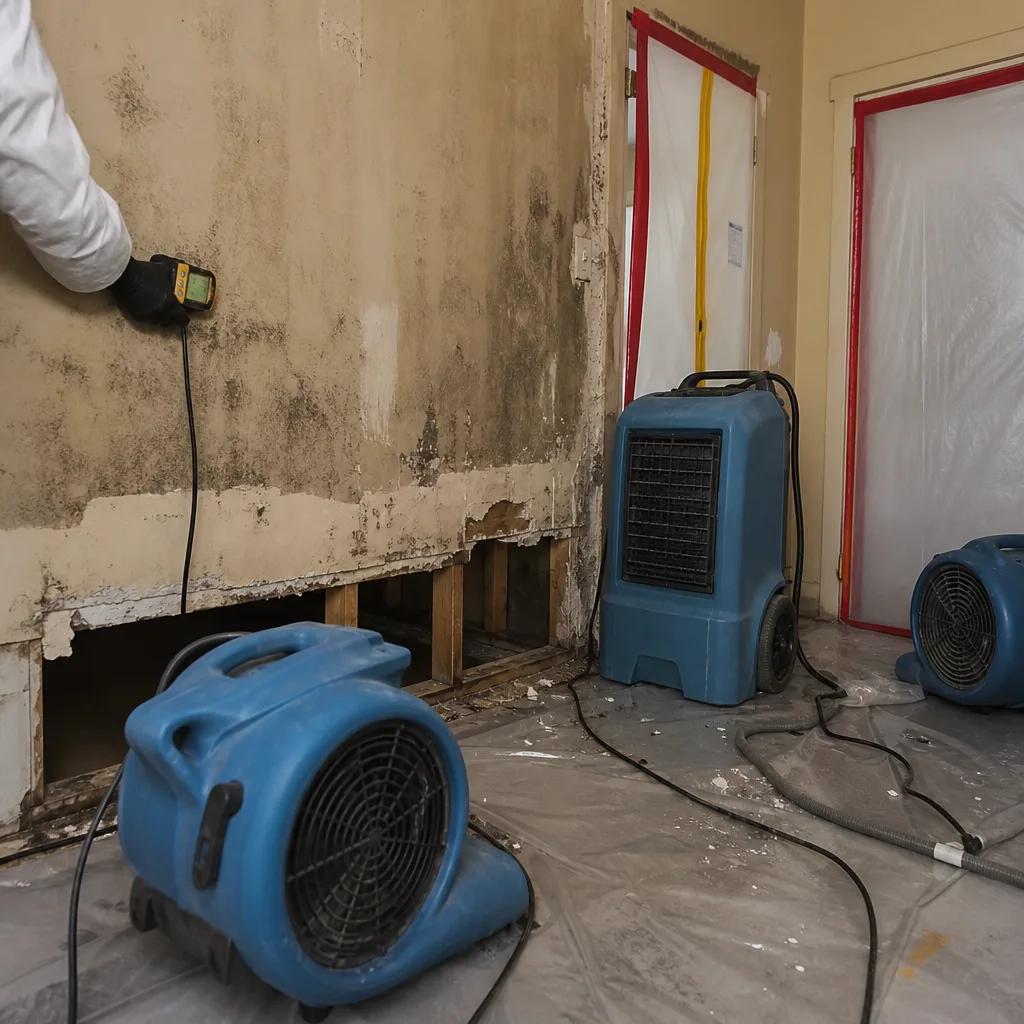 Before
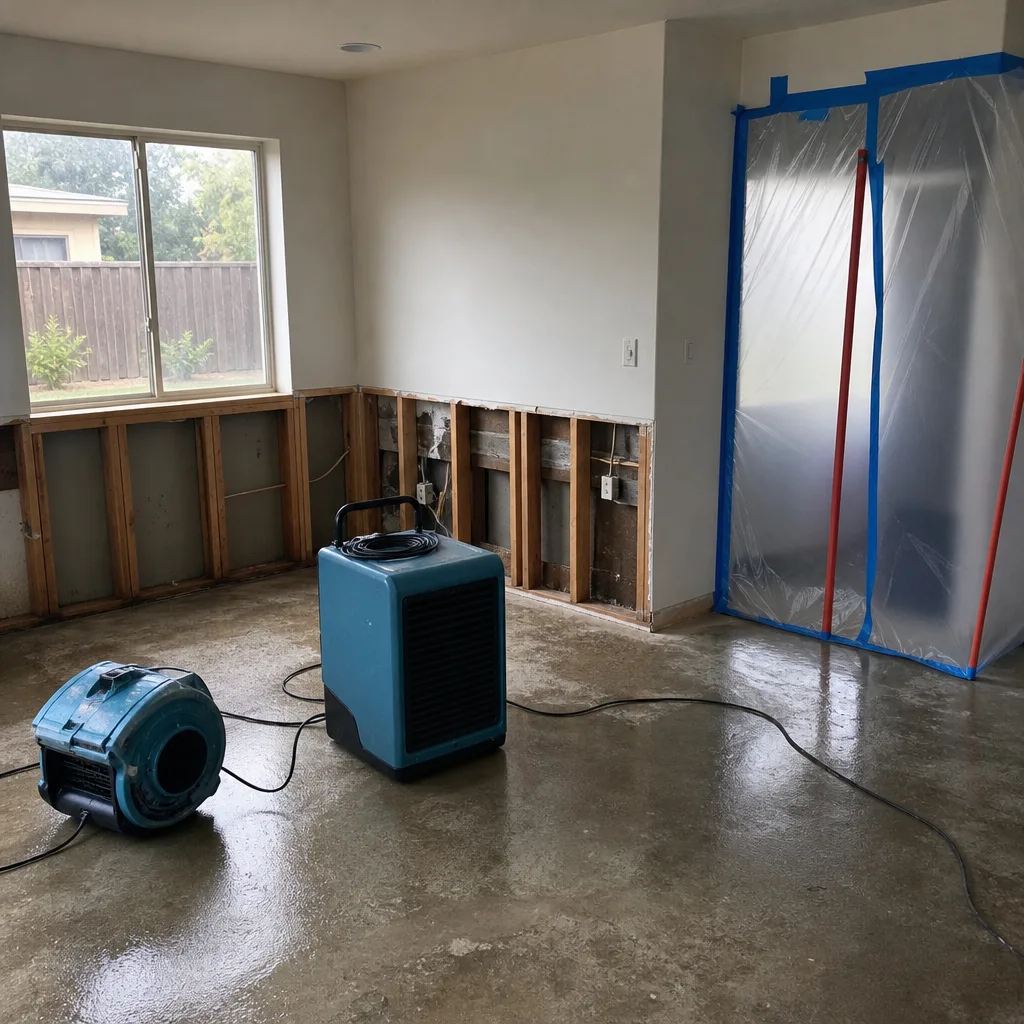 After
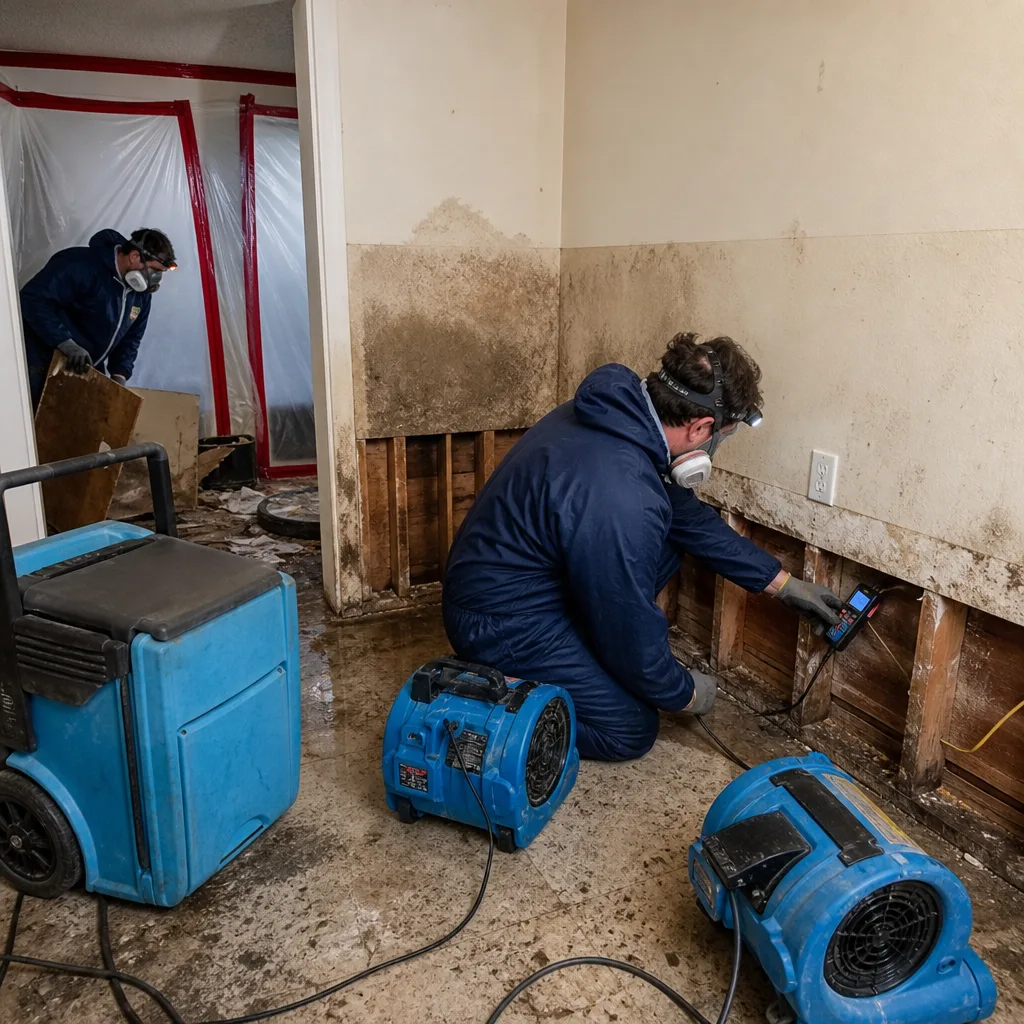 Before
 After
When to Call a Professional
Call a professional restorer when water has been sitting longer than a few hours, when the source is inside a wall or ceiling, when water has spread across more than one room, or when the water source is anything other than clean supply water. For preparation tips, read our Damage Restoration Emergency Preparedness Guide for Newport Beach Homes. These are the situations where the wet zone is almost certainly larger than the visible damage, and where drying in place without proper equipment invites mold. If the water is from the bay, the ocean, or sewage, don’t attempt any cleanup yourself. Category 3 water requires full containment, removal, and antimicrobial treatment. Guild Water Damage offers free estimates in Newport Beach; call (855) 855-9631 and we’ll assess the scope, explain the sequence, and give you a written plan before any work starts.
Frequently Asked Questions
Structural drying typically takes four to seven days in Newport Beach due to the marine layer’s 70 – 80% relative humidity, which extends drying times by 20 – 40% compared to inland conditions. Full restoration including rebuild depends on the scope, but drying verification happens before any rebuild begins. Call (855) 855-9631 to get an exact timeline for your specific loss.
Most homeowner policies cover sudden and accidental water damage, such as a burst supply line or water heater failure, but not gradual leaks that occurred over months. Coverage depends on your policy language and the water source, and proper documentation from an IICRC-certified restorer significantly improves the claim outcome.
Yes, when conditions allow. Injectidry cavity-drying systems push controlled air inside wall cavities and under subfloors, drying them in place without demolition. This works well for clean water losses caught early, especially in Newport Beach’s older homes with plaster and original finishes that are expensive to replace.
Clean water comes from sanitary sources like supply lines; gray water from appliances like washing machines and dishwashers; black water from sewage backups or coastal flooding. The distinction determines what can be saved and what must be removed. A restorer should classify the water category in writing before work begins.
The marine layer is the cool, moisture-rich air mass that sits over coastal Newport Beach, especially between May and September. It keeps relative humidity high, which slows evaporation and extends drying times. Restoration equipment that works quickly inland operates less efficiently here, which is why drying setups in Newport Beach require more dehumidification capacity and longer run times. Explore more guides & resources on coastal restoration challenges.
No, and in fact you’re better off with one credentialed source. Mold remediation in Newport Beach and water damage restoration are tightly linked, and a company that handles both under one roof eliminates the coordination risk of multiple vendors on the same loss. Guild Water Damage covers water, mold, and fire restoration with a single documented process.
The Bottom Line
Water damage in Newport Beach behaves differently than it does inland. The marine layer slows drying, salt air corrodes copper supply lines in ways that produce slow, hidden leaks, and slab foundations trap moisture that raised homes don’t. The restoration sequence, when done right, accounts for all of these local variables. The right contractor is the difference between a four-day dry-out with documentation your adjuster accepts, and a six-month mold problem that costs double to fix. If you’re dealing with water damage now, or want a second opinion on a quote, call (855) 855-9631. We’ll walk the property, map the moisture, and tell you what the data says, not what the sales pitch hopes you’ll believe.
Written by the team at Guild Water Damage, serving Newport Beach since 2017.