Last updated October 30, 2026
 Water damage drying
 Fire & smoke cleanup
 Mold remediation
 Storm response
 Sewage cleanup
 Reconstruction
Free visual inspection and a written scope of work before any mitigation begins - photos, moisture readings, and drying logs go in your claim file
The scope we write is the scope we bill. Anything new gets shown to you, in writing, before we touch it.
Get your free estimateSeasonal Damage Restoration Care for Newport Beach: Year-Round Homeowner’s Guide
Newport Beach’s driest months, July through September, produce the highest rate of HVAC condensate overflow claims because systems running at peak load push drain lines past their capacity exactly when no one is thinking about water damage. Homeowners here assume mild weather means low risk, but the data from restoration calls tells a different story: four distinct risk windows hit coastal Orange County every year, each driven by a different mechanism, and each one catches unprepared properties on schedule. This guide maps the actual seasonal risk calendar for Newport Beach, from atmospheric rivers to Santa Ana pressure swings, and gives you the inspection protocols and documentation habits that keep a small issue from becoming an insurance claim. By the end, you’ll know what to check, when to check it, and where most homes in this city fail first.
Quick Answer
Seasonal damage prevention in Newport Beach requires attention to four specific risk windows: winter atmospheric rivers that test drainage and flashing, spring marine-layer condensation that collects inside exterior walls, summer HVAC condensate overflow that damages ceilings, and fall Santa Ana pressure events that drive moisture through envelope gaps and stress supply lines. Most damage in this city is seasonal and predictable, which means a simple inspection calendar and a consistent property log are the two highest-return habits a homeowner can adopt. Start with the season you’re in, and work backward through the risk windows you’ve missed.
Restoration work we handle
Table of Contents
- Winter (November – March): Atmospheric River Season
- Spring (April – June): June Gloom Condensation and Vapor Management
- Summer (July – September): Peak HVAC Load and Condensate Overflow
- Fall (October – November): Santa Ana Winds and Soil Settlement
- Year-Round: The Property Log That Makes Claims Clean
- Common Mistakes to Avoid
- When to Call a Professional
- Frequently Asked Questions
Winter (November – March): Atmospheric River Season
Atmospheric rivers are narrow bands of concentrated moisture that form over the Pacific and deliver most of Southern California’s annual rainfall in a handful of multiday events. For Newport Beach homeowners, the risk isn’t the total rainfall volume, it’s the intensity: water arrives faster than drainage systems designed in the 1960s and 1970s can handle. Low-lying Balboa Peninsula properties face street-grade drainage failures that back water up against foundation walls. Homes on the bluffs and in Newport Heights deal with wind-driven rain finding every improperly flashed window, deck transition, and roof penetration.
The flat-roof deck is the single most common winter failure point we see in Newport Beach. Most were built or modified decades ago, waterproofed with materials that have a finite service life, and then left untouched because they look fine from the inside. Water pools against worn membrane seams, finds a pinhole, and travels horizontally through the assembly before it ever shows up as a ceiling stain. By the time you see it, the deck substrate is saturated and often requires structural drying, not just surface repair.
Winter Inspection Protocol
- Check all roof penetrations: vents, skylights, plumbing stacks, and the transitions where flat decks meet pitched roof sections. Look for cracked sealant, lifted flashing, and debris dams that hold water against seams.
- Clear and test drainage: balcony drains, scuppers, downspouts, and the area drains on grade-level patios. A clogged scupper on a roof deck sends water over the edge, down a stucco wall, and into window framing.
- Inspect window and door flashing: especially on south- and west-facing elevations where winter storms drive rain. Push on the stucco around window corners; if it flexes or sounds hollow, water may already be behind it.
- Walk the yard during daylight rain: not after, during. You’re looking for ponding against the foundation, water running toward the house, and gutters overflowing at specific points.
- Check the interior baseboards on exterior walls: after any storm with sustained wind. Run your hand along the baseboard and the drywall just above it, feeling for cool spots, swelling, or bubbling paint.
For homes in the Harbor View, Newport Heights, and the older sections of Corona del Mar, winter is when latent storm damage from previous years reveals itself. A small leak that happened in a prior season may have dried on the surface while continuing to degrade framing, insulation, and drywall paper behind the wall. If you find water staining that seems old but can’t confirm when it happened, a moisture reading with professional-grade equipment will tell you whether the cavity is actively wet or simply stained from a past event. Guild Water Damage’s Water Damage Restoration in Newport Beach process starts with that exact assessment: document, measure, and scope before anyone starts cutting.
Spring (April – June): June Gloom Condensation and Vapor Management
June Gloom is the marine layer that sits over coastal Orange County through late spring and early summer, keeping temperatures in the low 60s and relative humidity above 80% for weeks at a time. The damage mechanism here is quieter than a storm. It’s condensation, and it accumulates inside exterior wall assemblies of homes that lack adequate vapor management. Interior air conditioned to 68°F meets exterior air at 60°F and 85% humidity against a wall cavity, and the dew point lands inside the wall. Moisture forms on the backside of the interior drywall, soaks into insulation, and creates the conditions where mold becomes active in six to ten days.
Newport Beach homes built before modern building envelope codes often have no exterior vapor barrier, minimal insulation, or both. Homes built in the 1970s and 1980s in neighborhoods like Baycrest and Westcliff are particularly susceptible: open beam ceilings, minimal wall insulation, and stucco systems not designed for month-long humidity saturation. The moisture problem isn’t a leak you can find and fix. It’s an environmental condition that repeats every year until the wall assembly is corrected.
What to Look For in Late Spring
- Condensation on interior window glass that persists past mid-morning, especially on north- and east-facing windows.
- A musty, earthy smell in closets on exterior walls, in built-in cabinetry, or behind furniture that sits against exterior walls.
- Visible mold growth on the back corners of closets, on the underside of window sills, or on baseboards in rooms that get minimal airflow.
- Buckled or swollen drywall in areas where no plumbing exists, pointing to cavity moisture rather than a pipe leak.
- Paint that peels in sheets rather than chips: that’s a sign of moisture pressure behind the paint film.
The most practical spring habit for coastal Newport Beach is a twice-daily ventilation routine during marine layer season: open windows for 30 minutes in the late morning when humidity typically drops, then close them and run exhaust fans when cooking or showering. If you have a whole-house fan or HRV, run it. These habits don’t fix a poorly designed wall assembly, but they keep surface condensation manageable, and they buy you time to plan a real solution. When we encounter active mold conditions from persistent condensation, our Mold Remediation in Newport Beach team begins with containment and moisture source correction before any removal work begins. Treating the mold without addressing the vapor drive is a guarantee it returns next spring.
Summer (July – September): Peak HVAC Load and Condensate Overflow
The counterintuitive risk season in Newport Beach is the dry one. Air conditioning systems run at peak load from July through September, and the condensate they produce has to go somewhere. A small residential system can generate five to twenty gallons of condensate per day in coastal humidity. The primary drain line, a 3/4-inch PVC pipe, carries that water to the nearest drain or the exterior. The drain pan under the air handler catches overflow if the primary line clogs. But if both fail, or if the pan rusts through, or if the secondary drain was never properly installed, twenty gallons a day goes straight through the ceiling.
We see this exact scenario every summer in Newport Beach: a homeowner notices a water stain on the ceiling of a downstairs hallway or closet, directly below an attic or second-floor mechanical closet. The stain spreads over a week. By the time they call, the drywall is soft, the insulation above it is soaked, and the HVAC system has been leaking for days or weeks. The fix starts with clearing or replacing the drain line, but the restoration work involves drying the ceiling cavity, repairing drywall, and checking for mold in the warm, wet, dark space above the stain. That’s a full water damage restoration in Newport Beach scope, not a handyman patch.
Condensate Line Inspection Protocol
- Locate the primary drain line where it exits the house. It’s usually a PVC pipe dripping water near the condenser unit or into a bathroom sink drain.
- Check the drip rate on a hot day: a steady drip is normal. No drip when the AC is running hard means the line may be backed up and water is pooling somewhere else.
- Inspect the drain pan under the air handler. If it’s rusted, dented, or has standing water, the secondary drain is compromised. A pan that’s wet when the primary line is dripping normally indicates the primary is partially clogged.
- Check for a float switch in the pan. If your system has one, test it by lifting the float. The system should shut off. If it doesn’t, the switch is dead and you’re running without a safety cutoff.
- Look at the ceiling below the unit. Any discoloration, even faint, means water has already overflowed at some point. The time to act is now, not when the stain spreads.
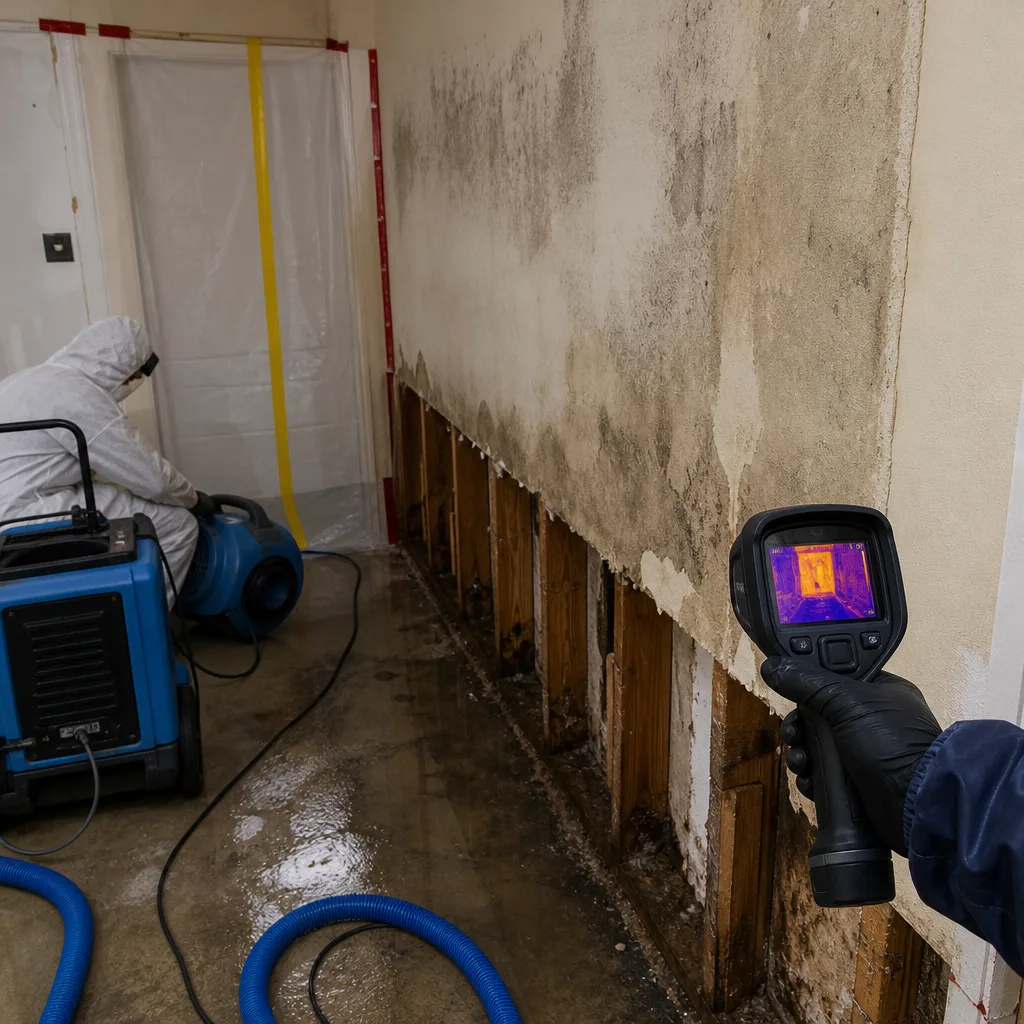
Professional-grade equipment matters here. A standard homeowner moisture meter reads relative moisture in drywall, but the real question is whether the ceiling cavity is actively wet and how far the water has traveled. We run Dri-Eaz and Phoenix meters with penetrating probes and thermal imaging to map the actual wet zone, then dry it with targeted airflow rather than tearing out more drywall than necessary. The IICRC-certified process means following documented drying standards, and that’s what turns a three-day dry-out into a one-week full resolution instead of a three-week guessing game.
Fall (October – November): Santa Ana Winds and Soil Settlement
Santa Ana winds hit in two waves of damage: first the wind event itself, then the soil settlement that follows weeks later. The wind is the obvious one. Sustained gusts from the northeast can reach 50 to 70 mph through the canyons and passes that feed Newport Beach, and they create a strong negative pressure differential across the building envelope. Warm, dry, high-pressure air outside pulls interior air through every gap in the building shell: window frames, door seals, electrical penetrations, can lights, and the transitions between wall and floor where sill plates don’t seal tightly to the foundation. If there’s moisture anywhere in the wall cavity from prior seasons, the Santa Ana pressure differential actively pulls that moisture out of the cavity and into the living space, carrying mold spores and odor with it.
The second damage mechanism takes longer. Santa Ana episodes strip soil moisture from the ground, especially in the clay-rich soils that underpin older Newport Beach neighborhoods. Clay expands when wet and contracts when dry. Extended dry periods cause the soil to shrink and pull away from foundation walls, which changes the load-bearing profile under the slab or footing. The result is differential settlement: one corner of the house settles a quarter-inch while the other stays put. A quarter-inch doesn’t sound like much, but it’s enough to crack rigid supply lines, pull pipes out of fittings, and open hairline gaps in stucco that the next winter’s rain will exploit.
Fall Inspection Sequence
- After any Santa Ana wind event, walk the exterior and check for lifted flashing, damaged roof tiles, and any place where wind-driven debris may have scoured a surface.
- Inspect the foundation perimeter for new cracks or widening of existing ones. Mark cracks with a pencil line and date, so you can track movement over time.
- Check all hose bibs and supply lines in exterior walls for any sign of weeping, drips, or corrosion at joints. A hairline crack in a rigid copper line under slab is one of the most expensive repairs a homeowner can face.
- Walk every room and check door fit. Doors that stick or swing open on their own are often a sign that a floor or wall has shifted.
- Run a smoke test or use a stick of incense around window and door frames on a breezy day. Wherever the smoke is drawn outward in a thin stream, you have an air leak that the next winter storm will push water through.
For homes in the Cliffs and Cameo Highlands neighborhoods, where foundations sit on transition zones between different soil types, fall is when we see slab leak calls spike. The insurance conversation is harder here than it needs to be: many policies cover the water damage but not the leak itself, and the distinction between “sudden and accidental” and “gradual deterioration” becomes the battleground. Documented seasonal inspections, with dated notes and photographs, are the difference between a covered loss and a denied claim. Guild Water Damage handles water damage, mold remediation, and fire damage restoration as a single credentialed contractor, which means one scope of work and one point of contact for the adjuster. When you’re documenting for a seasonal log, that consistency matters.
Year-Round: The Property Log That Makes Claims Clean
A property log isn’t a diary. It’s a dated record of observations, inspections, and conditions that creates a factual baseline you can point to when something goes wrong. The most expensive sentence in restoration is “I’m not sure when this started.” Insurance adjusters need to distinguish between sudden events and long-term conditions, and clean documentation makes that distinction in your favor. More than that, a log helps you spot trends: a moisture reading that creeps up each spring, a crack that widens every fall, a drain line that drips slower every summer.
The log doesn’t need to be elaborate. A spreadsheet or a simple notebook with four columns: date, area inspected, observation, and action taken. Do the seasonal walkthroughs described in this guide, record what you see, and photograph anything unusual with a date stamp. Store it in the cloud so it survives a fire or flood. Twice a year, do a comparative review: what was normal last October, and what’s different this October?
What to Include in a Property Log
- Baseline moisture readings taken in the same locations each season: exterior walls, under sinks, near the water heater, and at the base of any wall where you’ve seen past staining.
- Photos of every inspection with dates in the filename. Wide shots for context, close-ups for detail.
- Any repair, no matter how small. A tightened fitting in March explains why a leak didn’t happen in December.
- HVAC service dates and drain line cleaning records. These are the receipts that prove maintenance when an adjuster asks.
- Weather events that affected the property: heavy rain amounts, wind speeds, power outages. Correlating conditions with observations helps identify patterns.
- Contractor visits: who came, what they did, and what they found. Even a handyman replacing a faucet washer belongs in the log.
The IICRC-certified process we follow at Guild Water Damage relies on documentation as much as equipment. A moisture map from a Dri-Eaz penetrating meter, thermal imaging from a Phoenix camera, and written psychrometric readings create a record that stands up to adjuster scrutiny. Your property log is the homeowner’s version of the same principle: measure, document, and establish a base line before the loss happens. When a loss does happen, the log is the first thing we ask for. It changes the conversation from “what happened and how long has this been going on?” to “here’s exactly what we’re dealing with.”
Common Mistakes to Avoid
- Assuming a mild climate means low risk. Newport Beach’s four risk windows are driven by specific seasonal conditions, and the dry months are often the most damaging. A home that never sees a hurricane can still be taken out by a clogged condensate line.
- Ignoring small stains on ceilings or walls. A faint discoloration under an attic air handler is an early warning that water has already escaped its containment. Waiting until it spreads is waiting until remediation costs triple.
- Treating mold as a surface cleaning problem. If you see mold on a wall, the active growth is almost certainly deeper in the cavity. Bleach and paint don’t address the moisture source, and the mold returns within months. Proper containment and source correction are the only durable fix.
- Not documenting seasonal observations. “I noticed that crack last year but didn’t write it down” is a phrase that turns a covered claim into a denied one. Dated notes and photos are cheap insurance.
- Running HVAC systems with neglected drain lines. The $12 PVC line is the difference between normal operation and a ceiling collapse. Clean it or have it cleaned before peak season, every year.
- Waiting for the rainy season to plan drainage improvements. The time to fix a grading issue or replace a scupper is in June, not in the middle of an atmospheric river event. Contractors are available, materials are stocked, and you’re not competing with every neighbor who just watched water pour over a balcony.
- Dismissing the Santa Ana season as a fire risk only. Yes, fire danger goes up. But for the homeowner who hasn’t checked supply lines and foundation performance, the wind event is just the opening move in a sequence that ends with a slab leak in November.
When to Call a Professional
Call a professional when you find active water intrusion you can’t immediately trace and stop, when you see mold growth larger than roughly ten square feet or mold in an HVAC system, when a ceiling stain is growing or accompanied by sagging, or when you suspect a slab leak because water appears in odd places with no plumbing nearby. Fire and smoke damage always warrants professional assessment because the damage extends into wall cavities and ductwork well beyond what’s visible. In these scenarios, the cost of a professional inspection is always less than the cost of guessing wrong. Guild Water Damage offers free estimates in Newport Beach; call (855) 855-9631 and we’ll assess the situation with the same IICRC-certified process and professional-grade equipment we’d want used on our own homes.
Frequently Asked Questions
Four times per year, once at the start of each season, with the specific checklist for that season: drainage and flashing in winter, condensation and vapor in spring, HVAC condensate lines in summer, and foundation plus envelope gaps in fall. Most Newport Beach homes develop damage on seasonal cycles that are predictable, so four targeted inspections catch issues before they become claims.
Many policies cover the resulting water damage but not the mechanical failure that caused it, which means your ceiling restoration is reimbursable while the drain line repair is out of pocket. But the distinction hinges on maintenance: if the adjuster determines neglect, the entire claim can be denied, which is why a documented drain line cleaning history is worth keeping. Call (855) 855-9631 for a free assessment before you file, and we’ll help you document the loss correctly.
For active water intrusion, time matters, and the response window in Newport Beach is typically within hours when you call a local restoration contractor directly. Every hour of standing water increases the likelihood that porous materials become permanently damaged and that mold conditions develop. Call (855) 855-9631 and we’ll get a technician out to assess the situation, stop the water, and start professional-grade drying.
Visible mold on drywall almost always means active growth in the wall cavity behind it, and surface cleaning alone leaves the source intact. Professional mold remediation in Newport Beach involves containment to prevent spore spread, removal of contaminated porous materials, and correction of the moisture condition that allowed growth to start. Without all three, the mold returns, usually within the same season.
Yes, and it does every year in coastal Newport Beach homes that lack proper vapor management. Persistent high humidity, interior air conditioning, and a wall assembly without adequate vapor control together create conditions where moisture condenses inside the wall cavity, not on the visible surface. The result is hidden mold growth and gradual drywall degradation that homeowners often misattribute to leaks.
Look for IICRC certification, which is the restoration industry’s most recognized technical credential, plus professional affiliations like RIA membership that signal adherence to a code of ethics. IICRC-certified firms follow documented drying standards and produce the kind of technical documentation adjusters expect. Guild Water Damage combines those credentials with professional-grade equipment from Dri-Eaz, Phoenix, and Injectidry, including non-invasive cavity-drying technology that preserves more of your home while the claim is processed.
The Bottom Line
Seasonal damage in Newport Beach isn’t random. It follows a calendar: atmospheric rivers in winter, condensation in spring, condensate overflow in summer, and pressure-plus-settlement in fall. The homeowners who avoid the worst outcomes treat inspection as a recurring appointment, not a reaction to visible damage. Four seasonal walkthroughs, a simple property log, and documented maintenance records are the difference between a contained issue and a full restoration. And when an issue does surface, credentialed restoration with professional-grade equipment and non-invasive drying methods preserves more of your home and keeps your claim clean. For a free estimate in Newport Beach, call (855) 855-9631.
Written by the team at Guild Water Damage, serving Newport Beach since 2017.
See the difference
 Before
 After
 Before
 After
 Before
 After