Last updated October 30, 2026
 Water damage drying
 Fire & smoke cleanup
 Mold remediation
 Storm response
 Sewage cleanup
 Reconstruction
Free visual inspection and a written scope of work before any mitigation begins - photos, moisture readings, and drying logs go in your claim file
The scope we write is the scope we bill. Anything new gets shown to you, in writing, before we touch it.
Get your free estimateWater Damage Restoration Troubleshooting: Common Problems and How to Fix Them
A dehumidifier humming in a wet room is not proof the room is drying. It’s proof the machine is on. Without grain depression calculations and daily moisture mapping against IICRC drying goals, you have no way to know if the job is progressing or quietly stalling. This guide gives Newport Beach homeowners a practical framework—alongside our The Complete Guide to Damage Restoration in Newport Beach—to verify that their restoration is actually working, what to check when it isn’t, and the documentation you should demand at every inspection checkpoint. We’ll cover psychrometric readings, hidden moisture pockets, coastal EMC correction factors, and the five most common reasons drying stalls. If your restoration feels stuck, this is how you confirm it.
Quick Answer
When our Water Damage Restoration services aren’t working, the drying system has almost always stopped hitting its IICRC drying goals, which means grain depression has stalled, hidden moisture pockets were missed, or equipment is undersized for the vapor load. The fix starts with daily moisture readings against a written drying plan, a psychrometric check for GPP and dew point trends, and a hard look at whether cavities, subfloors, or HVAC systems are reintroducing moisture. If your contractor cannot produce moisture maps and equipment logs showing measurable daily progress, the job is running on hope, not data.
Restoration work we handle
Table of Contents
- How to Read a Psychrometric Report and Know If Drying Is Actually Working
- The Five Most Common Reasons Drying Stalls
- How to Spot Secondary Damage Developing During Restoration
- Why Newport Beach Moisture Readings Need EMC Correction
- Documentation to Demand at Every Inspection (and Red Flags If It’s Missing)
- What a Homeowner Can Safely Check Between Contractor Visits
- Equipment Specifications That Actually Matter for Drying Performance
- How to Use Documentation to Keep Your Insurance Claim Moving
How to Read a Psychrometric Report and Know If Drying Is Actually Working
A psychrometric report is the single most important document in a water damage restoration job, and most homeowners never see one. It measures the relationship between temperature, relative humidity, and moisture content in the air, expressed in grains per pound (GPP). When drying is working, the GPP inside the affected area should drop steadily day over day, and the dew point should track downward. When drying is stalled, the GPP flatlines or rises while equipment keeps running.
Here is what the key numbers mean on a psych chart:
- Grains per pound (GPP): The actual amount of moisture in the air. A healthy drying environment in coastal Newport Beach might start at 70-85 GPP and drop toward 50-60 GPP as the structure releases moisture. If GPP isn’t falling, water is still entering the air faster than the dehumidifier can remove it.
- Grain depression: The difference between the GPP of the air entering the dehumidifier and the GPP of the air leaving it. A professional-grade Phoenix dehumidifier should deliver meaningful grain depression. If the depression is near zero, the unit is either undersized, frozen, or the air is so saturated the unit cannot keep up.
- Dew point: The temperature at which condensation forms. If the dew point inside the structure approaches the surface temperature of walls or subfloor, condensation recurs and drying stops. This is a classic stalled-job signature.
- Relative humidity (RH): Useful for comfort, but misleading for drying decisions. RH changes with temperature even when absolute moisture stays the same. A crew that only checks RH is not doing psychrometric work.
In our experience on Newport Beach losses, the most common psychrometric failure is running a dehumidifier sized for a 500-square-foot room in a 1,200-square-foot affected area with open doorways and a connected hallway. The unit runs constantly, the GPP never drops because the vapor load exceeds the equipment’s removal capacity, and the technician keeps writing “drying in progress” on the log. That is not progress. That is a machine running.
The fix is straightforward: demand a written psychrometric baseline at the start of the job, then daily GPP readings compared against that baseline. IICRC drying goals require measurable daily moisture removal. If the numbers are not moving, the drying plan is failing and needs adjustment, not more time.
The Five Most Common Reasons Drying Stalls
When a restoration job stalls, the cause is almost always one of five problems. Each one is identifiable with basic instruments, and each one has a specific correction. A restoration company running documented IICRC-certified processes will check all five before telling you the job is “on track”—a standard we detail further in Choosing the Right Damage Restoration Brand: A Buyer’s Guide for Newport Beach.
1. Undersized Equipment
The most common stall cause we see in Newport Beach homes is a dehumidifier or air mover sized for a smaller vapor load than the structure actually contains. Water trapped in drywall, hardwood, and subfloor releases moisture over days, not hours. If the equipment was sized based on square footage alone without accounting for material saturation, the system falls behind and never catches up. The correction is a load calculation that accounts for affected materials, not just room dimensions, and typically means adding a second professional-grade unit like an XPOWER air mover or a higher-capacity Phoenix dehumidifier.
2. Incorrect Negative Air Pressure
Containment and air pressure matter. If a drying chamber is supposed to be under negative air pressure and the technician sets it neutral or positive, moist air escapes into unaffected areas and new air enters the chamber, which adds vapor load and contaminates clean spaces. The fix is a micromanometer reading at setup and daily verification. A proper negative air pressure setup should hold steady; if it drifts, the containment is compromised.
3. Hidden Cavity Moisture
Water travels inside wall cavities, under cabinetry, behind baseboards, and beneath flooring systems. Surface readings can look fine while the cavity behind the drywall holds 30% moisture content and is actively growing mold. This is where Injectidry cavity-drying technology changes outcomes. Instead of tearing out drywall to reach the cavity, a professional restoration crew can insert drying mats into wall cavities and subfloor spaces, driving warm, dry air through the hidden space and pulling moisture out through the panel. Without this capability, a contractor either tears out everything or, worse, closes up the wall with moisture still inside. The repair scope expands and the mold risk compounds.
4. HVAC Recirculation Contamination
If the HVAC system ran during the water event or was exposed to standing water, the ductwork and coils can hold moisture and distribute mold spores through the home. Running the HVAC during drying can also pull humid air from the affected area and push it into unaffected rooms. The correction is to seal off supply and return registers in the affected zone, inspect the ductwork, and run the system only when it has been cleaned and dried or when the drying plan explicitly accounts for it. A technician who never checks the HVAC is skipping a major moisture pathway.
5. Unsealed Exterior Penetrations
Newport Beach homes face a coastal environment where the ambient outdoor humidity is routinely high. Any unsealed exterior penetration, a leaky pipe chase, a gap around a vent, an open crawl space door, lets that humid air into the drying chamber. The dehumidifier then fights outdoor moisture instead of structural moisture. The fix is a methodical inspection of every exterior penetration in the affected zone and sealing them before the drying system is sized and started. In our coastal climate, skipping this step guarantees an uphill battle.
How to Spot Secondary Damage Developing During Restoration
Secondary damage is the restoration mistake you don’t see for weeks. The initial water is gone. The surface feels dry. Then the paint bubbles, the hardwood cups, the baseboards ghost, and you realize moisture was trapped the whole time. Here is what each symptom indicates and what to do when you spot it.
- Efflorescence: A white, chalky residue on concrete floors or masonry walls. It means water moved through the material and deposited mineral salts on the surface as it evaporated. In restoration, it signals that moisture is still migrating through the slab or wall even after the visible water is gone. If efflorescence keeps reappearing after cleaning, the concrete is still actively drying or there is a pressure-driven moisture source.
- Ghost lines: Dark or light outlines along studs, joists, or drywall seams. These appear when thermal bridging and moisture differentials cause condensation or particle deposition on the cooler, wetter framing surfaces. Ghost lines are a strong sign of hidden cavity moisture, exactly the kind of condition that benefits from Injectidry cavity drying rather than surface drying alone.
- Cupped hardwood: Hardwood planks that curl upward at the edges. Cupping happens when the underside of the board holds more moisture than the top surface. It is a subfloor drying problem, not a surface drying problem. If a contractor only runs air movers across the top of the floor, the cupping worsens even as the surface dries. The correction is subfloor drying with a panel-drying or cavity-drying system.
- Paint bubbling or peeling: Moisture trapped behind paint film pushing outward. It often appears weeks after the job closes and indicates the wall was painted or repaired before the substrate reached the target moisture content. The correction is moisture verification before any cosmetic repair, with readings taken at the deepest point of the material, not just the surface.
In our experience, these four symptoms share a root cause: the drying plan treated the surface as the finish line. A properly documented restoration treats the deepest affected material as the finish line and keeps drying until every layer hits the IICRC drying goal. If you see any of these symptoms developing during an active restoration, photograph them immediately. They are evidence the drying plan needs adjustment and documentation you may need for the insurance claim.
Why Newport Beach Moisture Readings Need EMC Correction
Moisture meters are not magical. They measure the moisture content of a material relative to its dry standard, which for wood is typically calibrated at 8-12% moisture content. But that calibration assumes the material’s equilibrium moisture content (EMC) matches an inland, moderate-humidity environment. In Newport Beach, where the ambient relative humidity routinely sits above 70%, wood and other hygroscopic materials settle at a higher natural baseline. A moisture reading of 12-14% on hardwood in a coastal home may be completely normal for that environment, not evidence of active water damage.
Here is the practical problem: a technician who does not apply EMC correction factors will either under-dry the structure, because they think the material is already at target when it isn’t, or over-dry it, because they keep chasing an inland target that the coastal material will never reach. Both errors create problems. Under-drying leaves hidden moisture that feeds mold. Over-drying wastes days, money, and can over-stress hardwood and cabinetry.
The fix is a specific step: before any drying plan is written, the technician takes baseline moisture readings from an unaffected area of the same material in the same home. That baseline, not a generic industry number, becomes the drying target for the affected materials. If the unaffected hardwood in your Newport Beach home reads 13%, the affected hardwood needs to return to 13%, not 9%. A restoration company that skips this step is applying a generic template to a coastal reality.
Our IICRC-certified process includes EMC correction on every coastal job. It is one of the details that separates a documented, repeatable restoration from a guess.
Documentation to Demand at Every Inspection (and Red Flags If It’s Missing)
Documentation is the difference between a restoration that can be verified and one that runs on the contractor’s word. The IICRC standard expects a written drying plan, daily moisture readings, and an equipment log. If your contractor cannot produce these on request, that is not a paperwork problem. It is a process problem.
Here is what you should see at each inspection checkpoint:
- Moisture map: A room-by-room diagram showing affected materials, the moisture reading at each location, and the target reading for that material. The map should be updated daily, not copied forward. A moisture map that shows the same numbers day after day is a stall in progress.
- Equipment log: A dated record of every piece of equipment on site, its location, and its running status. If a dehumidifier was added or moved, the log shows it. This log is also critical for insurance substantiation of equipment charges.
- IICRC drying goal worksheet: The written drying goals for each affected material, based on the baseline EMC reading and the material type. Without this worksheet, “dry” is a subjective word.
- Psychrometric readings: Daily GPP, grain depression, dew point, and temperature readings for the affected area and the ambient outdoor air. These numbers tell you if the drying system is actually removing moisture or just running.
Red flags to watch for: a technician who only checks surface moisture with a non-penetrating meter and never takes deep readings; a drying log that shows “in progress” without numeric data; a crew that cannot explain what grain depression is; a contractor who wants to start drywall repair without showing you their moisture map. None of these are acceptable on a job that is supposed to be restoration, not guesswork.
What a Homeowner Can Safely Check Between Contractor Visits
You don’t need to become a restoration technician, but there are simple checks you can do between visits to verify the job is moving. These are observation-based, require no specialized tools, and give you data to discuss with your contractor if something looks off.
- Document the equipment daily: Take a photo of every air mover and dehumidifier in place. Note if equipment has been moved, unplugged, or turned off. If a unit is running and you see no water in the collection tray after a full day, it may be frozen or not condensing.
- Check for condensation on windows or walls: Condensation inside the drying area means the dew point is too high and the drying environment is saturated. The system is not keeping up.
- Watch for new odor: A musty smell that appears during drying, especially in a room that previously smelled fine, suggests mold activity in a hidden cavity or wet material. Report it immediately.
- Look at the dehumidifier’s discharge air: The air leaving the unit should feel warm and dry. If it feels cool and humid, the unit is not removing moisture effectively.
- Keep a simple daily note: Date, time, what you observed, and any changes. This simple log becomes powerful evidence if the claim is disputed or the job stalls.
These checks are not a replacement for professional moisture readings. They are a homeowner’s early warning system. If your daily notes show three days of no visible change and your contractor cannot show you a moisture map with falling numbers, it is time to stop waiting and start asking harder questions.
Equipment Specifications That Actually Matter for Drying Performance
Restoration equipment is not all the same, and the difference is not brand loyalty. It is output capacity, air movement, and water removal rate. When you hear a contractor say “we have commercial equipment,” that is a start, but the specifications matter more than the category.
Professional-grade dehumidifiers like the Phoenix line are built for continuous operation over weeks, with grain depression capabilities that consumer units cannot match. A consumer dehumidifier from a big-box store might remove 30 pints a day in ideal conditions. A professional Phoenix unit removes several times that volume under load, and it maintains that output in cool, saturated environments where consumer units freeze or throttle. The difference is not marginal. It is the difference between drying a structure in five days and stalling for three weeks.
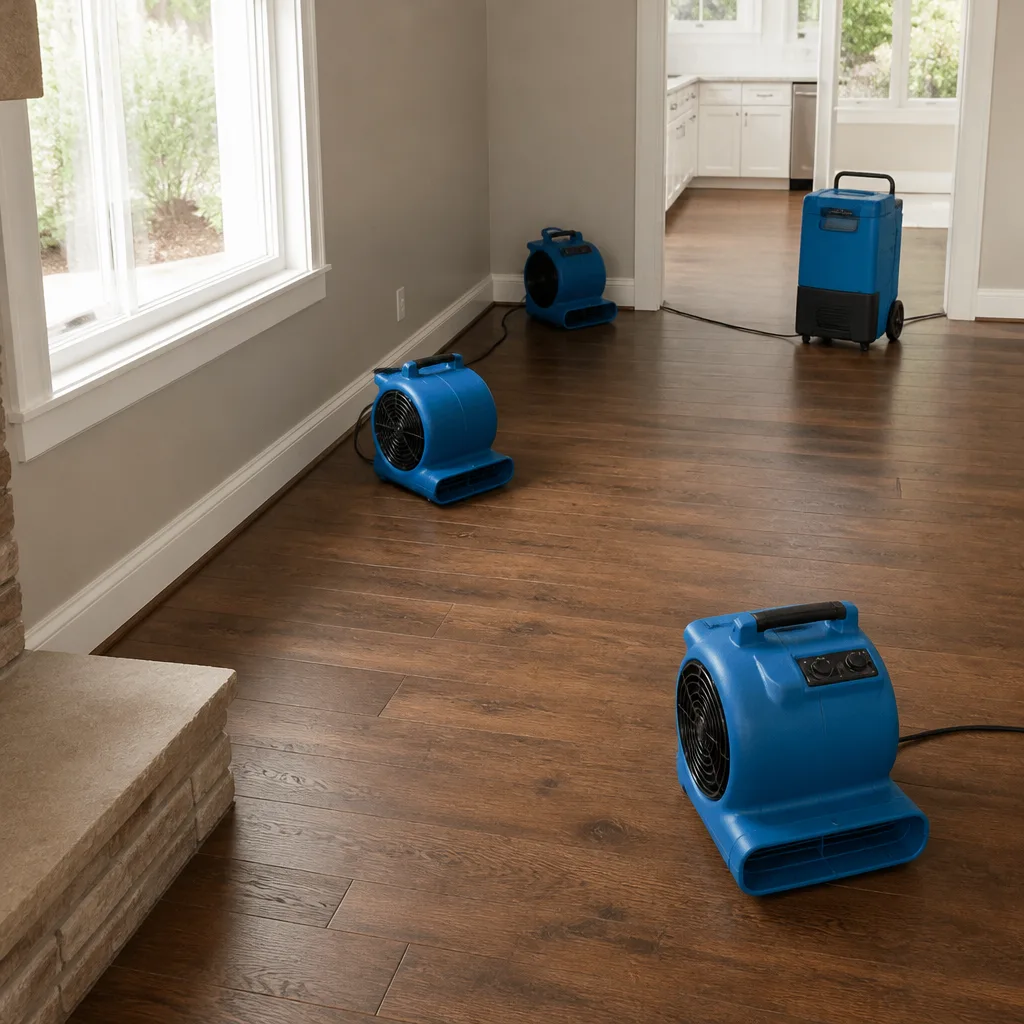
Air movers are similarly specific. An XPOWER air mover is a high-velocity axial fan designed to create airflow across surfaces at a rate that accelerates evaporation. The placement matters: air movers should be angled at 15 to 45 degrees against walls, positioned to create a vortex pattern, and placed every 10 to 16 linear feet along affected walls. If the crew puts four fans in a room and calls it a day, they are not following air movement engineering. The placement and angle determine whether the water in the material actually evaporates into the air where the dehumidifier can remove it.
Then there’s the B-Air blower used in containment, the negative air pressure systems, and the Injectidry mats for cavity drying. Each serves a specific function, and each must be sized and placed for the specific structure, not pulled from a template. In our Newport Beach restoration work, we match specific equipment to the material types and moisture load of each job, because a balanced drying system is engineered, not rented.
How to Use Documentation to Keep Your Insurance Claim Moving
Insurance adjusters work from documentation. The more data your restoration contractor produces, the smoother the claim. When a claim stalls, it is often because the restoration company submitted a vague invoice with no supporting data, and the adjuster has nothing to verify against the policy’s coverage requirements.
Here is how to use the documentation from this guide in the claims process:
- Share the moisture map with your adjuster: It shows the affected area was real, measured, and tracked. It establishes the scope.
- Submit the equipment log: It substantiates the restoration company’s equipment charges and shows the job was run with professional-grade tools, not a rented fan.
- Forward the psychrometric readings: They prove the drying system was working and the job hit its targets, which reduces the chance of a later dispute about whether the work was done correctly.
- Keep your daily homeowner notes: If there is ever a dispute about the timeline, your dated observations are independent evidence.
A restoration company that cannot produce this documentation is creating claim risk for you. A company that produces it without being asked is running an auditable process, the Guild standard we apply on every job. For more guides & resources on what to expect, see our blog. Insurance claims in Newport Beach often involve coastal moisture complications, and clean documentation answers the adjuster’s questions before they are asked.
Common Mistakes to Avoid
- Confusing equipment noise with drying progress: Running fans and dehumidifiers is not evidence of moisture removal. If the GPP is not dropping, the equipment is just consuming electricity.
- Ending drying based on surface touch: “Feels dry” is not an IICRC drying goal. The deepest affected material must hit its target moisture content, verified with a penetrating meter.
- Skipping EMC baseline readings in coastal homes: Newport Beach humidity means wood settles at a higher moisture level. Without a local baseline, the drying target is wrong from day one.
- Closing walls before cavity moisture is verified: If the technician does not check inside wall cavities and subfloors, mold can develop behind fresh paint and new drywall.
- Accepting “drying in progress” without numbers: A drying log that doesn’t show daily moisture readings is not documentation. It’s a status message.
- Not photographing everything: From the initial damage to the daily equipment setup to any new symptoms, photos are evidence for the insurance claim and for holding the contractor accountable.
- Hiring a generalist instead of a restoration specialist: A handyman can run a fan. A restoration company with IICRC certification, RIA membership, and professional-grade equipment runs a verifiable drying process. In a coastal climate like Newport Beach, the difference shows up in weeks, not days.
See the difference
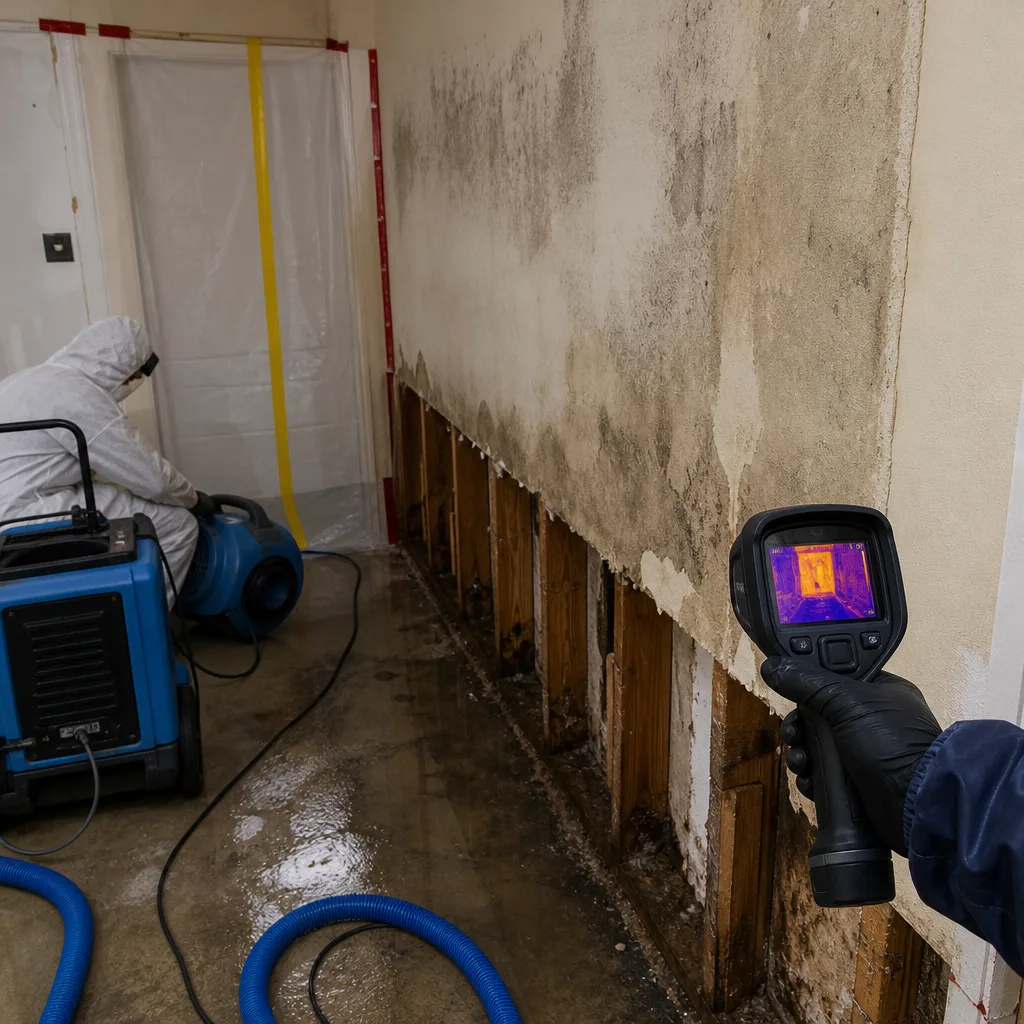 Before
 After
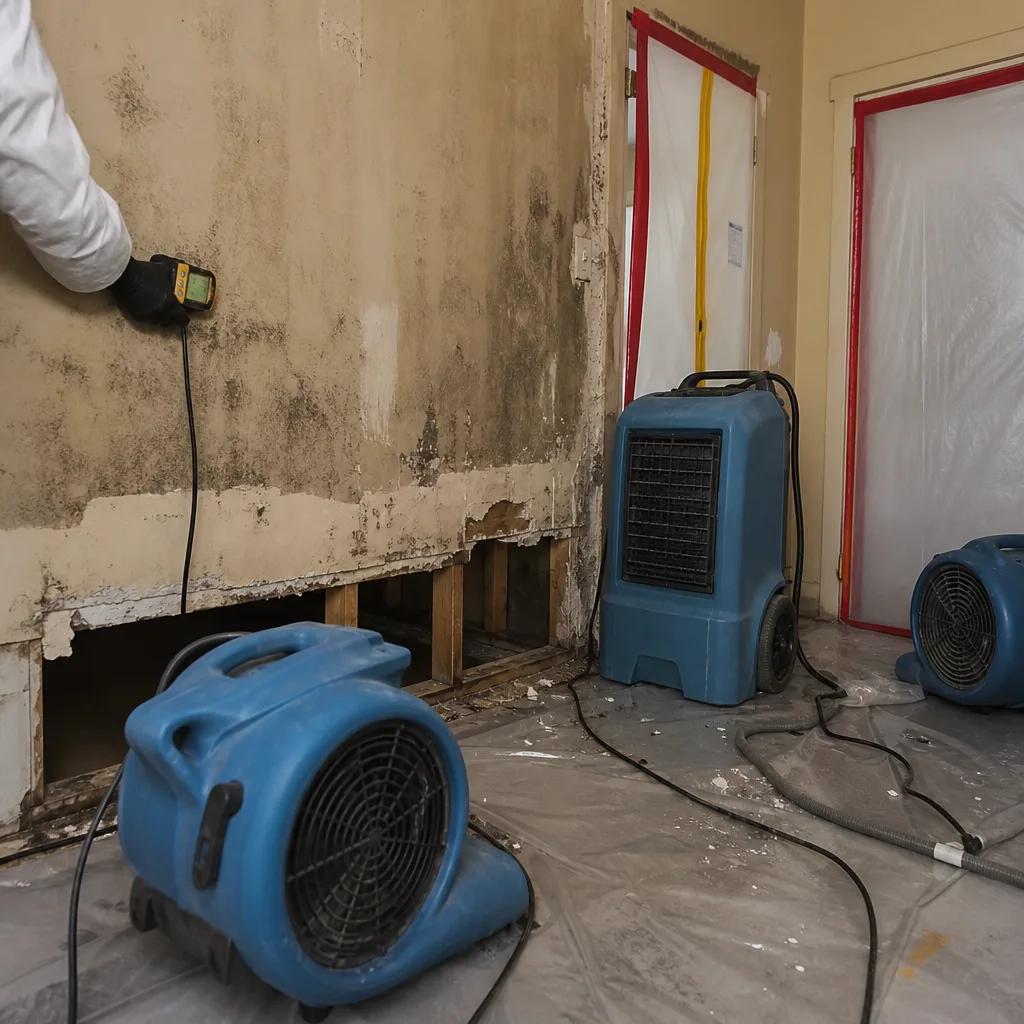 Before
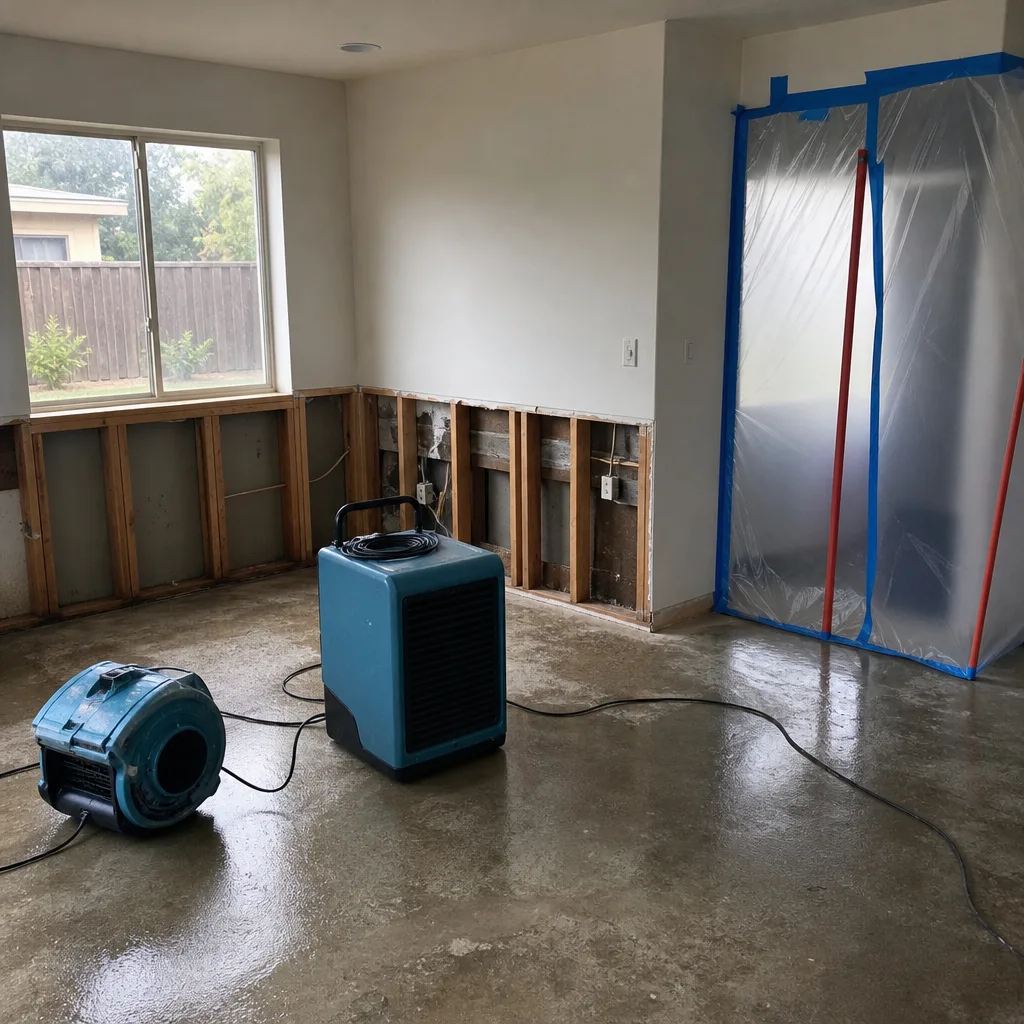 After
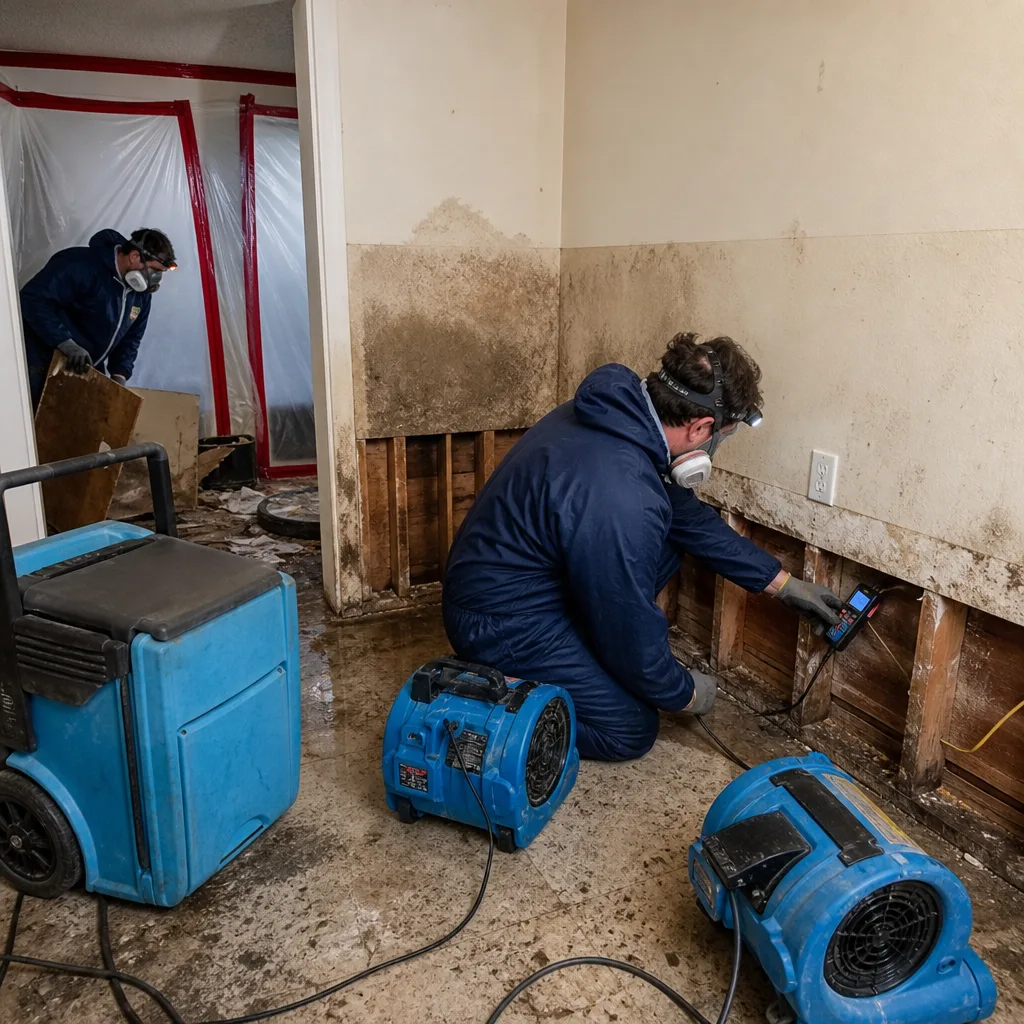 Before
 After
When to Call a Professional
Call a restoration professional when the water event involves any of these: water that sat for more than 24 hours, water that reached wall cavities or subfloors, water from a contaminated source, or any situation where you smell mustiness or see discoloration developing. If you have already started a restoration and your contractor cannot produce moisture maps, psychrometric readings, or daily equipment logs, the time to bring in a second set of eyes is now, not after the drywall is closed. Hidden moisture doesn’t wait.
Guild Water Damage offers free estimates in Newport Beach. We run IICRC-certified processes with professional-grade Dri-Eaz, Phoenix, XPOWER, and B-Air equipment, and we use Injectidry cavity drying to preserve more and tear out less. Call (855) 855-9631 to have an experienced technician assess your drying plan and confirm the job is actually working.
Frequently Asked Questions
You know restoration is working when daily moisture readings on a moisture map show falling numbers toward a written drying goal, psychrometric readings show falling GPP and dew point, and the affected materials are progressively hitting their target moisture content. If the numbers are flat or the contractor cannot produce the readings, the job is stalled.
The dehumidifier is likely undersized for the vapor load, the room’s exterior penetrations are letting in humid Newport Beach air, or hidden moisture in cavities and subfloors is continuously releasing water vapor faster than the unit can remove it. The fix is a load calculation, sealing the space, and adding cavity drying if needed.
No. With Injectidry cavity-drying systems, water trapped inside wall cavities and subfloors can often be dried in place without removing drywall or flooring. This preserves more original material, reduces repair scope, and gets the structure back to target moisture faster. It is a specialized capability that most general contractors don’t offer.
In coastal Newport Beach, unaffected hardwood often reads 12-14% moisture content due to the ambient humidity, so a reading in that range may be normal for your home. The correct drying target is your home’s own baseline reading from an unaffected area, not a generic inland standard of 8-10%.
Insurance covers documented water damage, not vague invoices. If your restoration contractor cannot produce moisture maps, equipment logs, and psychrometric readings, the claim can stall or be disputed. The documentation is what establishes the scope and verifies that the work was done correctly.
A properly equipped and documented drying job typically takes three to seven days for the drying phase, depending on the materials affected and the moisture load. If the job is running past seven days without clear progress on the moisture map, something in the drying plan is wrong and needs correction, not more time.
The Bottom Line
Water damage restoration fails quietly. The equipment runs, the contractor reassures, and weeks later the paint bubbles, the floor cups, or the mold appears. You prevent that failure with documentation: a written drying plan, daily moisture maps, psychrometric readings, and equipment logs that show measurable progress toward IICRC drying goals. In coastal Newport Beach, that means EMC-corrected baselines and cavity drying that accounts for hidden moisture. If your contractor cannot produce the numbers, the job is not being managed. It is being hoped for. Demand the documentation, check the numbers, and if the drying has stalled, call (855) 855-9631 for a professional second opinion. For more on our restoration process in coastal Orange County, visit the Guild Water Damage home page, or read about our Water Damage Restoration in Newport Beach, Mold Remediation in Newport Beach, and Fire Damage Restoration in Newport Beach services.
Written by the team at Guild Water Damage, serving Newport Beach since 2017.