Last updated October 30, 2026
 Water damage drying
 Fire & smoke cleanup
 Mold remediation
 Storm response
 Sewage cleanup
 Reconstruction
Free visual inspection and a written scope of work before any mitigation begins - photos, moisture readings, and drying logs go in your claim file
The scope we write is the scope we bill. Anything new gets shown to you, in writing, before we touch it.
Get your free estimateThe Complete Guide to Damage Restoration in Newport Beach
Most Newport Beach homeowners don’t realize their house is fighting a daily battle against three forces that inland properties never face: a marine layer that keeps outdoor humidity above 75% for most of the year, clay-heavy soils that expand and contract with every rain cycle, and slab foundations poured decades ago that now channel moisture sideways instead of letting it evaporate. This guide maps exactly how water, mold, and fire damage unfold in coastal Orange County homes, why standard restoration timelines routinely fail here, and what a Newport Beach-specific restoration process actually requires. By the end, you’ll know how to read a moisture map, what your insurance adjuster needs to see, and which questions separate a credentialed restoration contractor from a generalist with a fan.
Quick Answer
Damage restoration in Newport Beach covers three distinct emergencies: water intrusion from plumbing failures or storm surge, mold colonization driven by persistent coastal humidity, and fire damage from kitchen, electrical, or wildfire-related incidents. The restoration process follows a documented sequence of assessment, mitigation, structural drying, and reconstruction, with timelines in Newport Beach running 30-50% longer than inland Orange County because ambient humidity slows evaporation. A credentialed contractor with IICRC certification and professional-grade equipment should handle any loss exceeding a few square feet.
Restoration work we handle
Table of Contents
- Why Newport Beach Homes Fail Differently
- Category and Class: The Two Numbers That Determine Scope
- How Marine Humidity Changes the Drying Equation
- Reading a Moisture Map Report
- Mold Remediation in a Coastal Climate
- Fire Damage Restoration: Sequence and Standards
- Working With Insurance on a Newport Beach Loss
- Common Mistakes to Avoid
Why Newport Beach Homes Fail Differently
Newport Beach isn’t one climate. It’s at least four microclimates stacked along a three-mile gradient from the Pacific. Balboa Peninsula sits at the water’s edge, where salt spray accelerates corrosion on supply lines and exterior fixtures. West Newport carries the same exposure but adds aging infrastructure from the 1950s and 60s build-out, when galvanized steel supply pipes were standard. Further inland, neighborhoods like Dover Shores and Harbor View deal with less salt but more clay-heavy soil that grips foundations and holds moisture against slab edges. Corona del Mar and Newport Coast sit on hillsides where drainage patterns channel water downhill into lower-lying structures.
The common thread across all of these zones is a slab-on-grade construction method that dominates Newport Beach tract housing. Unlike raised foundations, where moisture under a house can evaporate upward and out, a concrete slab traps moisture against the bottom of flooring systems. When water intrudes from a supply line leak or drain failure, it doesn’t pool visibly on the surface in most cases. It travels laterally beneath the flooring, saturating the subfloor and wicking up through the concrete itself. By the time you see staining or buckling at the surface, the water has often been migrating for days or weeks.
We’ve inspected hundreds of Newport Beach slab homes where a pinhole leak in a copper supply line under the kitchen island had quietly saturated 300 square feet of engineered hardwood before the homeowner noticed anything. The water traveled along the slab, not through it, and the first visible sign appeared fifteen feet from the actual source.
This failure pattern means Newport Beach restoration work must start with a thorough moisture assessment, not a visual inspection. The visible damage is almost always smaller than the actual damage. A professional-grade moisture meter, used correctly across a grid pattern, tells the real story.
Category and Class: The Two Numbers That Determine Scope
Any credentialed water damage assessment begins with two classifications from the IICRC S500 Standard for Professional Water Damage Restoration. These two numbers do more to determine scope, cost, and drying strategy than square footage does.
Category of water refers to the contamination level of the water source:
- Category 1: Clean water from a supply line, faucet, or rainwater. No immediate health risk, but it degrades quickly.
- Category 2: Gray water containing some contamination, typically from washing machine discharge, dishwasher overflow, or sump pump failure. Carries microorganisms.
- Category 3: Black water containing sewage, storm surge, or standing water that has supported bacterial growth. Requires full containment and disinfection protocols.
Class of water refers to the extent of absorption and evaporation load:
- Class 1: Less than 5% of affected surfaces are porous. Minimal absorption.
- Class 2: Significant absorption into carpet, fabric, or gypsum. Evaporation load is moderate.
- Class 3: Ceiling, walls, insulation, and subfloor saturated. The greatest evaporation load.
- Class 4: Deep saturation into low-permeability materials: hardwood, concrete, plaster, brick. Requires specialized drying methods and longer equipment runtimes.
A Category 1, Class 1 loss in a Newport Beach bathroom might dry in two days with a single air mover and dehumidifier. A Category 3, Class 4 loss from a sewer backup in a Balboa Peninsula rental might require a week of containment, demolition, and drying before rebuild can even be scoped. The category and class determine the IICRC-certified process, not the square footage. Any restoration estimate that doesn’t state these two classifications up front is guessing.
In Newport Beach, most water damage starts as Category 1 but degrades to Category 2 or 3 if left for more than 48 hours in the coastal humidity. That’s an accelerated timeline compared to inland communities where the same degradation might take three or four days. This is one reason why same-day response matters more here than in Riverside or Temecula.
How Marine Humidity Changes the Drying Equation
The IICRC S500 standard sets drying goals based on psychrometric readings: temperature, relative humidity, and specific humidity or grains per pound of air. The standard assumes you can lower the vapor pressure in the affected space enough to pull moisture out of wet materials at a meaningful rate. In Newport Beach, that assumption fails in predictable ways.
At an average year-round relative humidity of 75-80%, the ambient air in a Newport Beach home is already carrying most of the moisture it can hold. When you introduce professional-grade dehumidifiers, they work, but they’re fighting a constant influx of humid air through every gap, crack, and open door. The net evaporation rate from saturated drywall or hardwood flooring drops compared to the same loss in a drier inland climate.
This means standard drying timelines need adjustment. A Class 2 water loss that might dry in three days in Irvine can run five to seven days in Corona del Mar or Newport Heights, even with the same equipment. Contractors who apply inland drying assumptions to coastal properties routinely remove equipment too early, leaving residual moisture in wall cavities and subfloors. That residual moisture becomes mold.
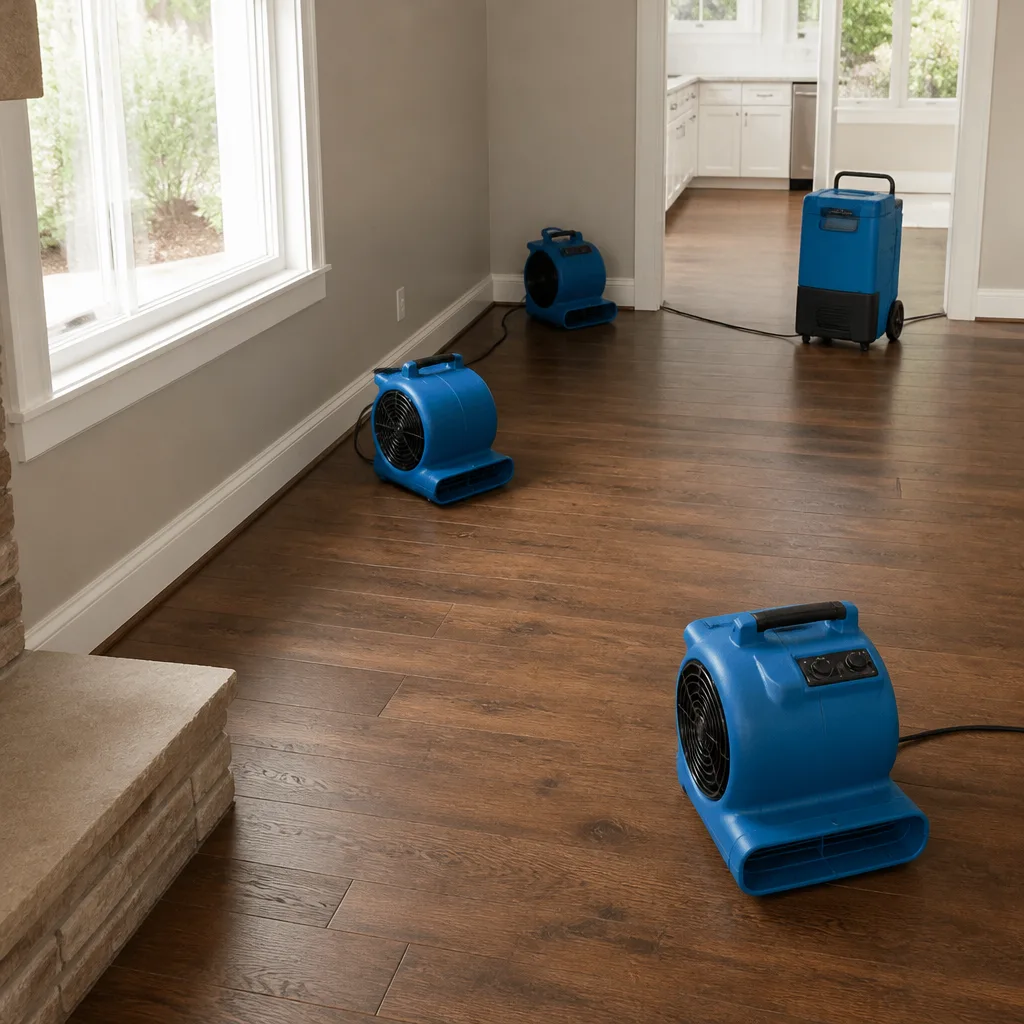
The solution is not simply running equipment longer. It’s running the right equipment, positioned correctly, with continuous psychrometric monitoring. A Phoenix dehumidifier placed in the wrong location creates drying pockets that look good on one reading but mask saturated areas elsewhere. The drying goal isn’t a number on a single meter. It’s a documented pattern of declining moisture content across the entire affected grid, verified against the dry standard for each material type.
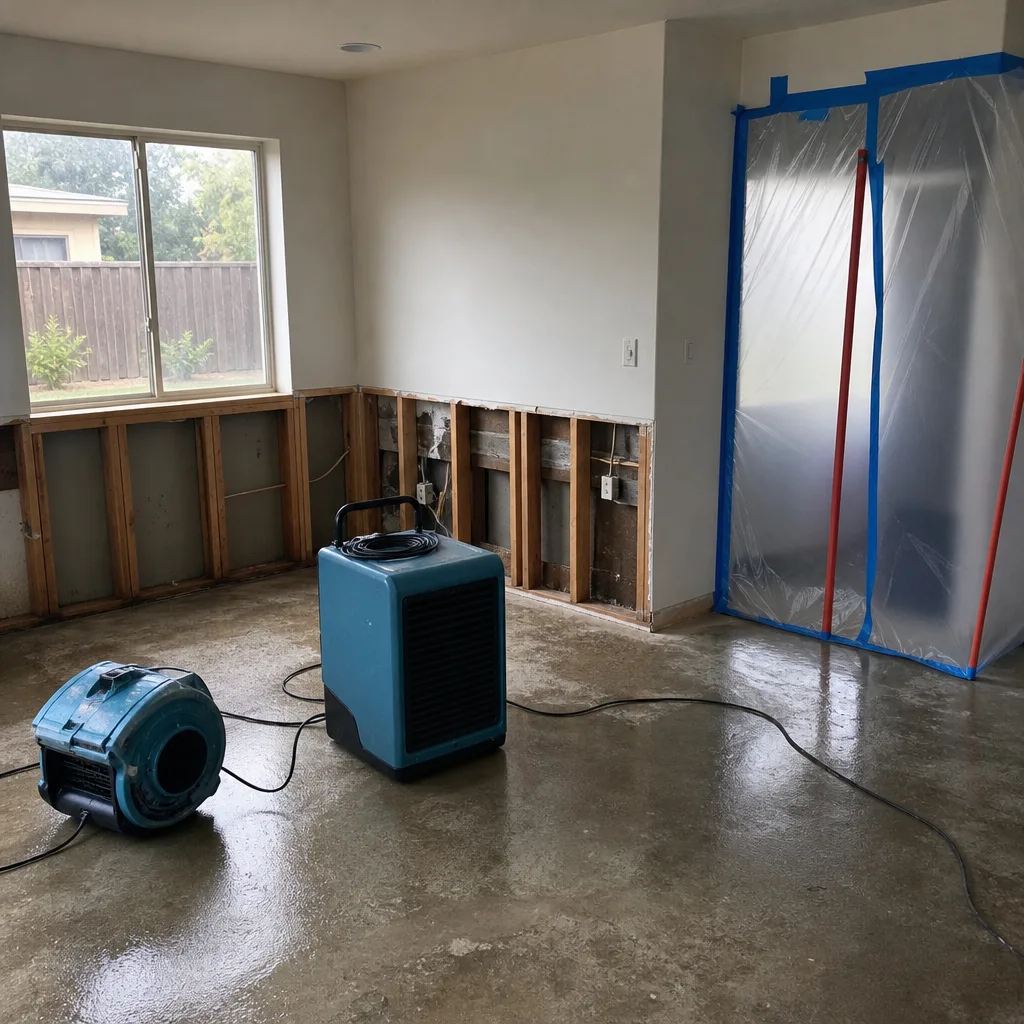
For Newport Beach slab homes, a second factor compounds the humidity problem: the concrete slab itself. Concrete holds moisture and releases it slowly under pressure. When a slab becomes saturated from below, it can continue releasing moisture into the structure for weeks after the visible surfaces look dry. This trapped moisture beneath flooring systems is why Injectidry cavity-drying technology matters in coastal restoration. The system forces controlled air through wall cavities and under subfloors without requiring demolition, targeting the areas where moisture hides. In a conventional approach, those areas would either be torn out or left to dry on their own, which in Newport Beach humidity often means they never dry completely.
The practical takeaway for a homeowner: ask your restoration contractor to show you the psychrometric readings relative to the outdoor dew point, not just a final moisture reading. If they can’t explain why their drying goals were adjusted for coastal humidity, they’re not running a documented drying process.
Reading a Moisture Map Report
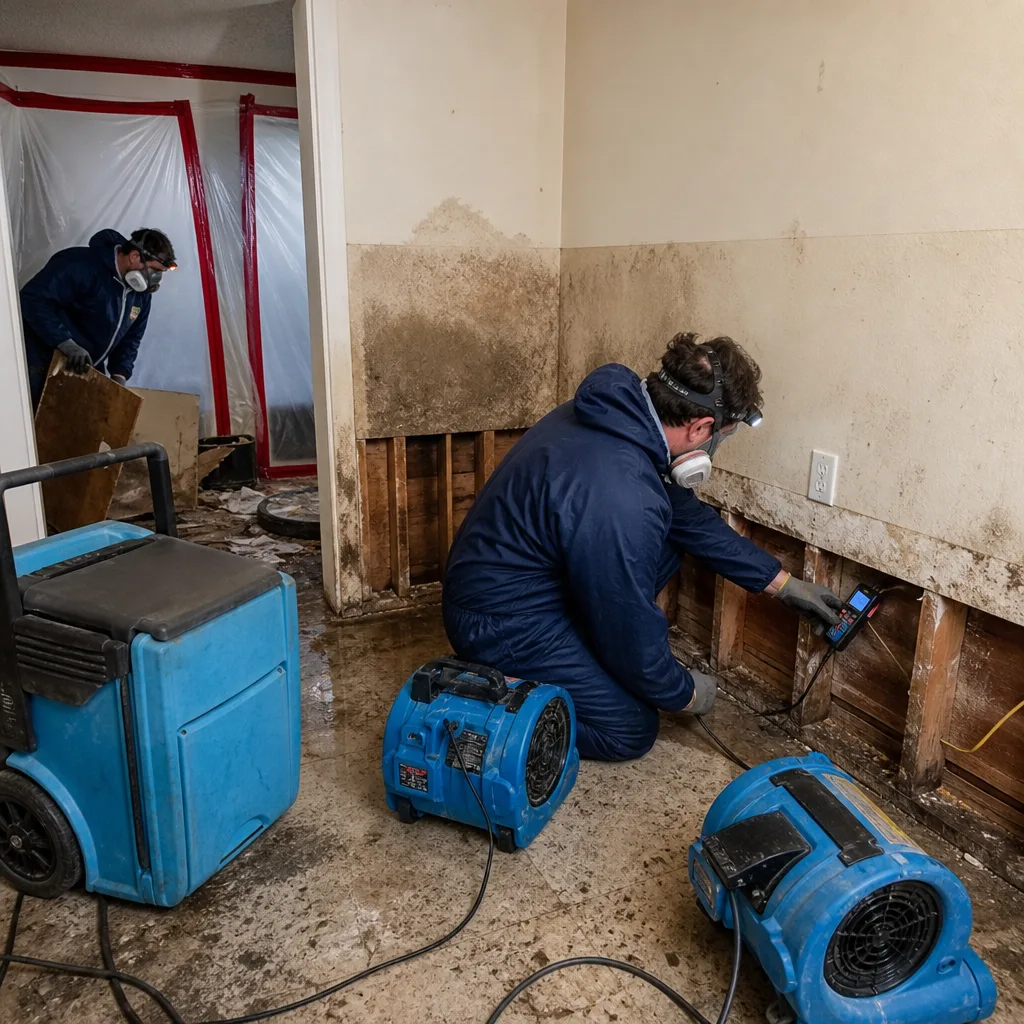
A moisture map is the single most important document produced during water damage restoration. It’s a room-by-room, grid-by-grid record of moisture readings taken with a penetrating or non-penetrating moisture meter, showing exactly where water traveled and how much each affected surface holds. Done correctly, it becomes the baseline against which drying progress is measured and the verification that the job is actually complete.
Here’s what a legitimate moisture map should include:
- Material type for each reading: Moisture content in drywall means something different than in hardwood or concrete. An 8% reading in drywall is fine. An 8% reading in concrete is saturated.
- Reading locations marked on a floor plan: Not just “wall near door.” Specific grid points that can be revisited with the same meter.
- Dry standard for each material type: The target moisture content that indicates the material has returned to its pre-loss condition.
- Date and time of each reading: Drying curves only mean something with timestamps.
- Equipment placement notes: Where air movers and dehumidifiers were positioned during each reading.
When a Newport Beach restoration project is nearing completion, the final moisture map should show every affected reading at or below the dry standard, with readings stable across at least 24 hours. If a contractor removes drying equipment based on “it feels dry” or a single surface reading, the job isn’t documented and the warranty is worth nothing.
The final moisture map also serves another purpose: it’s the document your insurance carrier uses to close out the claim. A complete moisture map with clear drying verification makes the claim process smoother. An incomplete one invites adjuster questions and delays. This is the difference between a restoration contractor who runs a documented IICRC-certified process and one who wings it.
Mold Remediation in a Coastal Climate
Mold in Newport Beach is not an anomaly. It’s the default outcome of any moisture event that isn’t dried completely, and it’s a constant background threat in older homes with chronic condensation, leaky windows, or inadequate bathroom ventilation. The marine layer doesn’t cause mold by itself, but it keeps indoor surfaces just wet enough for dormant spores to activate.
The critical distinction most homeowners miss is that mold remediation is not the same as mold removal. You cannot remove all mold spores from a building. Spores are present in outdoor air everywhere, including the ocean breeze. Remediation means reducing indoor mold levels to normal background levels and, more importantly, removing the moisture source that allowed visible colonization to occur. Without the source correction, any remediation is temporary.
A proper mold remediation project in a Newport Beach home follows a defined sequence:
- Containment: The affected area is isolated with negative air pressure to prevent spores from spreading during removal.
- Source identification: The moisture source is located and corrected. This is non-negotiable.
- Removal and cleaning: Affected porous materials are removed and non-porous surfaces are cleaned with appropriate antimicrobial treatments.
- Verification: Post-remediation air sampling or surface testing confirms indoor spore levels match outdoor background levels.
The challenge unique to Newport Beach is the moisture source identification step. In a slab home with water migrating laterally under flooring, the visible mold might be on a baseboard in the hallway while the actual moisture source is a supply line leak in the kitchen fifteen feet away. If the remediation only treats the visible mold and doesn’t trace the moisture pathway, the mold returns in the same spot within weeks.
Professional-grade moisture investigation equipment makes the difference here. A restoration contractor with meters that can read through flooring, thermal imaging, and the experience to trace moisture patterns in slab construction can find the real source. A generalist contractor with a spray bottle of bleach is guessing.
Fire Damage Restoration: Sequence and Standards
Fire damage in Newport Beach takes two forms: kitchen fires that remain contained to one room, and larger structural fires that affect multiple rooms or the entire property. Both share the same restoration challenges: smoke penetration, soot deposition, and water damage from firefighting efforts. The water component surprises many homeowners. A kitchen fire suppressed with a fire extinguisher might produce minimal water, but a fire that brings the Newport Beach Fire Department means hundreds of gallons of water inside the structure.
The restoration sequence follows a defined order:
- Board-up and stabilization: Openings are secured, damaged structural elements are shored up, and utilities are addressed.
- Water extraction: Firefighting water is removed before secondary damage sets in.
- Soot and smoke assessment: Soot types are identified. Protein soot from a kitchen fire is different from synthetic soot from burning plastics, and each requires different cleaning methods.
- Contents processing: Salvageable contents are inventoried, cleaned, and stored. Non-salvageable items are documented for insurance.
- Structural cleaning and deodorization: Surfaces are cleaned, and odors are addressed with appropriate methods, including hydroxyl generators or ozone treatment where appropriate.
- Reconstruction: Damaged materials are replaced to pre-loss condition.
The IICRC S700 Standard for Fire and Smoke Damage Restoration governs this sequence. A contractor who skips steps or reorders them without justification is not following a documented process.
In Newport Beach specifically, fire restoration intersects with the same coastal humidity problem that affects water and mold mitigation. Materials that have absorbed firefighting water and then sit in humid air for a week will develop mold colonies alongside the fire damage. A full-scope fire restoration project must address both damage types simultaneously. This is why a contractor with credentialing across water, mold, and fire restoration under one roof creates a more efficient recovery than coordinating three separate vendors on the same loss.
Working With Insurance on a Newport Beach Loss
Most Newport Beach homeowners carry homeowners insurance with water damage coverage, but the scope of that coverage varies significantly. Some policies cover sudden and accidental discharge from supply lines but exclude slow leaks or groundwater intrusion. Others include mold remediation up to a capped amount or exclude it entirely. The fire damage coverage is typically broader, but the specific exclusions and deductibles still matter.
The single most important thing you can do for your claim is document everything before mitigation begins. Photograph every affected area from multiple angles. Video the damage as you found it. Keep a written timeline of when the loss was discovered and what actions you took.
Then, when the restoration contractor arrives, insist on a written scope of work before any equipment is placed. This written scope should specify the category and class of water loss, the affected areas, the drying plan, and the expected equipment needs. It becomes the document your adjuster reviews, and it protects you from scope disputes later.
A credentialed restoration contractor can also work directly with your insurance adjuster, providing the documentation the carrier requires: moisture maps, drying logs, photo documentation, and itemized scope reports. This direct coordination removes the common bottleneck where the homeowner is caught between the contractor and the adjuster, trying to translate technical information.
One persistent myth in Newport Beach is that all restoration contractors charge “what insurance pays.” This is not accurate. Contractors set their own rates, and insurance pays based on the policy terms and the documented scope. A contractor who inflates the scope to maximize the claim is committing insurance fraud, and a contractor who under-scopes to win the job will leave damage behind. The written scope is the safeguard against both.
Common Mistakes to Avoid
- Waiting to see if the water dries on its own. In Newport Beach’s 75-80% average humidity, wet materials almost never dry completely without mechanical assistance. Every day of waiting pushes a Category 1 loss toward Category 2 or 3 and increases the mold risk.
- Hiring a generalist contractor for a specialized loss. Water, mold, and fire restoration require specific technical protocols and equipment. A general contractor who does restoration on the side rarely carries professional-grade drying equipment or follows documented IICRC standards.
- Accepting a visual inspection as sufficient. In slab-on-grade Newport Beach homes, water travels laterally under flooring. Visual inspection consistently underestimates the actual affected area.
- Removing drying equipment based on elapsed time. Equipment should be removed based on documented moisture readings showing dry standards met, not because “it’s been five days.” Coastal humidity extends drying timelines unpredictably.
- Skipping post-remediation verification for mold. Without air sampling or surface testing to confirm indoor spore levels match outdoor background, you cannot verify the remediation was complete.
- Not documenting the loss before mitigation begins. Photographs and video taken before equipment is placed protect your insurance claim and prevent disputes about the original scope.
See the difference
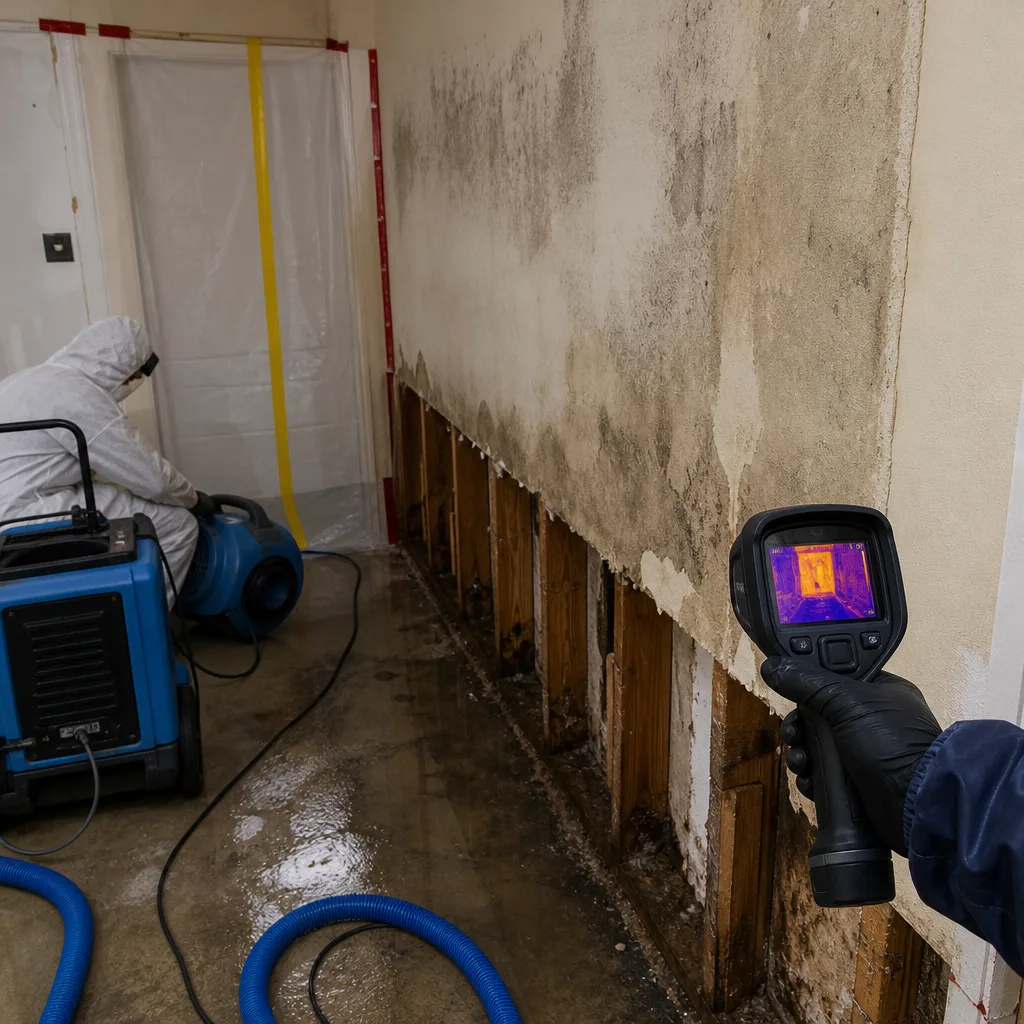 Before
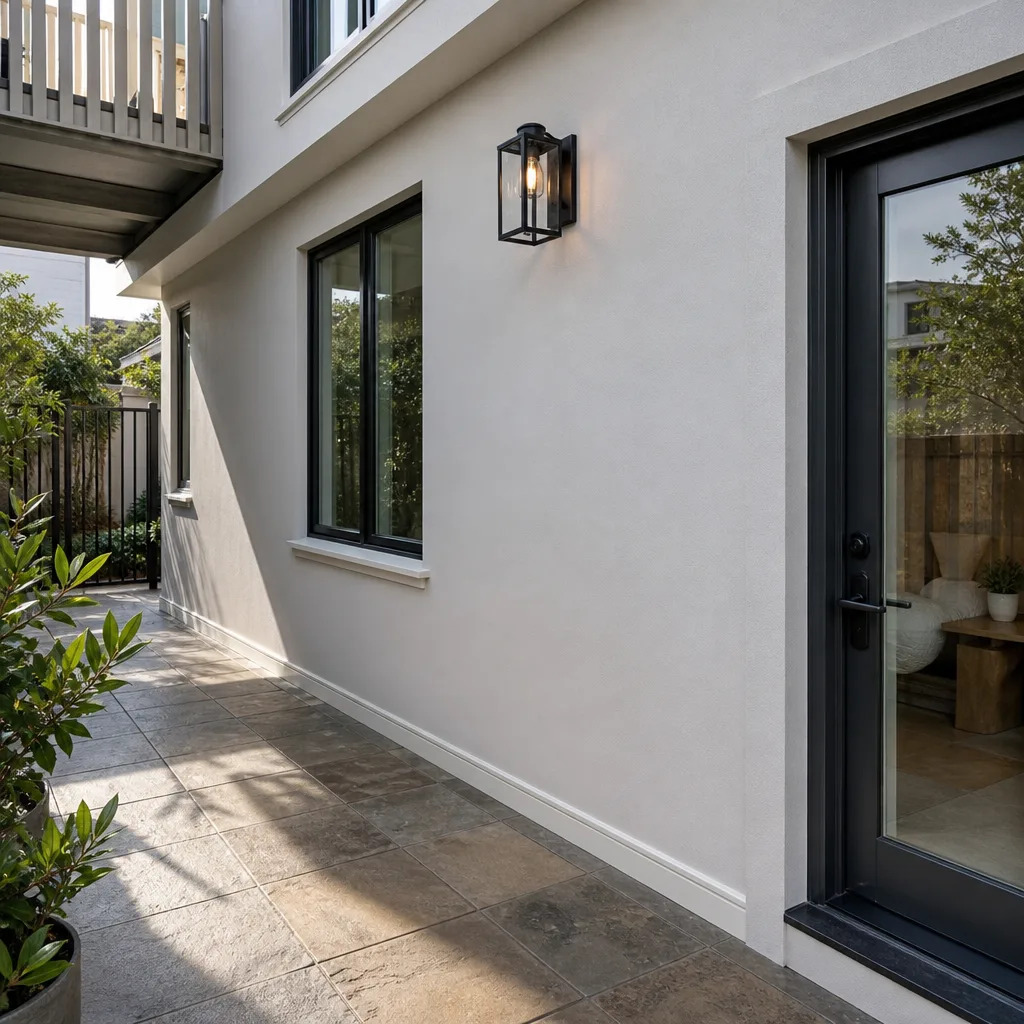 After
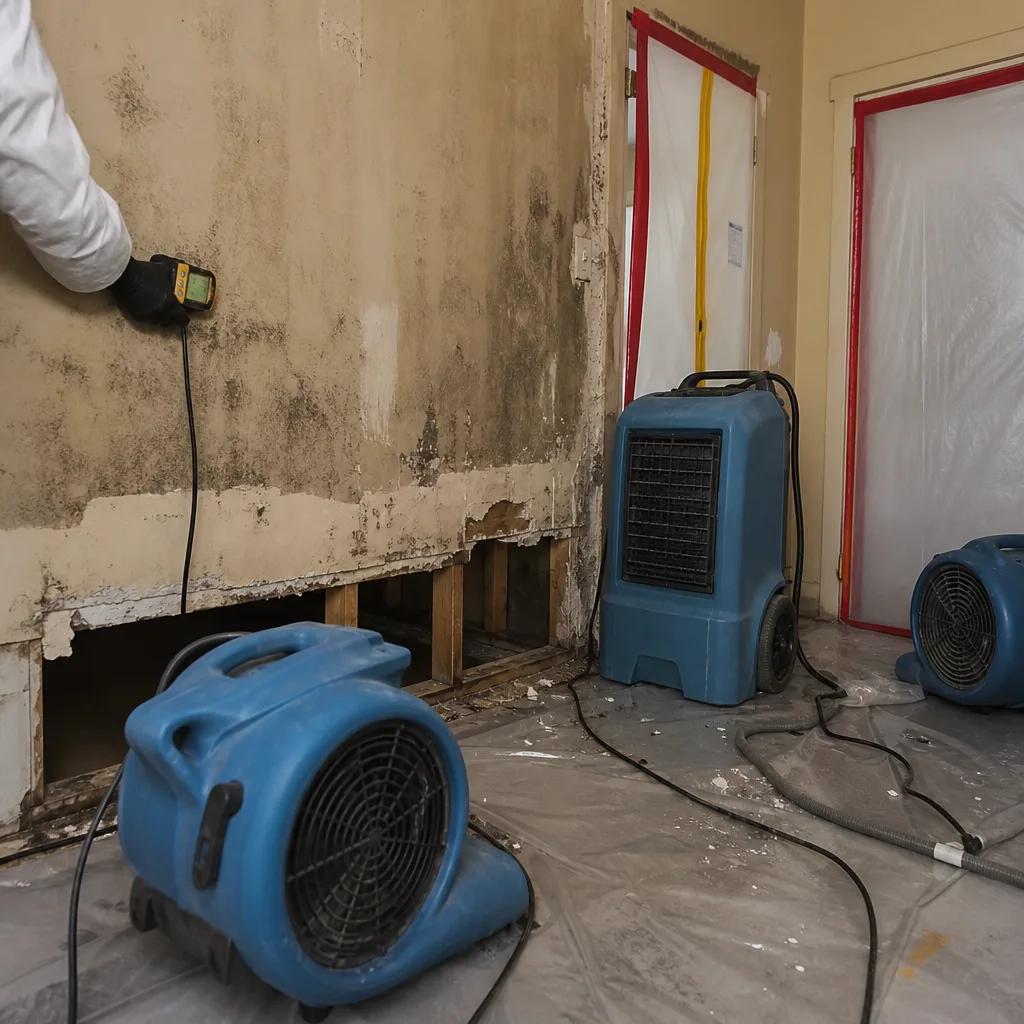 Before
 After
 Before
 After
When to Call a Professional
Call a credentialed restoration contractor when water has affected porous materials like drywall, flooring, or cabinets; when the water source is contaminated; when visible mold covers more than about ten square feet; or when a fire has occurred, even if the fire damage appears contained. For small, clean-water spills on tile or concrete that you can dry completely within hours, a shop vac and a fan will usually suffice. But the threshold for professional help in Newport Beach is lower than most homeowners assume because the coastal humidity works against DIY drying efforts at every step. When in doubt, document what you see and call for an assessment. Guild Water Damage offers free estimates in Newport Beach, call (855) 855-9631. Our technicians are IICRC-certified and run professional-grade Dri-Eaz and Phoenix equipment.
Frequently Asked Questions
Water damage restoration in Newport Beach typically takes 3 to 7 days of structural drying, plus additional time for demolition and reconstruction, as detailed in The Complete Water Damage Restoration Guide for Newport Beach Homeowners. The coastal humidity extends drying timelines by 30-50% compared to inland Orange County, and Category 3 or Class 4 losses can require longer equipment runtimes.
Most homeowners policies cover sudden and accidental discharge from a supply line, including the damage caused and the restoration required; see our Damage Restoration Cost Breakdown: The Newport Beach Homeowner’s Reference for 2026 for typical claim ranges. Slow leaks that have been ongoing may be excluded, so document what you find and contact your adjuster promptly.
Surface staining that wipes away with a damp cloth and leaves no residue is likely not active mold colonization. Any growth that returns after cleaning, appears fuzzy or porous, or covers porous materials like drywall requires professional mold remediation assessment.
Class 3 means significant saturation of highly porous materials like carpet, drywall, and insulation throughout a room. Class 4 means deep saturation of low-permeability materials like hardwood, concrete, plaster, or brick, which requires specialized drying methods and longer equipment runtimes.
Yes. Mold inside wall cavities is common in Newport Beach slab homes where moisture migrates laterally beneath flooring and wicks up into walls. Musty odors, persistent condensation, or recent water damage without visible mold are indicators that hidden colonization may exist.
Ideally, within the first 24 hours. Every day of delay in Newport Beach humidity allows a Category 1 loss to degrade toward Category 2 or 3 and increases the mold colonization window. Same-day assessment and equipment placement produce materially better outcomes.
The Bottom Line
Damage restoration in Newport Beach demands a different approach than inland Orange County. The marine humidity slows drying, slab foundations hide water migration, and aging infrastructure in neighborhoods like Balboa Peninsula and West Newport elevates supply-line and drain failure risk. A documented, certification-backed restoration process that starts with accurate category and class classification, runs professional-grade equipment, and verifies drying with moisture map data is the only path to a permanent fix. The alternative is a recurring problem: mold returning, flooring buckling, and insurance claims reopening. When a loss occurs, document it, call a credentialed contractor, and insist on a written scope before work begins. That’s how coastal homes recover completely.
Written by the team at Guild Water Damage, serving Newport Beach since 2017. Explore more guides & resources.