Last updated October 30, 2026
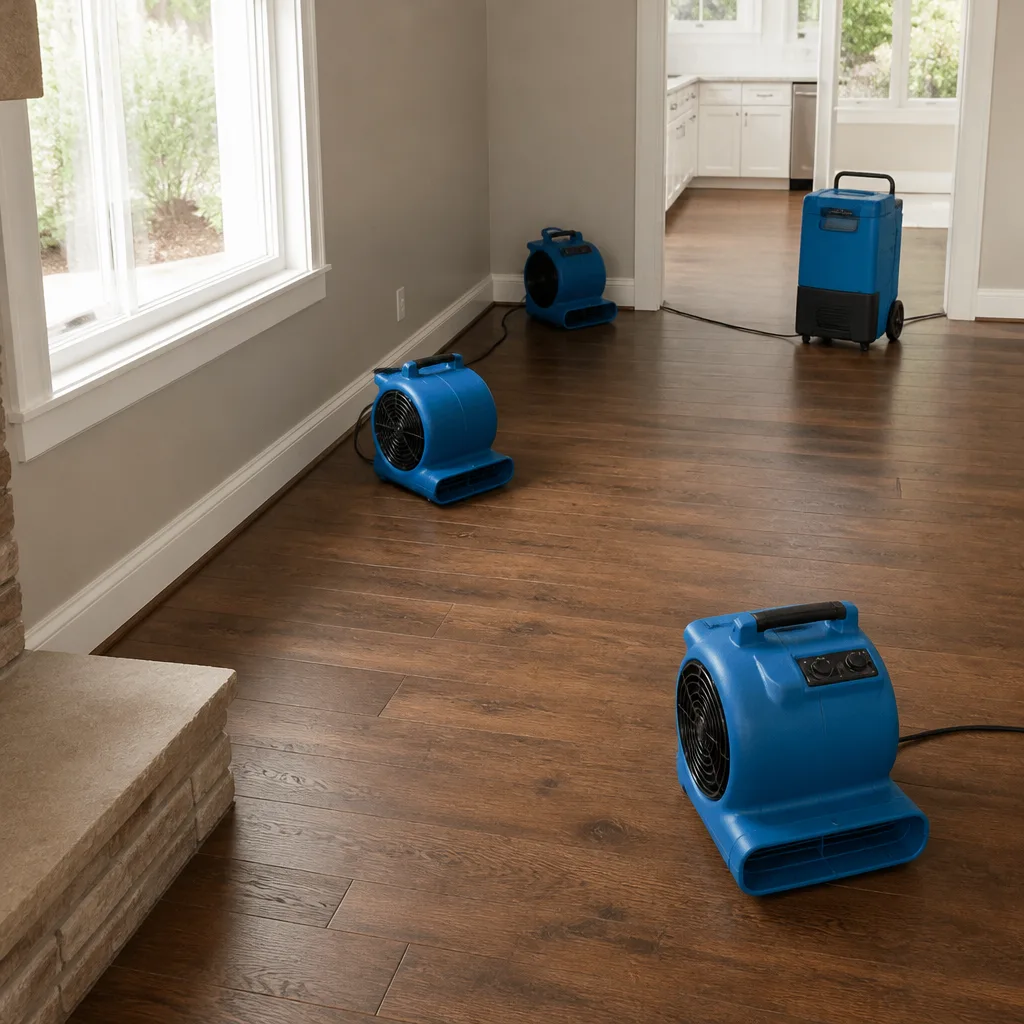 Water damage drying
 Fire & smoke cleanup
 Mold remediation
 Storm response
 Sewage cleanup
 Reconstruction
Free visual inspection and a written scope of work before any mitigation begins - photos, moisture readings, and drying logs go in your claim file
The scope we write is the scope we bill. Anything new gets shown to you, in writing, before we touch it.
Get your free estimateHow to Hire a Damage Restoration Contractor in Newport Beach: A Step-by-Step Guide
California requires no specific license to perform water damage restoration. Read that again. Any general contractor with a pickup truck and a rental dehumidifier can legally respond to a pipe burst in your Newport Beach home, extract some water, and call it restoration. The result, months later, is often hidden mold inside wall cavities, warped hardwood, and a claim dispute your insurance company won’t help you win. This guide gives you a repeatable vetting framework built around what credentialed Newport Beach restoration specialists actually do, so you can filter out the unqualified before a single truck rolls up. For more guides & resources, visit our blog.
Quick Answer
Hire a damage restoration contractor in Newport Beach by verifying three certifications (IICRC WRT, ASD, and RCT) on the official IICRC registry, confirming they run commercial-grade drying equipment from brands like Dri-Eaz or Phoenix rather than rental units, and demanding a written scope of work with daily moisture readings before signing anything. If the contractor balks at any of those three asks, keep looking.
Restoration work we handle
Table of Contents
- The Licensing Gap: Why ‘Licensed’ Doesn’t Mean ‘Qualified’
- The Three Certifications That Actually Matter
- Commercial-Grade Equipment vs. Rental Gear
- How to Read a Scope of Work Before Signing
- Insurance Pitfalls Specific to Newport Beach Claims
- The Subcontractor Question Most Homeowners Skip
- Newport Beach-Specific Factors That Change the Equation
- Red Flags That Signal a Low-Process Operator
The Licensing Gap: Why ‘Licensed’ Doesn’t Mean ‘Qualified’
California’s Contractors State License Board (CSLB) issues general building contractor licenses (Class B) and specialty licenses for trades like plumbing and electrical. None of those license categories cover water damage restoration, mold remediation, or fire damage restoration as a distinct trade. What this means in practice: a Newport Beach homeowner with water flooding a downstairs bedroom can hire a fully licensed general contractor who has never run a desiccant dehumidifier, never logged psychrometric readings, and never touched a moisture meter.
We see the consequences regularly. A general contractor extracts the standing water, sets up box fans from Home Depot, and pronounces the room dry after three days. The surface is dry. The wall cavity behind the baseboard is not. In Newport Beach’s marine climate, where relative humidity routinely sits above 70%, trapped moisture inside building assemblies grows mold fast. The homeowner discovers it six months later when the new buyer’s inspector finds Stachybotrys behind the drywall during escrow.
The licensing absence cuts both ways. It means you cannot rely on a contractor’s license as proof of restoration competence. It also means the burden falls on you to verify the credentials that restoration insurers and commercial property managers already require: IICRC certification, RIA membership, and IFA affiliation. A contractor who has invested in triple industry credentialing has signaled they operate to a documented standard, not to whatever the technician on duty happens to know.
When you call a restoration company in Newport Beach, the first question should not be “Are you licensed?” It should be “Which IICRC certifications do your technicians hold, and can you give me their names so I can verify them on the registry?”
The Three Certifications That Actually Matter
The restoration industry’s recognized technical credentialing body is the IICRC, the Institute of Inspection, Cleaning and Restoration Certification. Their certifications are not decorative. Each requires structured coursework, a proctored exam, and continuing education credits to maintain. When a restoration firm claims “IICRC-certified,” that claim only means something if you know which certifications and verify them.
For water damage restoration in Newport Beach, the three that matter are:
- WRT (Water Restoration Technician): The foundational certification covering water damage theory, extraction methods, drying science, and equipment placement. A WRT holder understands psychrometry, the physics of drying, and why treating a Category 3 water loss differently from a supply-line break is non-negotiable.
- ASD (Applied Structural Drying): The advanced certification focused on drying building structures, not just extracting water. ASD-certified technicians can design a drying plan for wall cavities, subfloors, and hard-to-reach structural spaces.
- RCT (Rug and Textile Cleaning): Relevant when water damage involves carpet, rugs, or upholstered furniture. RCT certification covers fiber identification, cleaning methodology, and the restoration of textiles that are often written off as unsalvageable by untrained crews.
Here’s the critical part: do not take a business card at face value. The IICRC maintains a public registry where you can look up any certified technician by name. Ask the contractor for the names of the technicians who will actually perform the work, then verify them. A company that claims certification but refuses to give you technician names is a red flag. In our experience, legitimate credentialed firms are happy to prove it.
Beyond IICRC, two organizational affiliations signal a firm operating to a professional standard. RIA (Restoration Industry Association) membership binds a company to a code of ethics and industry best practices. IFA affiliation adds an additional accountability layer. Neither is a technical certification, but both indicate the firm participates in an ecosystem where documented protocols are the norm, not the exception. The Guild Water Damage home page details how our IICRC-certified process works in practice.
Commercial-Grade Equipment vs. Rental Gear
The equipment a restoration contractor brings to your Newport Beach property tells you more about their process than any marketing claim. There are two tiers in this industry, and the gap between them is measurable in drying time and structural outcomes.
Consumer-grade equipment, the kind you can rent from a big-box store, includes small-portable dehumidifiers rated at 30 to 50 pints per day, box fans, and carpet extractors. These tools are designed for light-duty use. They cannot generate the airflow or humidity removal capacity required to dry building materials to the low moisture content thresholds that prevent mold growth.
Commercial-grade equipment is built to specifications set by restoration engineers. The brands matter because the rated capacities are published and verifiable:
- LGR (Low Grain Refrigerant) dehumidifiers: Dri-Eaz and Phoenix manufacture LGR units rated at 125 to 200-plus pints per day. These units continue removing moisture efficiently even as the air dries out, which is exactly when consumer units plateau. An LGR dehumidifier can pull humidity down to the low grain counts required for structural drying.
- Desiccant dehumidifiers: Used for difficult drying conditions or low-temperature environments. Desiccant units remove moisture through chemical absorption rather than condensation, making them effective where refrigerant units struggle.
- Axial air movers: Professional axial fans from brands like XPOWER and B-Air deliver rated airflow in the 2,500 to 3,000 CFM range. Consumer box fans may move air, but they cannot generate the directed, high-velocity airflow required to push moisture out of building materials.
- Injectidry systems: This is the differentiator worth asking about. Injectidry technology enables non-invasive drying inside wall cavities and under subfloors without tearing out drywall or flooring. In a Newport Beach home with custom millwork or hardwood floors, that capability alone can reduce repair scope by thousands of dollars. Most residential contractors do not own Injectidry equipment because it requires specialized training and investment.
You don’t need to become an equipment expert. You need to ask one question: “What brands of dehumidifiers and air movers do you run, and what are their rated capacities?” A credentialed firm will answer immediately. A firm running rental gear will deflect. The Water Damage Restoration in Newport Beach page lists the professional-grade brands our crews operate.
How to Read a Scope of Work Before Signing
A scope of work is the contract document that defines what the restoration contractor will do, how they’ll do it, what it costs, and how success is measured. Low-process operators write vague scopes. Credentialed firms write scopes you can audit. In Newport Beach, where the cost of an incomplete restoration can exceed the original damage through mold remediation and reconstruction, the scope is your primary protection against being oversold or under-served. Use our Water Damage Restoration Maintenance Checklist for Newport Beach Homeowners to track key steps.
Here’s a numbered framework for reading any scope of work before you sign:
- Moisture mapping: The scope should state that moisture mapping will be performed at the start of the project using moisture meters and thermal imaging or equivalent tools. This establishes the baseline extent of water migration. A scope without moisture mapping is a scope built on guesswork.
- Psychrometric logging: The scope should reference daily readings of temperature, relative humidity, and specific humidity recorded at the job site. These readings tell the technician when equilibrium has been reached and the structure is dry. A scope that skips psychrometric logging cannot prove drying was completed.
- Equipment list and placement plan: The scope should specify the type and quantity of equipment to be deployed, along with a placement plan. “Dehumidifiers as needed” is not a plan. “Two Dri-Eaz LGR dehumidifiers rated at 150 pints per day, positioned in the affected bedroom and adjacent hallway” is a plan.
- Drying goals: The scope should state target moisture content levels for affected materials. Wood framing should return to its pre-loss moisture content, typically measured against an unaffected reference point in the same structure. A scope without documented drying goals gives the contractor no objective completion standard.
- Daily monitoring protocol: The scope should specify that monitoring will occur daily, with readings documented and available to the homeowner and insurance adjuster. Daily readings are how legitimate restoration firms demonstrate progress. Weekly visits are how less thorough operators cut corners.
- Demolition scope: If the scope includes demolition, it should specify exactly which materials will be removed and why. Vague language like “remove affected materials as needed” invites scope creep. Specific language like “remove drywall to 24 inches above the visible water line in the affected bedroom” protects you.
Read the scope line by line before signing. If a contractor pushes back on your request to review the scope carefully, or uses pressure tactics to get a signature, walk away. A written scope agreed before work starts is the single most important document in your restoration project.
Insurance Pitfalls Specific to Newport Beach Claims
Water damage claims in Newport Beach carry different stakes than claims in most markets. The average home value in this city exceeds $2 million, and restoration invoices on high-value losses regularly reach six figures. That dollar volume attracts contractors who overbill, perform unnecessary work, or use assignment-of-benefits (AOB) agreements to take control of the claim.
An AOB is a legal document that transfers your insurance claim rights to the contractor. The contractor then bills your insurer directly. In California, AOB agreements are legal but rife with abuse. Unscrupulous operators inflate invoices, perform work the insurer would never approve, and leave the homeowner stuck with the difference when the insurer disputes the bill. Once you’ve signed an AOB, you’ve lost control of your claim.
Here’s what to know before signing anything insurance-related:
- Never sign an AOB under pressure: If a contractor insists you sign an AOB before they’ll start emergency mitigation, that’s a red flag. Credentialed firms work with your insurer without taking ownership of your claim.
- Verify the contractor’s insurance billing experience: Ask specifically whether they bill insurers directly and how they handle adjuster documentation. A firm with IICRC-certified processes should provide photo documentation and daily drying logs that meet insurer standards. Our team photographs every phase of the restoration and provides adjusters with the documentation they need to approve coverage.
- Watch for inflated equipment charges: Common AOB abuse includes billing for equipment days that never happened or billing commercial-grade rates for rental equipment. Daily monitoring documentation is your audit trail.
- Confirm the contractor will work with your adjuster directly: The best restoration experience happens when the contractor and adjuster communicate professionally. Ask how the contractor handles adjuster relationships before you hire.
In Newport Beach specifically, insurance carriers are sophisticated about restoration claims. They’ve seen the inflated invoices. A contractor whose documentation is sloppy or whose scope is vague gives the insurer ammunition to deny or reduce your claim. A contractor whose documentation is rigorous strengthens your position. The Guild standard exists for this reason: documented, certification-backed protocols create an auditable restoration process that stands up to adjuster scrutiny.
The Subcontractor Question Most Homeowners Skip
Many restoration firms that present well during the sales call hand off the actual drying work to uncredentialed subcontractors. The salesperson quotes you a credentialed process, the estimator writes a detailed scope, and then a sub crew shows up with rental equipment and no IICRC certifications among them. You wouldn’t know unless you asked.
This happens more often than homeowners realize. The business model works like this: a general contractor or restoration “brand” secures the job, takes a margin, and subcontracts the work to whichever crew is available. The subcontractor is motivated to finish fast and move to the next job, not to dry your structure thoroughly. The result: incomplete drying, hidden moisture, and a homeowner who discovers the problem after the warranty period has expired.
Here are the questions to ask before you hire:
- “Will your employees perform the work, or will you subcontract?” The answer should be direct and immediate. If the firm uses subcontractors, ask who they use and what certifications those crews hold.
- “Can you give me the names of the technicians who will actually be on site?” Then verify those names on the IICRC registry. This is the single most effective filter in the entire hiring process.
- “Who supervises the drying process?” A credentialed firm assigns a certified technician to monitor daily readings and adjust equipment placement. A low-process operator drops equipment and checks in occasionally.
- “What happens if the drying stalls?” The answer should reference psychrometric readings, equipment adjustments, and possibly adding capacity. A shrug is not an answer.
For a project that combines water damage, mold remediation, and fire damage restoration, the subcontractor risk multiplies. Every handoff between vendors creates a gap in accountability. The Mold Remediation in Newport Beach and Fire Damage Restoration in Newport Beach pages explain why we handle all three disciplines in-house: one credentialed contractor, start to finish, no handoffs to unvetted crews.
Newport Beach-Specific Factors That Change the Equation
Newport Beach presents restoration challenges that contractors from inland areas often underestimate. The marine climate, coastal architecture, and high-value finishes all affect how drying should be approached.
The coastal humidity issue is real. Newport Beach’s relative humidity routinely stays above 70%, especially in the morning hours and during the “June Gloom” period when marine layers settle over the coast. See our Seasonal Damage Restoration Care for Newport Beach: Year-Round Homeowner’s Guide for climate-specific planning. Elevated humidity slows evaporation, extends drying times, and increases the risk of secondary damage. Drying a structure in this environment requires equipment with enough capacity to overcome ambient moisture, not fight it to a draw. LGR dehumidifiers and desiccant units matter more here than they do in, say, Palm Springs.
Coastal home construction also matters. Many Newport Beach homes sit on raised foundations or combine slab-on-grade construction with wood framing. Water migrates through building materials differently in each configuration. Newport Beach’s older neighborhoods, like Balboa Peninsula and Lido Isle, feature homes built decades ago with materials and assemblies that respond differently to water intrusion than newer construction in Newport Coast or Crystal Cove. A restoration technician who understands these construction types plans drying differently than one who treats every structure the same.
Salt air adds another layer. Exposed metals and electrical components in coastal homes corrode faster than inland equivalents. After a water event, corrosion risk accelerates. A credentialed restoration contractor accounts for this in the scope, potentially recommending additional steps to protect electrical connections and metal components. A generalist won’t think about it.
Finally, high-value finishes demand non-invasive drying wherever possible. Custom hardwood floors, imported tile, and hand-built cabinetry are expensive to replace. Injection drying systems like Injectidry enable drying inside walls and under subfloors without tearing out finishes unnecessarily. In a Newport Beach home where the flooring alone might cost $50,000 to replace, preserving more and tearing out less is a significant financial benefit.
Red Flags That Signal a Low-Process Operator
Some warning signs appear before the contractor ever reaches your property. Others emerge in the first conversation. Here’s what to watch for, drawn from what we’ve observed over years of working in this market.
- No IICRC certifications verifiable on the registry: If the firm claims certification but you can’t verify any technician on the IICRC public registry, treat the claim as false. This is the most common deception in the industry.
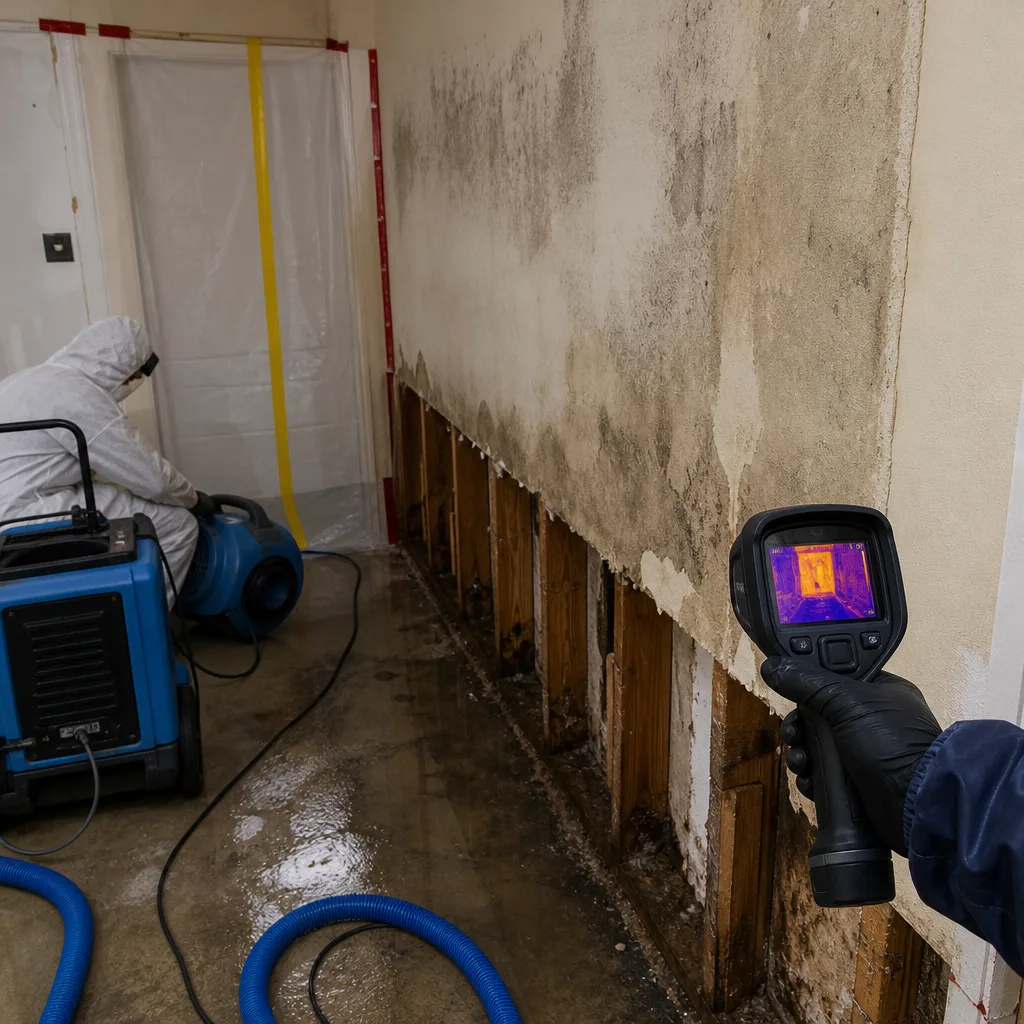
- No moisture meter on the initial visit: A contractor who assesses water damage without moisture mapping tools is guessing. Legitimate assessment requires meters, infrared cameras, or both.
- Pressure to sign before a scope is written: “Sign now so we can get started, we’ll figure out the details later” is a tactic, not a service. A written scope protects you. Walk away from anyone who wants your signature without one.
- No daily monitoring plan: If the drying plan doesn’t include daily psychrometric readings, the contractor cannot prove drying progress. This is non-negotiable.
- Vague equipment references: “Commercial-grade equipment” without brand names or rated capacities is meaningless. Professional firms name their equipment because the brands carry verifiable specifications. Dri-Eaz, Phoenix, XPOWER, B-Air, and Injectidry are names that appear in restoration engineer specifications for a reason.
- No documentation offered to the insurer: A contractor who resists photo documentation or daily logs is signaling they don’t want a paper trail. Your insurer needs that paper trail to process your claim. So do you.
- Unusually low bids: Restoration is equipment-intensive. A bid dramatically below competitors typically means consumer-grade equipment, no monitoring, or both. The cheapest bid on water damage restoration often becomes the most expensive after mold remediation and reconstruction are added.
Common Mistakes to Avoid
- Waiting to call while water spreads: Water migrates through drywall, flooring, and framing continuously. Every hour of delay expands the affected area and the final invoice. The first call after a water event should be to a restoration contractor.
- Using a general contractor because they’re “already working on the house”: A general contractor builds. A restoration contractor dries and remediates. Different trades, different equipment, different certifications. The general contractor may refer you to a credentialed restoration firm, which is the right move.
- Believing a dehumidifier from a rental shop is sufficient: Consumer rental equipment cannot dry building materials to the moisture thresholds required to prevent mold. Beyond visible water, trapped moisture inside walls and subfloors requires commercial LGR and desiccant capacity.
- Signing an assignment of benefits without reading it fully: Once signed, you’ve transferred claim control to the contractor. Read every line. Better yet, consult your insurance agent before signing one at all.
- Skipping mold testing after a Category 2 or 3 water loss: In Newport Beach’s humid climate, mold colonization can begin within 48 to 72 hours of water intrusion. If the water loss involved any contamination, testing is not optional.
- Choosing a vendor who only handles one discipline: Water damage often leads to mold. Fire damage always involves water damage from suppression. A contractor who handles water, mold, and fire under one credentialed roof eliminates coordination gaps between vendors.
- Not asking who actually performs the work: The salesperson and estimator may be credentialed. The crew that shows up may not be. Ask for technician names, then verify them.
See the difference
 Before
 After
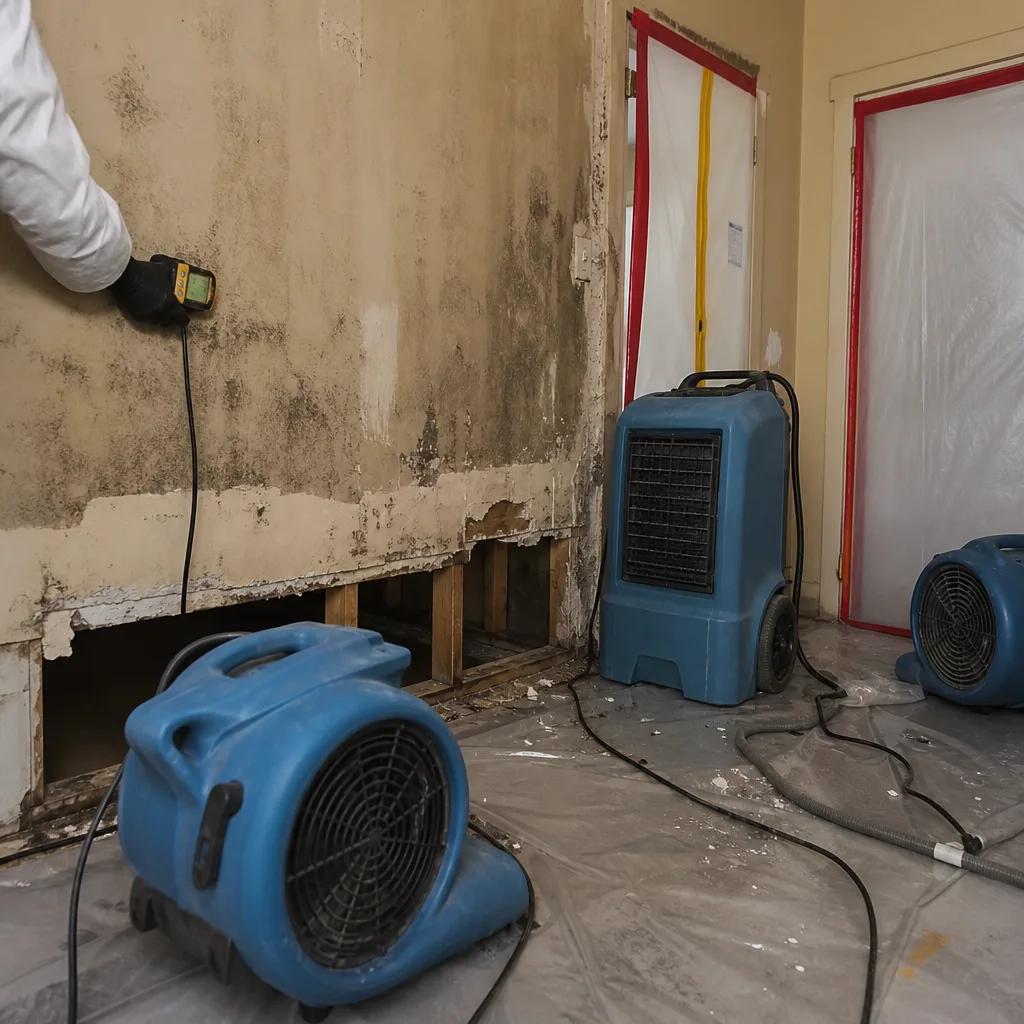 Before
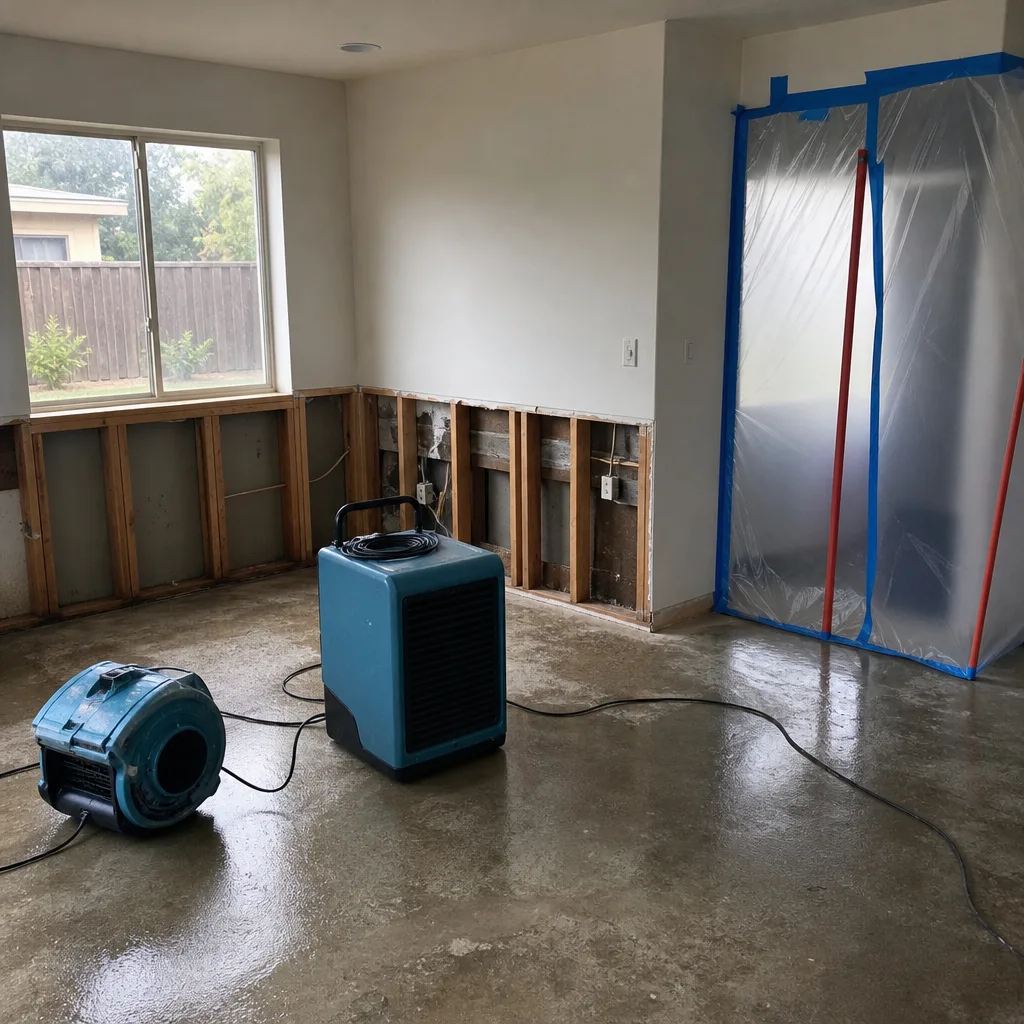 After
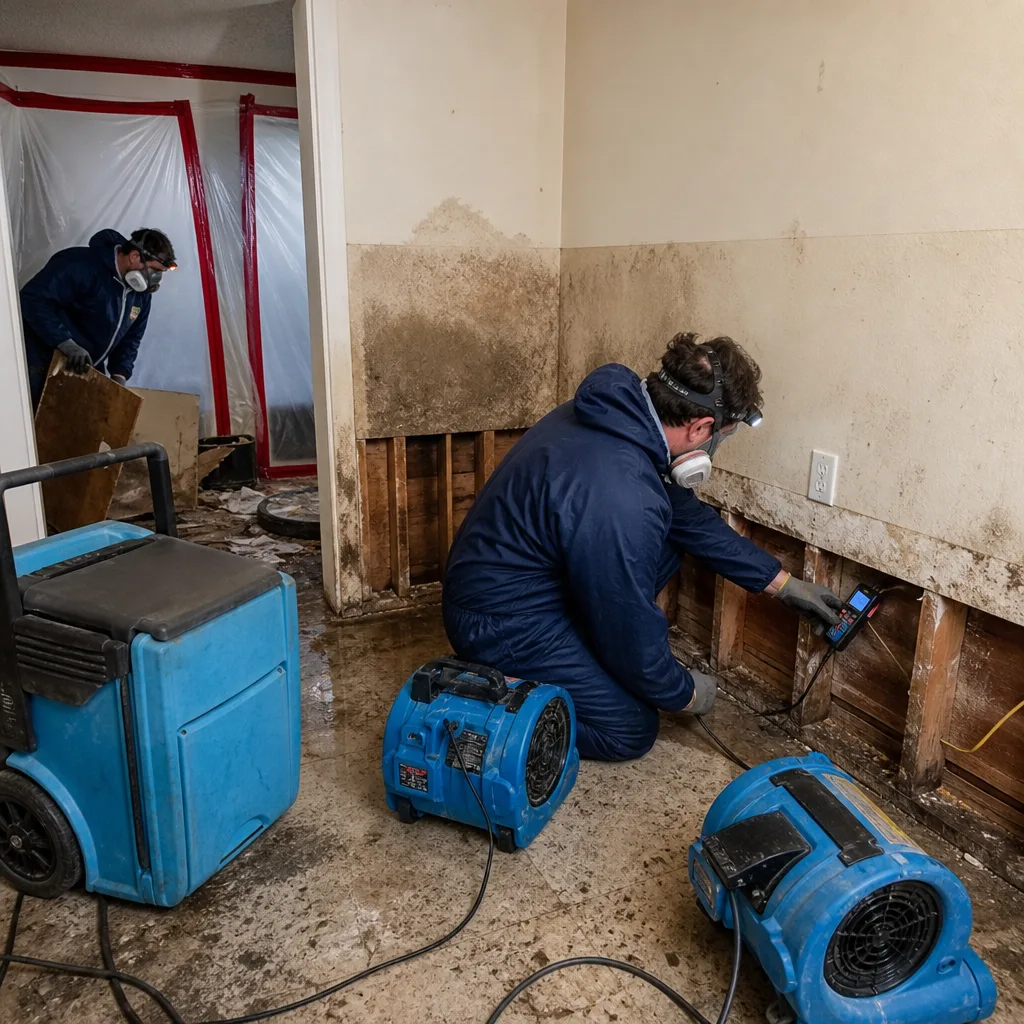 Before
 After
When to Call a Professional
Call a restoration contractor immediately when water has penetrated building materials, when visible mold appears on any surface larger than about 10 square feet, or when a fire has left structural damage or widespread smoke residue. Specific triggers include water from a burst pipe that soaked drywall or flooring, a roof leak that has persisted through one or more rains, any sewage backup, or any fire event that required suppression water. If you can smell mustiness but can’t see the source, that’s also a call. Mold growing inside wall cavities is invisible until it’s a problem. Guild Water Damage offers free estimates in Newport Beach and will assess the situation with moisture mapping equipment before recommending any work. Call (855) 855-9631.
Frequently Asked Questions
A qualified contractor should hold IICRC certifications including WRT (Water Restoration Technician) and ASD (Applied Structural Drying), with RCT (Rug and Textile Cleaning) for carpet and textile work. Verify every certification on the IICRC public registry using technician names provided by the contractor, not just the company name.
Most reputable restoration firms in Newport Beach can dispatch a crew the same day for water emergencies, because the first 48 hours are critical for preventing mold colonization. Confirmed dispatch times vary by workload, so call early. You can reach Guild Water Damage at (855) 855-9631 for a free estimate.
Homeowners insurance typically covers sudden and accidental water damage, such as a burst pipe or appliance failure, but may exclude damage from gradual leaks, flooding, or lack of maintenance. The restoration contractor’s documentation, including photo records and daily drying logs, directly affects whether your insurer approves the claim. Work with a contractor who provides adjuster-ready documentation.
Ask the contractor for the names of the technicians who will perform the work, then look up those names on the IICRC’s public registry at IICRC.org. Certification numbers are issued to individuals, not companies. If no technician at the firm appears in the registry, the company’s certification claim is unverifiable.
Testing is strongly recommended after any Category 2 or Category 3 water loss, and in any situation where water was present for more than 48 hours. Newport Beach’s marine climate accelerates mold growth, and visible mold is only the surface symptom. Testing identifies whether mold has colonized wall cavities and other hidden spaces.
Shut off the water source if possible, then call a credentialed restoration contractor before moving anything. Document the damage with photos for your insurance claim, but don’t attempt DIY extraction. The first call starts the clock on drying, and the equipment a professional brings matters more than anything you can rent. If problems persist, consult our Water Damage Restoration Troubleshooting: Common Problems and How to Fix Them. Call (855) 855-9631 for immediate guidance.
The Bottom Line
Hiring a damage restoration contractor in Newport Beach is a process of verification, not trust. Verify IICRC certifications on the registry, not on a business card. Verify equipment brands and rated capacities, not vague “commercial-grade” claims. Verify the scope of work includes moisture mapping, psychrometric logging, and daily monitoring before you sign. In a market where property values magnify every restoration mistake, the cost of vetting is measured in minutes. The cost of skipping it is measured in tens of thousands of dollars, and it follows the property into future transactions. Ask the hard questions before the truck arrives. A credentialed firm will welcome them.
Written by the team at Guild Water Damage, serving Newport Beach since 2017.